
A college library
We assume libraries are the same everywhere since their purpose is the same: lending books to the public. Yet how libraries actually work, how they enable the public to access which types of books and periodicals, and equally important, how inviting they are as a quiet study space may vary greatly. The library thus provides an instructive angle on a country’s culture.
The library at Capital Normal University’s Foreign Languages College in Beijing, where I began a teaching post in 1994, will serve as our starting point. You would not be able to visit this library today, three decades later. Times have changed over the years in China, more than most countries. The campus itself has been razed, rebuilt, and replaced by CNU’s Education Department, while the Foreign Languages College was moved to a different location. You would not be allowed inside the campus in any case unless invited as a guest. Chinese universities have always been walled in, but the public used to be able to enter at will (political flashpoint Peking University excepted). Over the past decade, however, they have all been outfitted with electronic turnstile gates admitting only students and staff.
The small campus’ centerpiece back then was a plain three-story administration building which also housed the teachers’ offices. Other buildings housed the faculty and student dormitories (six to a room), and in a separate building, a contingent of international students. Chinese students could apply to share a room with a foreign roommate, something seldom offered at other Chinese universities. Those awarded this privilege unsurprisingly came out tainted with Western influence, and the building was hence dubbed, wryly by the faculty and amusingly by the students, the “dyeing vat.” It was indeed a cultural eye-opener for some: one female student of mine told me of her displeasure that her American roommate would use their room for private time with a male classmate and kept her waiting outside. I said, “It’s your room too. Just walk in on them and make yourself at home.”
The classrooms were housed in several army barracks-like structures. No grass lawns or commons, no outdoor seating. Rumor had it this was to discourage students from romantic dalliance and keep them focused on their studies.
My supervisor brought me to the campus library one day for a tour. It was so nondescript I would never have found it otherwise. The first floor was about the size of my junior high-school library back home but more utilitarian, a mere storage space for books. I pulled a dust-covered book off a shelf—an English-language textbook from the 1970s. The second and third floors contained reading rooms but nowhere near enough seating to accommodate the college’s 800 students. Rumor also had it that empty classrooms used to be a quiet evening study space for the students who couldn’t fit into the library, until a naughty couple were caught having sex in one. The classrooms were thenceforth all locked up outside of class hours.

The National Library of China
I needed a bigger library, a proper library, as I was also carrying out doctoral research and fieldwork for my PhD at the time. By good fortune the best in the city—the Beijing Library—happened to be on the way to school, a comfortable bike ride from my residence at the Friendship Hotel. Renamed the National Library of China in 1998, its holdings moved to a newly built structure immediately to its north in 2008. It is by far the country’s largest, with a collection of 46 million physical (non-digital) items. (It’s not to be confused with the massive new “Beijing City Library” built in 2023 in the Beijing Municipal Administrative Center of Tongzhou, 30 kilometers to the east, an independent institution with a collection of seven million books.) The old library is now used mainly as an exhibition space. But at the time, when it was the city’s largest library, I was curious what it had to offer in terms of English publications.
The public entrance opened into a galleried hall with several floors and scattered reading rooms, and that was about it. Like one of Kafka’s labyrinthine hallways leading to a mere dusty room, the library seemed a lot smaller on the inside than the outside. A key difference from other major libraries I had used, such as Regenstein Library at the University of Chicago during my graduate school years, was that users normally had direct access to the bookshelves or “stacks.” National libraries are understandably more protective of their progeny. As with the U.S. Library of Congress, the Beijing Library’s stacks were off limits and books had to be requested for retrieval. I found a book related to my research in the card catalog and requested it, presenting my Capital Normal University faculty ID. After an hour’s wait, the book was personally handed to me at the reception desk, delivered on a conveyer belt. I could use it in an adjacent reading room, with the option of paying for a photocopy. Only domestic professors and researchers could take books out of the library, I was informed.
More useful for my purposes was the foreign periodicals reading room. Here we did have shelf access to a selection of academic journals in various languages, though they couldn’t be removed from the room. I still had to surrender my ID in a little wooden box at the front desk upon entering. With my first-generation black-and-white Zenith laptop, I typed notes from the articles into my annotated bibliography. The internet was available for home hookup but too expensive and troublesome to bother with, still at a time when few people used email and the Web was barely out of the womb.
One item on the shelves caught my eye, a China Quarterly issue devoted to “Race and Racism in China,” documenting the anti-African riots in Nanjing in 1988–89 sparked by enraged Chinese university students after a male African student was observed walking in the company of a local female. As the rioting spread, terrified African students in Nanjing and other cities sought refuge in their countries’ consulates before being dispatched back to Africa. I’m not sure if this China Quarterly volume is still available to the public in any Chinese library today, under Xi Jinping’s more nationalistic censorship. Needless to say, the embarrassing event is not a part of official Chinese history. No Chinese person I have ever spoken with knows anything about the riots.

Peking University Library
While teaching at Beijing Foreign Studies University a decade later in the mid-2000s and researching semiotics (the science of signs and signification), I needed a journal article that I couldn’t find online. I had heard rumors that professors with an instinctive penchant for favoritism hoarded books and journals from the BFSU library. As grad students we could hoard books too at the University of Chicago but only until someone requested them. These professors were not forced to return anything. One student told me a complete set of a journal’s bound volumes “borrowed” from the library adorned her professor’s office bookshelf.
BFSU is not really a full-fledged university but more of a language-training school, yet its foreign-language instruction does have a reputation for being the best in China. Its English-major undergraduates strive for, and many achieve, an IELTS score of 8 or even 8.5 (out of 9), often cultivating an impeccable British accent; they get the highest TOEFL scores as well. I expected the library’s holdings would have a passable collection of academic literature in English. On the other hand, it wasn’t a research institute, so I wasn’t too surprised when the journal I was seeking didn’t turn up. Still, I approached a librarian to double-check in case I wasn’t searching right. She was a friendly, attractive lady around 30, and in terms of her credentials I couldn’t have asked for more: she was doing a doctoral dissertation in Library Science at the country’s premier institution, Peking University. When she found my article in that university’s database, she offered personally to take me to the Peking University Library to retrieve it, several kilometers north (there being no physical or electronic interlibrary loan system). We rode to PKU on our bikes.
Though the article’s status showed up in PKU’s intranet catalogue as “available,” no shelf location for the journal was listed. This was strange. A shelf location should have been listed even if the volume in question had been checked out. My librarian friend got the help of a senior librarian friend of hers there, who was also stumped and had no explanation for the omission. In any other country’s library system, this sort of lacuna would be almost criminal. Librarians are totalitarians when it comes to books, which they treat like unruly citizens. I don’t mean they would ever mistreat a book, but every book must be in its proper place and missing books cannot be tolerated. Librarians who take pride in their job lose sleep at night over wayward volumes.

Another university library
Jump ahead another fifteen years, when I’m an instructor at the University of Nottingham Ningbo Campus (UNNC), the China branch of D. H. Lawrence’s alma mater. The beautiful campus opened in 2004 and its spanking new library only a couple years before my arrival in 2021. Though nominally a British institution, the Chinese campus is in fact a joint venture with Zhejiang Wanli University a few kilometers to the north, which provides much of its sponsorship and funding, all overseen and approved by the Chinese Ministry of Education (University of Nottingham also has a campus in Kuala Lumpur, Malaysia). The undergraduate population is around 8,000 and the grad student population 2,000. First-year students are funneled through a solid English-training curriculum to prepare them for eventual postgraduate study in the UK and elsewhere, with the majority of instructors fluent or native English speakers hired from abroad.
Most of the library’s holdings are in English and are wide-ranging, though with a bias toward the technical professions (business, science, engineering) but also a sizable collection on Chinese history, society, and literature. My own interests had moved on from semiotics. I was now researching Chinese history, the Qing Dynasty in particular, for my historical novel, The Tao of Poison. Like U of C’s Regenstein Library in my grad-school years, the UNNC Library became my second home. It was a pleasant place to chill out and bump into fellow teachers and students. I could always be found at a worktable in the library café, my preferred “office” instead of my assigned office. Most of the books I needed I could find in the library—and more. The marvelous thing about library stacks is that once guided to a book in its designated spot by Dewey decimal number or other classification system, other related, perhaps more useful books are sitting right next to it on the shelf for easy perusal. It’s the same magic one experiences in a secondhand bookstore, though even the largest secondhand bookstores can’t compete with a decent library.

UNNC is acknowledged by China’s Ministry of Education to be a legally independent institution. But how much control does the library really have over its holdings? One fellow teacher told me he encountered books with politically sensitive passages blacked out. I randomly plucked several on modern Chinese history off the shelf and couldn’t find any defiled pages. But I did myself run up against the library’s limits. Kenneth M. Swope is a respected China historian specializing in the Ming and Qing Dynasties. The library had one of his books, A Dragon’s Head and a Serpent’s Tail: Ming China and the First Great East Asian War, 1592–1598. I was after another, his On the Trail of the Yellow Tiger: War, Trauma, and Social Dislocation in Southwest China during the Ming-Qing Transition, which it didn’t have. I assumed that was because it was a more recent publication, not yet acquired. Any decent library allows you to request a new book and if it’s deemed appropriate, it will duly be ordered (I once worked in the acquisitions department at U of C’s Regenstein Library on a work-study gig and am acquainted with the process).
I put in a request. A librarian showed me how to track the request’s status online. The book was listed as “On order until…,” showing an estimated arrival date of a few months later, and I would be informed by email when the book arrived. The date passed with no word. I inquired again and was given an email contact in the acquisitions department. The person in question soon got back to me to say that the book had, unfortunately, “not passed the censorship review.” I inquired as to why. She had no idea, as the decision was beyond her purview.
I managed to acquire the book by other means and read it. In his introductory chapter, Swope provides a balanced, reasoned overview of both international and PRC scholarship on the Ming-Qing transition and the notorious anti-Qing despot Zhang Xianzhong, who engineered a senseless orgy of violence that depopulated Sichuan Province in the 1640s. Some PRC scholars have downplayed Zhang’s brutality by claiming, perhaps correctly, that the accounts of his murder campaigns were exaggerated, others in order to cast him as a proto-anti-imperialist. It must have been the following passage, citing a pejorative Time magazine piece comparing Zhang and Mao Zedong, that sunk the book:
[I]n a 1950 Time magazine article on the Korean War, Zhang was the murderous yardstick by which Mao Zedong was judged with respect to the devastating human wave attacks and mass butchery perpetrated by America’s “Godless” communist foes. As the article claimed, “No warlord has left a more gory trail of death than Mao, not since the mad General Chang Hsien-chung [Zhang Xianzhong], who slaughtered 30 million in Szechuan during the Ming Dynasty.”

Twenty-five to 30 million is a generally accepted estimate of nationwide casualties during the 1618–1683 Ming-Qing transition, but Zhang, whose sphere of influence was mostly confined to Sichuan, may have been responsible for only a small proportion of the total, if still a staggering sum. Swope does not take sides on the debate regarding Zhang’s worthiness as a popular hero but is merely citing, in the above passage, an earlier source. Nevertheless, I can see how the quote was deemed by the censors to have crossed a line. This despite the fact that few of the university’s teachers, much less students, the majority of whom are business and finance majors, would be meddling in this particular period of Chinese Imperial history. Most of the books on the history shelves showed no signs of wear or had ever been cracked open. Surely no one in my remaining lifetime would ever crack open Swope’s book if they had allowed it. But it seems the censors now deem any history book expounding on violence in China to be unacceptable for public consumption, even if it took place four centuries ago.
Ningbo is in Zhejiang. A stereotype has long attached to Zhejiangers as being much accomplished at business and not much else. In Country Driving, China journalist Peter Hessler unintentionally parodied this stereotype by hanging out in a bra-clip factory in the city of Wenzhou to study how Zhejiang entrepreneurship gets things done. The truth is that Zhejiang Province (Ningbo, Hangzhou, Shaoxing) and Jiangsu Province to its north (Nanjing, Suzhou, Yangzhou), along with the metropolis squeezed between them, Shanghai, happen to be both historically and up through the present China’s most cultured region. You might say business and culture go together: the more money you make, the more luxury and leisure you possess to soak in the arts. Ningbo can’t compete with neighboring Hangzhou as a tourist city, but it’s graced with scores of elegant teahouses and cafés crammed full of locals.

China’s oldest library
Ningbo is also the location of China’s oldest surviving library, the Tianyi Ge. The name translates to “One Sky Pavilion,” taken from the first two characters of the line, “sky produces water” (tianyi shengshui) from the I Ching, meaning “cosmic unity” but also protection against fire. The library was built in 1561 by Fan Qin (1506–85), an Imperial Examination degree holder and military official who grew disaffected with his post and returned to his hometown of Ningbo to collect books.
Book collecting and private-library cultivation counted as major hobbies in the late Ming, a relatively peaceful and prosperous era, but Fan’s is the only library to have survived, as a consequence of his many innovations. With great foresight, he constructed his two-story, rectangular-shaped library at a remove from his residence, where cooking fires posed a potential threat, and surrounded it with firewalls. A pond in front of the library served as a water reservoir in the event of fire, fed by an underground stream from the nearby Moon Lake. Every summer he opened the windows lengthwise along the building for ventilation and dried out his books in the sun. Lemongrass and other herbs with deworming properties suffused the interior air, along with quartz stones to absorb moisture. No books were allowed out of the library by anyone else.

Fan had accumulated 70,000 books by the time of his death. Extremely knowledgeable about all aspects of books, he copied and engraved many of his own. His wide-ranging collection included ancient Buddhist sutras, Taoist classics, Imperial examination records, Ming Dynasty chronicles, memorials, histories, novels, biographies, and books on astronomy, astrology, geography, medicine, economics, military strategy, officialdom, ritual, criminology, poetry, calligraphy, music, painting, bookmaking, and other miscellanea.

To ensure loyalty and continuity, before his death Fan gave his sons a choice between two forms of inheritance: 10,000 silver taels or his entire book collection. The son who chose the book collection honored his commitment. To prevent unauthorized lending or theft, the library entrance was locked with multiple locks and could only be opened with all family members present, each of whom had a different key. Fan’s library earned him many scholarly friends during his lifetime but subsequent visitors were few, as no one was allowed in. One visitor who arrived two centuries after Fan’s death who demanded and was given entrance was the Qianlong Emperor in 1772. He was so impressed with the library that he made the family donate some of its collection to the Forbidden City’s Library of Four Treasures, whose structure he modeled on the Tianyi Ge. He was gifted 638 books. In return, the Emperor donated 10,000 volumes from the Imperial library to the Fan family.

The ten later generations of the Fan family did their best to preserve the library, but it proved to be an impossible challenge. During the British occupation of Ningbo in 1841–42 in the First Opium War, British troops ransacked and stole dozens of books and maps. When Ningbo was taken over again twenty years later by Taiping rebels, thieves took advantage of the chaos to demolish one wall of the library and plunder books to sell on the black market. Two years after the collapse of the Qing Dynasty, in 1914, greedy booksellers in Shanghai paid thieves to open a hole in the library’s roof and cart away over a thousand books. Some of the scattered volumes were recovered and returned to Tianyi Ge by conscientious booksellers but most perished, including many volumes that had been temporarily stored at a publishing house in Shanghai that was bombed by the Japanese in 1932. In 1933, a typhoon destroyed a wall of library, which the family lacked the funds to repair. Fortuitously, influential book collectors stepped in to raise funds to pay for a complete overhaul of the library, whose collection by this point had been reduced to 13,000 books, less than one fifth of the original collection. Insects and mold heavily damaged many of the surviving books.
After the Cultural Revolution, money and donations started to pour in. One person in 1979 donated 100,000 volumes. The Tianyi Ge collection now holds 300,000 volumes, including 80,000 rare books. Digitalization of the complete collection began in 2010. Book repair specialists employed by the library annually restore over 10,000 damaged book leaves for its own and other libraries.
Every year the Tianyi Ge collection is visited by thousands of scholars and researchers from around the world. The library grounds expanded considerably over the centuries with additional buildings, gardens, and several large ponds. It’s now one of Ningbo’s most popular tourist attractions. The five-day May Day holiday in 2025 alone saw 73,000 tourists swarm over the library grounds.*

Two city libraries
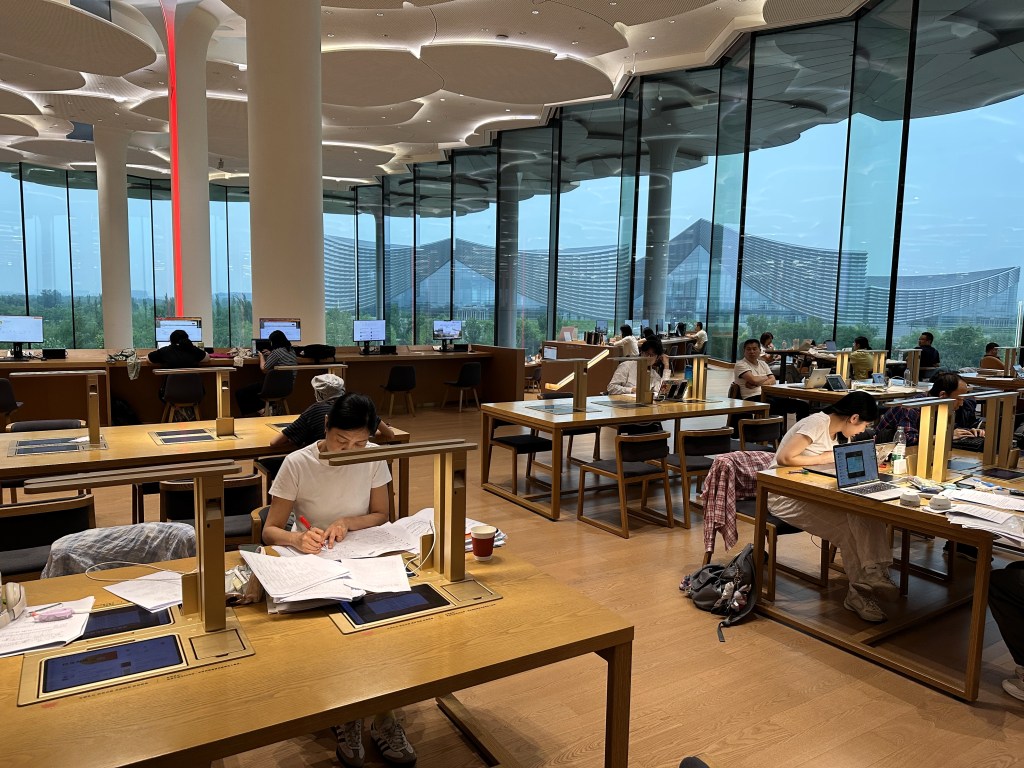
Just to the north of University of Nottingham Ningbo Campus’s northwest gate is the lovely Scholars Park, tree-shaded with a winding canal and arched stone bridges running through its two-kilometer extent (Chapter 1). It’s so named as it is surrounded by universities: the aforementioned Wanli University, Ningbo Institute of Technology, Zhejiang University Institute of Technology, Ningbo Textile and Fashion College, Ningbo College of Health Sciences, and at the south end of the park, UNNC. I don’t have exact figures, but the combined student population would be in the neighborhood of 70,000–100,000. Oddly, though all six institutions abut upon the park, most park visitors are the middle-aged getting exercise or the elderly with grandchildren. Students these days just can’t be torn away from their neon screens in their dorm rooms. Even the cafeterias are too much trouble for some; they order food to be delivered to the nearest campus gate. A notable exception is a hulking, space-age monstrosity of a library on the park’s southwest edge, as if a square-shaped UFO had landed there: the Ningbo University Zone Library, a public library with a solid collection of 1.25 million books. The library’s architecture reflects the alien-scale aesthetic of the early 2000s, yet the interior is surprisingly intimate. As a district public library, entry did not require identification when I visited. Every seat at every table in the reading rooms was occupied by students or local citizens. All were reading or studying. You could hear a pin drop it was so quiet. The students were from the surrounding universities, drawn to the library perhaps to escape the distractions of their classmates at their own university libraries. Locals were there to work or relax in a tranquil space. The silence was significant, in that China can be a very noisy place. It is as if the Chinese are inured to noise and wouldn’t even notice the sound of jackhammers or an air-raid siren outside their window. I’ve observed my students maintain concentration during sudden cacophony without missing a beat. The library’s intense quiet was a reminder that silence is extremely valued by many.
I found what I wanted. My current research was on the eighteenth-century White Lotus Rebellion, and the library had a whole shelf full of Chinese publications on the topic. Unlike English versions, these were safe from censorship as they had already been vetted by domestic publishing houses. I could have borrowed the books if I had taken out a library card (leaving a deposit based on the number and value of the books) but this was a one-off visit.

Ningbo’s Cultural Square business district, also known as Ningbo East New Town, ten kilometers to the north of Scholars Park, is replete with sleek space-age architecture (including the 409-meter-tall Ningbo Center skyscraper), swank shopping malls, and a network of pristinely built canals for public boating. At the eastern end is the Ningbo Library, the city’s largest with a collection of three million physical items. The library’s history follows different locations in the city going back to 1927. The modern structure was built in 2018. It’s airy, light, and attractive, if modest compared to some of China’s other recent, architecturally stunning cathedral-like libraries, such as the aforementioned Beijing City Library in Tongzhou and the Tianjin Binhai Library (opened in 2017). The only problem with these showcase libraries is they are magnets for crowds of tourists—and noise. The Ningbo Library strikes the right balance, drawing only the serious.
In contrast to the Ningbo University Zone Library, the Ningbo Library requires identification upon entry, though a simple cellphone swipe of a QR code gets one in (everyone who went through Covid in China is used to this). In the spacious lobby, which contains a circular information desk and above it, an LED sign with a 3D-view of the building and numerous statistics about the library, I noticed a curious machine for sterilizing books, recalling Fan Qin’s book-airing and deworming routines. Sterilization of borrowed or returned books is not required and functions as a psychological palliative, though it might have been a lifesaver during Covid.
I was looking for more books on the White Lotus Rebellion and was directed to the third-floor stacks and reading room, entered through a glass door. Outside the door was a bank of electronic lockers for storing one’s bag or backpack, all occupied. Visitors’ bags collected on the floor, with no concern anything would be stolen. A cellphone and laptop were allowed in the reading room.
A librarian at the desk was helpful and pointed out an interesting book on the White Lotus Rebellion published in 1974, during the Cultural Revolution. Since it was considered somewhat valuable, it was held in a locked bookcase. Her colleague who had the key was due back in half an hour. When he arrived, I was handed the book. No need for a photocopy machine; it was easy enough to photograph the contents of the thin volume with my cellphone.
Before leaving the library, I strolled through the main reading room on the first floor. As at the Ningbo University Zone Library, it was as quiet as a church.

* Sources consulted on the Tianyi Ge Library besides the world wide web:
Luo, Zhaoping. Tianyi Pavilion Compendium [Tianyi Ge Congtan]. Ningbo Publishing House, 2012.
Wang, Hongxing, and Tong, Jiemei. Illustrated History of Tianyi Pavilion [Tianyi Ge Huashi]. Ningbo Publishing House, 2020.
* * *
Other posts in this series:
Insights into China, Part 1: A walk down the street
Insights into China, Part 2: A meal in a restaurant
Insights into China, Part 3: An invitation to a party
Insights into China, Part 4: A stay in a hotel
Insights into China, Part 5: A glimpse inside a school
Insights into China, Part 7: An immersion in a museum
Insights into China, Part 8: An afternoon in a café
Insights into China, Part 9: A journey to the hinterland
Insights into China, Part 10: A vision in a concert hall
Insights into China, Part 11: A timeslip to the glorious Qing
Insights into China, Part 12: An idyll in paradise
BUY THE BOOK. FORTHCOMING THIS FALL:
At the Police Café: China in Twelve Scenes


Leave a Reply