
ANOTHER PANDEMIC
One day everyone has to dig up their face masks: a new virus is in town. It’s only been several years since Covid! Once again, we have to download a damn app to our cellphones, though now with only a simple press of the finger. I guess the app has always been there in the background and is undeletable. But this time there’s a difference. Instead of having to scan our phones at the entrance of every shopping mall, restaurant, library, park, and subway station, we scan upon exiting. Not sure what’s behind this illogical rule change. The government trusts us more?
We’re told it’s the coronavirus again, a virulent new strain. And this time China isn’t able to hold off the virus for long, despite the heavy precautions. People start getting sick before a month is out. Including myself. It’s a strange strain. My fever builds slowly, gently, over the course of a week, before peaking at 40 C. The fever breaks that night, though I still feel queasy the next day. I get out the old testing kit. The virus is still in my system, yet I feel fine. Most people around me are also recovering.
Nevertheless, everyone at our school—students, teachers, staff—are soon rounded up, put on buses and sent to an indoor sports stadium. We are assigned to numbered rectangles drawn on the floor with chalk, each containing an unmade cot with a blanket strewn upon it. Everything is a mess. We line up three times a day to have our temperatures taken and mouths swabbed by staff in white hazmat suits. They hold open a trash bag in which we must fish out our boxed meals from a welter of waste. This is most unhygienic and seems to contradict the strict precautions, which I can’t understand anyway since we’ve already all caught the virus and recovered. It’s hard to sleep with hundreds of others in the big space, the snoring, the noisy children, the overhead lights kept on all night. We’re stuck here for several weeks.
Once this trial is over, we’re free again to move about and go to work, though we must line up every 24 hours for the endless mouth swabs. These are gradually reduced to 48 and finally 72 hours. Eventually, we’re only required to test for the virus when traveling to other cities. But why does the government insist that everyone keep their masks on in public, when no one any longer has the virus? This is enraging many. Still, so as to go about our daily business in peace, over the months we manage to resign ourselves and get used to it. It is after all for the sake of public safety. We become so accustomed to face masks that the sight of strangers removing theirs in restaurants looks almost obscene, as if they’re exposing their genitals.
The threat of the virus lingers for another two years. It’s raging around the world now, devastating economies everywhere, though China as usual is weathering the storm better than most. Gradually, the virus is stamped out in one country after another, till the only country left is—China! After all these draconian measures, a resurgence. But it takes just a few months to put out the fire once and for all, and the masks are dispensed with for good—we hope.
URBAN TRANSFORMATIONS
The streets of Beijing are clean and orderly, unlike the city’s ramshackle turn-of-the-century past. They seem to know exactly how many share bikes to deposit at street corners, as there’s always one waiting for me. But then, after a year or two, something strange happens: a sudden explosion of share bikes everywhere, in a profusion of new colors and companies thrown, tossed, piled pell-mell till they block the pavement and force pedestrians to detour onto the street. They must be heralding other changes, since in many of Beijing’s older neighborhoods and hutong alleys, brick walls go up for no apparent reason, shielding the first floor of residential buildings from street view. Now, why would they do that? Even odder, new tenants seem to be moving into these blocked-up residences and—glimpsed through gaps and holes in the walls—stocking them with goods.
Ah, now I see why. They’re going to turn them into shops but want to keep it under wraps till they’re ready to open. Sure enough, it seems they’ve coordinated the shop openings around the same time all over the city, as the brick walls are rapidly coming down. Some of these newly unveiled shops, clustered on certain streets, turn out to be chic restaurants and bars. They’ve timed the opening well, as foreign tourists are beginning to show up and in droves. Wait—some of these pubs and cafés are not only attracting foreigners but are being run by them. How did they convert their tourist visas so quickly to business visas? Visa rules are certainly relaxing, as the foreigner populations in Beijing, Shanghai, Guangzhou, and Shenzhen are surging. I’m surprised the authorities, traditionally suspicious of all things foreign, are allowing, indeed encouraging this.
It must be good for the economy. But that’s odd, since urban infrastructure does not appear to be keeping pace. Some high-speed railway lines are inexplicably shutting down. And one by one, skyscrapers only recently built are coming down as well. It must be collective recognition that packing thousands, tens of thousands of workers in vertical chicken coops is psychologically deleterious. Are the Chinese becoming ecologically and environmentally conscious and returning things to human scale? Why then does air pollution keep getting worse? There are all sorts of contradictions that I can’t explain but may be able to as time passes. For instance, the Great Firewall is no longer so watertight; more and more American social-media sites are accessible and no longer need a VPN. But what I can’t understand is why they suddenly got rid of the share bikes—Poof! Gone—and eliminated such a useful transportation option amidst Beijing’s terrible traffic jams. Maybe they have a better idea cooking.
At least they haven’t torn down the imposing M. C. Escher-shaped CCTV Headquarters, uncharitably nicknamed “big pants” or “big boxer shorts,” thankfully so as it’s one of the world’s standout structures. But wait. Something’s happening to its equally weird sister, the adjacent TVCC building, which looks like it was squeezed in its midsection by an unseen giant and never snapped back into place, yet so svelte and graceful next to the big pants. Work crews are now for some reason redecorating its surface and coating it black but in a very rough and uneven way. And there the unaccountably uglified new touch-up stays. But it’s starting to smoke and flames are shooting out! Someone must have started the fire in protest at the unsightly workover. It’s too late for fire crews to respond and the whole building goes up in a conflagration. It happens to be the night of the Lantern Festival, when everyone is distracted by the fireworks erupting throughout the business district. It was the perfect cover, because the fireworks are going on even after the fire erupted. An inside job, perhaps?
A CONSTRUCTION RENAISSANCE
The pace of change seems to be picking up in a burst of creative frenzy, catalyzed by the great liberation from cellphone and internet addiction. People are noticing the world around them as if for the first time, envisioning their environment anew in salutary ways. It started with cellphones. Their designs grew ever sleeker until you could enfold them in your palm. But then, since they couldn’t get any smaller, they reversed and grew bigger. How the cellphone companies could ever have imagined people would regard the bulky contraptions as pleasing is beyond me. The predictable result was that everyone packed them back into their boxes and returned them to the stores. Cellphone mania is over for good.
People still need to communicate, however, and here’s where someone came up with an ingeniously elegant invention to replace the cellphone, a nifty little device you attach to your belt or pocket with a clasp. When someone wants to connect, they “beep” you with a signal. The display indicates who it is, and you simply head over to the nearest phone to call them. No need to rush; apart from urgent business, you can respond to them in due time. This has finally freed us up to interact with people face-to-face. Why in the world did we ever feel the need for cellphones? In my youth, we kept an address book in our back pocket and that was enough (though I’ll grant telephone answering machines to be of some use).
Now that everyone can attend to their locale, the authorities have hit upon the idea of making neighborhoods livable again. The air is full of construction dust as they tear up the wide boulevards, tear down cookie-cutter high rises, and remake the streets narrower and pedestrian friendly, even restoring old historic lanes, at least an ersatz version of them. I easily get lost as once familiar neighborhoods become unrecognizable. Beijing’s car traffic is drastically reducing. They’re dismantling the Third Ring Road since there’s no longer any use for it (the Fourth, Fifth, and Sixth Ring Roads are long gone). Thank goodness bicycles are back! But they’re no longer share bikes. They’re all the same color—black—and you have to buy your own. Of course, the disappearance of cellphones and GPS rendered share bikes obsolete.
Restaurants are shrinking in size as well and adopting a radically minimalist aesthetic: fluorescent tube lighting, bare concrete floors, inexpensive metal tables and chairs, and at most a photomural of a tropical scene on the blank walls. Not to mention bars, but cafés and even teahouses are rapidly disappearing. The idea seems to be that they are a wasteful luxury encouraging bourgeois laziness and lassitude; it’s enough to serve refreshments at home and go to a park for a stroll after dinner. There is a certain logic to that, I have to say.
Soon the Party is launching some kind of massive, rectification campaign, with big red character posters and banners everywhere. There is even a military parade, replete with tanks, converging on Tiananmen Square. And suddenly, after a mystifying interval when the authorities seem to be getting things set up and everything is a chaotic mess—there are accidents and people getting hurt in the sheer excitement of it all, gravely enough that ambulances are called—hordes of people are rushing to the square by the thousands. Have they been summoned by the army to lend their support to the campaign? The crowds keep building in the square, mostly young people, chanting, singing, laughing, and with such enthusiasm they can only be regarded as the future of the nation. It might be the most successful propaganda campaign in memory.
UNEASY NEW DEVELOPMENTS
I was always wondering if the old Mao suit would catch on as a kind of ironic, postmodern fad, but it has reappeared and seems to be sticking, and among the people you’d least likely expect to be starting a fashion: old men. You could occasionally see lone octogenarians with the quaint suit even into the Covid era. Now whole groups of male retirees congregating in parks to play Chinese checkers are dressed in identical blue, a smaller contingent in identical gray. Middle-agers are taking up the trend, and it’s not long before males of all ages are wearing the uniform. Even some women are donning blue, though with a more form-fitting tunic tightened around the waist with a belt, and matching baggy pants.
I find a job working as an English editor at Xinhua News Agency. One day some of us are summoned to a meeting with senior officials. We are surprised to discover we are to take up new duties in a rural area to the northeast of Tianjin. We are given the title of “Bourgeois Rightist” but aren’t clear what it means. Nor are we provided with any details except being advised to bring our own bedding. It turns out to be a large cordoned-off compound of one-story structures. Those of us with knowledge of English are assigned to teach at a middle school in the compound, the children of the cadres and police running it. The teaching is harder than anything I’ve experienced—250 students divided into classes of 50 for eight hours of instruction per day. The children of the higher-ranking officials sit in the back and spend their time playing and mocking the teacher. I am not allowed to confront them or exercise discipline.
Our living quarters is a sparsely furnished room with twelve cots; we share a single bathroom and shower in the corridor with the workers in the building’s other rooms. A canteen serves indifferently cooked food. We are not told how long our work assignments will last and are warned not to ask. Our salaries are reduced tenfold from what we had been earning in Beijing. As the spring turns to winter, our room’s heating is barely adequate—a single portable kerosene heater. When I come down with a serious flu, I discover the compound lacks even a clinic. There are several doctors—former doctors, now Rightists—also living in our building. While they are eager to help, there is no medicine or medical supplies. They can only roughly diagnose and reassure me that if I become gravely ill, I’ll be sent to a hospital in Tianjin.
The days grow into months and years. We’ve learned to filter from consciousness the monotonous daily exhortations by loudspeaker and take the sudden announcement of the death of the nation’s leader with a grain of salt. What we do take seriously is a bizarre scene some weeks later of piles of rubble growing everywhere and army trucks ferrying many injured and dead into the compound. Our quarters are intact, but one night the rubble activity intensifies, and we can’t sleep. Only after we are jolted out of our beds by a powerful shaking does everything become peaceful again and we’re able to sleep. The rubble has been entirely cleaned up by the next morning.
Several more years go by. We are transferred back to another farm camp. Our titles change again. Though we are still Rightists, we are no longer “replacement personnel” but “re-educated elements” doing “supervised labor.” We are lucky, we’re told, because we are permitted to live outside the compound barracks. Life indeed turns out to be freer here than at the teaching compound. We are assigned to tend the fruit orchards and live in bungalows with only six beds and may cook our own meals. We are even being praised as model workers. Yet a few years later we are moved again, without explanation, into the electrified-wire compound. Rumor from outside has it that the country is out of control and we are in fact safer here than we would be in the cities, where people are being randomly beaten up and their homes trashed. But we are dejected to discover that despite having been promised a release from our captivity—it’s been altogether fifteen years now for me—our education is apparently deemed incomplete and the decision cancelled. We must serve another three years. Once again, we are warned not to complain as this could further endanger our fragile standing: as enemies of the state, we are hardly in a position to complain.
Our food is now rationed. No more cooked meals but only several steamed buns and a thin soup seasoned with a bit of pork fat and purslane served twice a day. We are lucky to receive even this much sustenance, for a year or so later—constant brain fog is messing with my sense of time—the rations are drastically reduced. We become too weak for manual labor. The number of captives on sick leave is increasing. The camp guards give up, themselves grumbling about their own shrinking food allotments, and let us scavenge for edible weeds in the fields. It gets worse over the winter. We are bedridden and can barely get up to use the toilet. Our rations are now confined to “substitute” food—steamed buns made from bean stalks, elm bark, rice grass, any plants that can be powdered when dried and baked like a grain. The weakest inmates die. By the second winter, our starvation diet improves: corn meal and sweet potato powder is added to the fake products in our steamed buns. But even if the buns had been genuine, the meager portions render us ravenous as soon as we gobble them down.
MORE TROUBLE
Another year goes by and we are transferred again, to a distant outpost near the Soviet border in northeast Heilongjiang Province, a sparsely furnished camp without even surrounding barricades or barbed wire. We are shown where red flags have been planted at intervals to represent the perimeter; anyone who strays beyond it will be shot by the guards. We are back to twelve to a shack. It contains a long kang, a raised adobe platform heated underneath by firewood through pipes. The warmth is provided not for our comfort but because we would otherwise quickly freeze to death. We sleep lying flush next to each other on our sides, each person apportioned a mere sixty centimeters of width.
We soon get to work before dawn digging through the hard earth. We are taken to a field, solid whitish gray on its surface and barren of weeds. It’s white clay that had been dug up from under a rich layer of black soil the previous winter and turned over, burying the soil a meter into the earth. It was claimed the clay was even more fertile than the black soil, but evidence of life is not forthcoming. So we need to reverse the process and restore the black soil to the surface. The inmates comprise two groups, those convicted of normal crimes (robbery, homicide) and the rest of us political prisoners. The former have experience doing all sorts of labor and are much physically hardier, whereas we can barely cut through the icy surface with our spades, much less keep pace with the team. This enrages the guards, who accuse us of pretending to be on holiday, and they extend our working hours well into the evening as punishment. But the inevitable starvation diet of a handful of corn buns, salted turnip cubes, and watery cabbage soup only gives us enough strength to work in slow motion. Consciousness is devoid of thought, reduced to the primitive sentience of animals in search of food. The hunger is sharpest immediately after we eat as the stomach clamors for more.
It’s going on our third year in this labor camp when, once again without explanation, we’re transferred to Beijing. Twenty-four of us are packed into a jail cell and allotted fifty centimeters width between us on the floor. Still, it’s a significant improvement as there is no hard labor. We can rest the whole day! This helps us deal with the usual interminable hunger. The food isn’t much of an improvement over that in the northeast camp: two steamed buns made from millet powder, a bowl of millet porridge, and one cube of salty turnip pickle twice a day. Time moves quickly, however; there are rumblings that the mysterious incarceration will only be lasting a few more months. Sure enough, I’m soon released. It is springtime outside as the police escort me to my workplace at Xinhua News, and my old job is back.
But there’s trouble in the air. People seem to recognize me and point to me on the street. I am shunned. One evening I ride my bike to a cinema, and it’s not to see a movie. In the theater’s washroom, I smoke a cigarette to calm my nerves before ascending the stage. They are waiting for me, very angry, as if I had just that moment committed a further crime. The auditorium is packed with people shouting and cursing at me. Those on the stage force me to stand before the audience with my head down. When I’m finally allowed to leave several hours later, I notice big character posters outside the cinema denouncing me for Rightist crimes. I still have no idea what crimes I have supposedly committed.
There are meetings with the boss and Party secretary of the organization. They make me write out a list of reasons to exonerate myself from the charges, and each revision fails to satisfy them. I’m also required to return to the cinema but now it’s to sit among the audience and witness others get the same humiliating treatment. Throwing up my hands at the whole charade, I pen a lengthy essay entitled “Epidemic of Apathy” and paste it on the wall outside my workplace for everyone to see. I’m not the only exasperated one. As if on cue, public walls are suddenly plastered with many others’ “small character posters.”
Thinking hard, I try a new tack. I condense all of my frustrations into four succinct points: 1) People should be allowed to express their views in safety, including political views. 2) Civil laws are needed to protect people from unwarranted accusations, searches, and detainment. 3) Senior officials holding key posts in educational institutions and publishing houses must be technically qualified for their jobs. 4) People should be allowed to choose their own jobs, not randomly assigned to careers against their wishes and for which they moreover have no training. I present these points, which fit easily onto one page, to the bosses. It works. They are pleased. Is it only because I learned how to convey my ideas clearly and concisely and thus make it easier for them to read? Or because the general mood has suddenly shifted of late and everyone is being encouraged to express their grievances freely?
The whole experience has left a bad taste in my mouth. I decide to quit my job at the agency and take a break for a while to spend more time with my family. After all, I’ve been away from them for two decades. Yet they don’t seem to miss me all that much and carry on as if I had been there all along. I do odd jobs. One thing the incarceration experience taught me is how easy it is to pick up valuable new skills. I try my hand at gardening, cooking, watchmaking. With the nation’s new literacy drive, I find a temporary job as an education inspector in a distant suburb, which involves cycling long distances to isolated villages to check up on the standards at local grade schools. But I soon grow weary of occasional work and long to get back to my specialty, English teaching.
I apply to several universities in Beijing. My qualifications are certainly up to par, and I receive enthusiastic responses from each school. The next step for them is to request my personal file from my previous employer, the Xinhua News Agency. It’s at this point that I encounter a new roadblock. Each university is quick to reply again, only to apologetically turn me down, without stating a reason. Employers alone are permitted to view an applicant’s personal file and are not allowed to divulge its contents. Although I am no longer a Bourgeois Rightist, something else in the file is blacklisting me and I have no idea what it could be.
REVOLUTIONARY UNIVERSITY AND A RIFLE
Xinhua News Agency won’t take me back. They suggest I attend the North China People’s Revolutionary University to learn how to be a good communist. When I arrive at the school, they hand me the certificate of completion for the six-month course. I assume it’s because everyone passes and it saves them the hassle of a graduation ceremony. Yet there are no congratulations and they don’t seem too pleased to see me. We have a tight daily schedule: up at six in the morning and to bed at nine-thirty in the evening, seven days a week, with classes in the morning, self-criticism sessions all afternoon, and manual labor in the evening. The 24 of us who are in the same class sleep right in our classroom on the floor. The female students are moved to another classroom for the women to sleep in at the end of each day. We don’t need reminding that flirting with them is not just inappropriate, it’s strictly forbidden.
The manual labor keeps our minds focused on the task at hand: digging up human manure from a vegetable field and hauling it in wheelbarrows to the latrines, where we scoop up the manure from the wheelbarrow and dump it into the cesspool with a ladle. Upon finishing each evening, we have to choose between spending over an hour cleaning our clothes and bodies of the stench and sacrificing sleep or learning to get used to the smell for a sounder sleep. I am constantly criticized by my instructor for appearing not to enjoy the labor. Peasants, he reminds me, might have better things to do with their time than haul manure, but they are hardly distressed by it. On the contrary, they take it fully in stride as an invigorating feature of working the land. They even relish the attendant odors. No exams are given or needed in the training course. We are simply observed, dourly. That I don’t take to the work with greater enthusiasm is proof enough I may not be cut out for communism.
The training course completed, I find a cheap room for rent, the sole tenant in an old house built in the European style. I set about looking for a new job. One day I’m visited by a PLA officer. After looking around the house, he returns with a rusty rifle. Sternly he reminds me that civilians are not allowed to possess weapons. I don’t understand. I follow him to the garden out in back and to a junk pile between the house and the enclosing wall, which I had never noticed before. It’s here where he found the rifle, he says, an old Japanese infantry rifle. I had absolutely no knowledge of the rifle, I protest. He confiscates the weapon. I don’t like the look on his face as he leaves. And now it all comes together. Could this be why I’ve been blackmarked for all these years? Am I regarded as a suspected spy for the Japanese? Why the Japanese?
The answer eventually becomes clear but not before a few more momentous events, so many events I don’t know where to begin. Soon the Party is staging massive rallies in Tiananmen Square. There is fighting, and the PLA withdraws from the city. The new Nationalist Government rushes in to take their place. I find an English teaching gig at People’s University, now renamed the China University. One day ambulances ferry hundreds of students from the hospital to their dormitories, where they are in a real mess, beaten and bloody, some even killed, their lifeless bodies dumped in their rooms, until scores of thugs dressed in black gowns and felt hats appear wielding bludgeons to set things aright. Only when the students reassure them they are only hungry and their dorms and classrooms lack heating do the thugs get back in their vans and leave. Americans are everywhere in the city, mostly journalists and reporters, yet they don’t investigate whatever happened to the students at the hospital and keep their distance from local disturbances.
Then the Americans are gone, and with them the Nationalists. With shocking suddenness, the Japanese devils take over. I note with relief that they don’t try to enlist me as a spy. I keep to myself and endure years of boredom while they are in charge. Finally, they are gone, the army at least. The city is still swarming with Japanese in civilian clothes. You can easily spot them in restaurants and bars, where they arrogantly bully the staff. But at least we’re now spared the sight of their soldiers slapping people in the face or stripping them on the street. They are still in Manchuria, however, and people are protesting their presence and the government’s weakness in dealing with them.
I lose my teaching job at the China University, when it’s shut down for unexplained reasons and its buildings disassembled. But I’ve saved enough money to live for a bit without having to work, for there is now too much fun and too many things to do.
BEIJING COMES INTO ITS OWN
Joy is in the air. People are dressing differently. Girls are shucking their baggy blue for short jackets and brightly patterned trousers. I should qualify this. They fall into two types. The patriotic communist supporters disregard the latest fashions. They dress with prim rectitude, wearing severely bobbed hair, no makeup, and lumpy garments. By the sincerity of their words alone, they try to convince you of the weirdest ideas, such as women must be celibate if they want to be revolutionary. The “modern” girls, by contrast, perm their short hair in a wavy pattern and brandish tight gowns with slits along the sides almost to the hips. They cross and uncross their legs like men; you can even see their underwear. Men and women mingle freely in public, holding hands, even kissing. Older women dress more traditionally but have their own fashion: tiny, pointed shoes raised heels, so tiny they cramp their feet and cause them to limp. I’ve never understood women’s penchant for adopting torturous footwear.
Restaurants gush with newfangled dishes: shark’s-fin soup, steamed quail-eggs, spiced garlic chicken, mushrooms stuffed with minced prawn. Oh, it’s been a good portion of a century since I’ve been able to eat so well!
I try a zaotang after dinner, a bathhouse. It’s larger than any I had visited in the Beijing of yore. The spacious public room, with tiers of bunk beds along the walls, can accommodate fifty or sixty guests. After disrobing, I ascend my bunk and am served a tray of tea and steamed dumplings stuffed with sugared black beans. The towel across my mid-section jiggles off as a masseur slaps, pounds, and kneads my flesh. It’s now off to the bathing pools—hot, warm, and cold—each the size of a private swimming pool. An attendant lays me on a crucifix-shaped wooden board in the water and proceeds to scrub the grime off my skin with a wet hand towel. I climb out of the pool to soap myself up and rinse off with a pan of water at a wall tap. Once I’m toweled off and dressed, a serving boy leads me through a corridor of private rooms and shows me one with its enameled tub, where I can have every square inch of my body bathed by a personal attendant. I’ll try that next time, I tell him. He then escorts me through a garden and out of the establishment.
I pay one last visit to my room at the House of Springtime Congratulations in the “willow lanes” off Qianmen. Well, it’s not exactly my room but that of a lady with perfectly bobbed hair, high bangs, and gorgeously expressive eyes named Jade Flute. It’s early morning. I get out of my clothes and slip into bed as a maid arrives to serve me a pot of tea and a bowl of rice porridge with sweetened lotus seeds. Jade Flute is asleep. My desire is wholly sated; I feel as if we’ve finally consummated the act. It’s why I really didn’t want to return today. In fact, I was planning on never returning again. But here I am. I fall asleep.
I wake up to furious lovemaking in the evening. Now my passion for Jade Flute unaccountably erupts and I’m head over heels in love. So much for that final visit. This may be the only time we have sex, however, for the next evening she lets me accomplish no more than to put my around her as we lean back against the bed’s bolster. Each time I try to kiss her, she gets up to refill our teapot. At least the matron doesn’t barge in with her usual fruit plate to spy on us. The evening after that, I don’t even succeed in getting my arm around her. I’m desperately frustrated by this beautiful young woman. I willingly hand over each evening’s not insubstantial fee, with no assurances I’ll ever get her into the sack. Adding to the torment is Jade Flute’s habit of disappearing from the room just as I think I’m making progress, to go banter with neighboring customers. Her high laugh is easily audible several rooms down, precisely calculated to amplify my jealousy.
You will never encounter a teenage girl with so many talents. She can play the pipa to songs she composes herself. She’s an expert mahjong player. She can expound equally on business and politics—advising me on me on the best stock investments while weighing the relative merits of the Nationalists and the Communists. She flirts shamelessly yet with subtlety and virtuosity. On top of it all, she is always tastefully dressed, today in a black silk jacket and white silk trousers that accentuate the swell of her hips. And on this our final, that is first night together, one week later, she introduces me to the wonders of nepenthe. Our conversation becomes lively, our discussion animated, conjuring up aphrodisiacal scenes and erotic scenarios, so vivid they appear as holograms. What’s that smoky haze in the air? I seem to recognize the thick, sweet, illicit smell. It’s not hashish. Ah, there we go. Jade Flute places the ivory mouthpiece of a long carved wooden pipe to my mouth. I take a deep breath and blow the smoke out through the pipe. She turns the pipe’s ceramic bowl toward the flame of an oil lamp with its glass chimney to boil the globulet, before removing it with a kind of knitting needle and molding it above the flame until it hardens. She then attaches the pellet to a larger slab of the same. She repeats the process several times until the haze dissipates and the mood returns to normal.
THE DYNASTY’S CULTURAL FLOWERING
My opium addiction makes the years go by in a seamless reverie—too bad it has shorn a decade and a half from my life. I resolve to quit. I’ll spare you the horrors of going cold turkey. When I emerge from hibernation, events are in the air. There has been a national strike, severely disrupting the economy. I can’t figure out what it’s about, what with all the conflicting opinions. A thousand students are freed from Beijing’s prisons en masse. Apparently, an agreement was reached to resolve a political scandal, again involving the Japanese.
Perhaps it hasn’t been resolved after all, as the students start demonstrating again—thousands of them now in Tiananmen Square on this sunny day in early May. At least half of the students are female. From comments overheard among onlookers, I gather the females are outrageously demanding the right to demonstrate in public, instead of confining themselves to their homes where they belong. Some are even advocating the abolition of arranged marriage, others opening up of the country to science and Western-style democracy. Worst of all, they want to replace classical Chinese with the modern vernacular in literature, putting a whole generation of scholars out of work so that people can read novels in the gutter language of everyday speech!
The intolerable atmosphere of riotous language and incendiary agitation reigns for years before people have had enough, and the government finally institutes a series of steps to snuff it out. The students go back to their studies. Only a few contrarian intellectuals dare to speak up about change. The solution gradually dawns on everyone: centralization of absolute power. For the first time in China’s history, the government installs an emperor and inaugurates a dynasty.
In case the population isn’t sufficiently attuned to the change, a draconian proclamation is announced: all males must permanently attach a long plait of hair to the back of the head and shave the rest of their head every ten days. This provides employment for many new barbers tasked with implementing the bizarre new regulation. I’m not sure where they’ve come up with so many queues, all ready-made and braided, but there’s no shortage of them. It’s no joke. Any man refusing the queue or the head shaving faces instant execution—his entire family as well! At first, I felt thoroughly ridiculous with the new hairstyle. Then I began to understand. There is immense satisfaction in appearing the same as everyone, a delirious feeling of surrender upon becoming a subject of the State. Once I grasped this, the legions of males and their queues look quite stylish. And of course, it’s all for a good cause: the restoration of order and obedience.
Meanwhile, women have now all adopted the high-heels fashion. Shoe sizes continue to shrink, so much so that they can barely walk; many are carried on the backs of male family members. No longer ambulatory, most women simply stay home and rarely venture out of the house. Which is strange because they’ve lost the opportunity to show off their prized high heels in public. Needless to add, Western female dress styles have also fallen by the wayside. On the other hand, it’s said that the disappearance of women behind closed doors has vastly increased their sex appeal. If you’re lucky, you might catch a glimpse of an exotic specimen through the curtain of her palanquin as it passes by in the street.
The government has instituted a new exam system, which requires aspirants of the refined life to churn out elaborate, abstruse essays in the antiquated style if they wish to attain any kind of professional or civil-service job. The standards have been toughened up to such an extent that only a fraction of examinees ends up passing, even after being allowed multiple attempts. For the majority who fail, they can look forward to a career composing drunken poetry to a favored courtesan, provided they can afford one, rather than a run-of-the-mill prostitute. Of course, it’s only natural that the most qualified secure employment worthy of them, so they shouldn’t really complain. All admirable developments, I believe. The courtesan houses anyway remain alive and well.
Things are just beginning to settle down when there is fresh trouble in Beijing. Foreign troops from the European countries, the USA, Russia, and Japan somehow managed to break in and have been running roughshod over the city, burning down temples, ransacking and looting, randomly executing people, and raping women and girls by the thousands. They are even targeting buildings where people are sheltering and setting them afire. Everyone’s in a panic. Where are the nation’s troops? And whatever has given rise to this orgy of violence? It’s been dragging on for close to a year when rumors circulate that the Empress Dowager has snuck back into the city disguised as a Buddhist nun. I didn’t even know she was away. The foreign troops are soon driven out, literally over the city walls, although many are still holding out in the Legation Quarter. Our siege of the Quarter goes on for a month. More rumors reach us that the foreigners are tearing up the train tracks after them as they escape to Tianjin and their ships harboring along the coast.
Meanwhile local women and children were corralled by the thousands into the huge Peitang Roman Catholic Cathedral, by Japanese troops it’s said, before they too fled the city. Some say the women and children were forced into the church for their protection, others that they were on the side of the foreign invaders. So I’m not surprised when our troops launch an operation against the church. I’m torn by this. As the stained-glass windows disintegrate amidst the shelling and gunfire and fires break out inside, agonizing screams are heard. I am drawn to the screaming and dash into the church. They see I am unarmed and let me inside. It’s a hell scene inside of triage, smoke, cacophony, and crying. I’m not sure I’ll make it. But it’s too late and there’s no backing out of it now. I find reassurance in Samuel Beckett’s lines from The Unnamable: “Where I am, I don’t know, I’ll never know, in the silence you don’t know, you must go on, I can’t go on, I’ll go on.”
Acknowledgements:
The narrative technique employed in this essay is borrowed from Martin Amis’s novel Time’s Arrow (Vintage, 1992).
The period of Chinese history described above between 1945–79 is drawn from the powerful memoir Mirror: A Loss of Innocence in Mao’s China (Xlibris, 2001) by Peter Liu (刘乃炎) (1924–2008), who was imprisoned for 21 years after being falsely accused as a Rightist.
The memoir City of Lingering Splendour: A Frank Account of Old Peking’s Exotic Pleasures (Shambhala, 1989) by British author John Blofeld (1913–1987) has supplied me with vivid depictions of 1930s–40s Beijing.
* * *
Other posts in this series:
Insights into China, Part 1: A walk down the street
Insights into China, Part 2: A meal in a restaurant
Insights into China, Part 3: A stay in a hotel
Insights into China, Part 4: A visit to the library
Insights into China, Part 5: An invitation to a party
Insights into China, Part 6: An afternoon in a café
Insights into China, Part 7: A glimpse inside a school
Insights into China, Part 8: An immersion in a museum
Insights into China, Part 9: A journey to the hinterland
Insights into China, Part 10: A vision in a concert hall
Insights into China, Part 12: An idyll in paradise
BUY THE BOOK. FORTHCOMING THIS FALL:
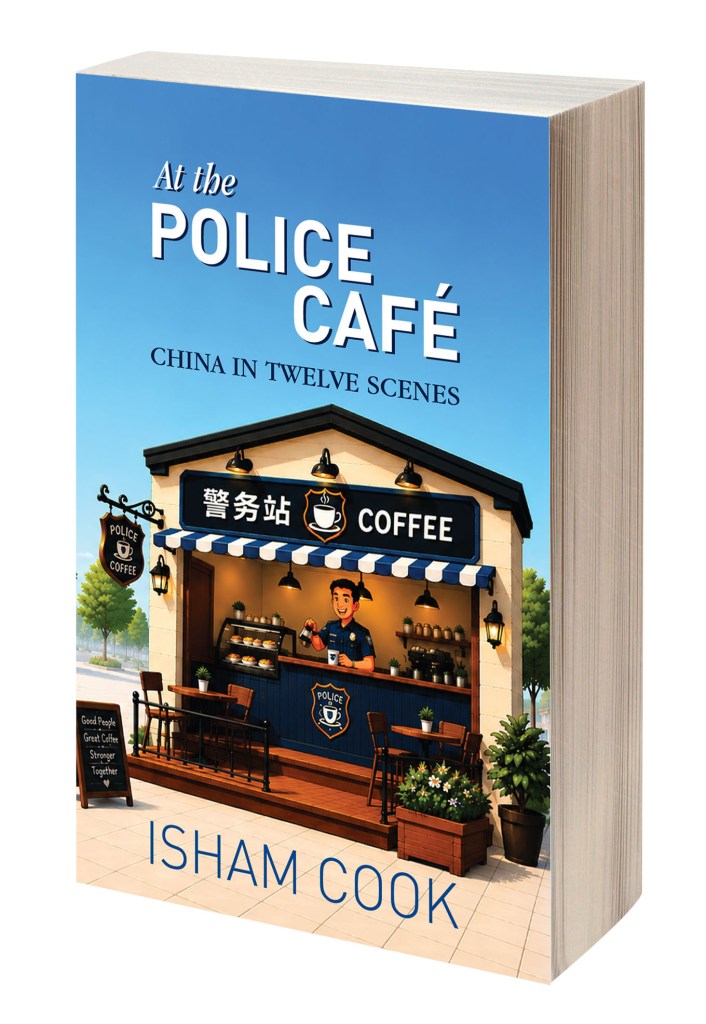
At the Police Café: China in Twelve Scenes


Leave a comment