DALI’S DESTRUCTION
Incomprehensible in its scale, the Taiping Rebellion (1850–64) left 20 to 30 million dead across southeastern China before finally being crushed by the Qing. When factoring in the probable extent of starvation, disease, and plague following agricultural collapse, some estimates go as high as 80 to 100 million, which would make it the most destructive civil war in history. Further uprisings spread to western China in a domino effect. The Miao Rebellion (1854–73) in Guizhou Province left three to five million dead, the Panthay Rebellion (1856–73) in Yunnan Province one to three million dead, and the Dungan Revolt (1862–77) in Shaanxi, Gansu, and Xinjiang Provinces 21 million dead. The latter conflict obliterated the majority of the populations in those three provinces, again mostly from famine, war’s deadliest weapon. While the causes of these conflicts were many, at bottom they were ethnic wars, pitting the Han of the Taiping, the Miao of Guizhou, and the Hui and Uyghur Muslims of Shaanxi, Gansu, Yunnan, and Xinjiang, against the hated Manchus of the Qing Dynasty.
The walled city of Dali, capital of the Panthay Sultanate in Muslim-controlled Yunnan Province from 1857–72, fell to Qing forces in January 1873 (the Panthays were the Burmese term for Chinese Muslims). When the Sultan, Du Wenxiu, surrendered and committed suicide by opium overdose, he was beheaded while still conscious, his head encased in honey and sent to Beijing, along with the noses and ears of the massacred Hui. Despite Qing promises to spare civilians, the Hui Muslim population of Dali was largely slaughtered. Estimates vary from 10,000 to 150,000; the upper figure undoubtedly includes casualties from the rural vicinity and attendant famine. Frenchman M. Emile Rocher, an eyewitness to the massacre, claims 30,000, and reports a likely exaggerated figure of seven million killed and one million surviving for the whole of Yunnan Province over the course of the war (Johnston). It is certain that numerous Hui and Hmong (i.e. Miao) refugees escaped to Burma, Laos, Thailand, and Vietnam, as today they can trace their origins to southwest China (information and figures for the above rebellions under their respective titles in Wikipedia).
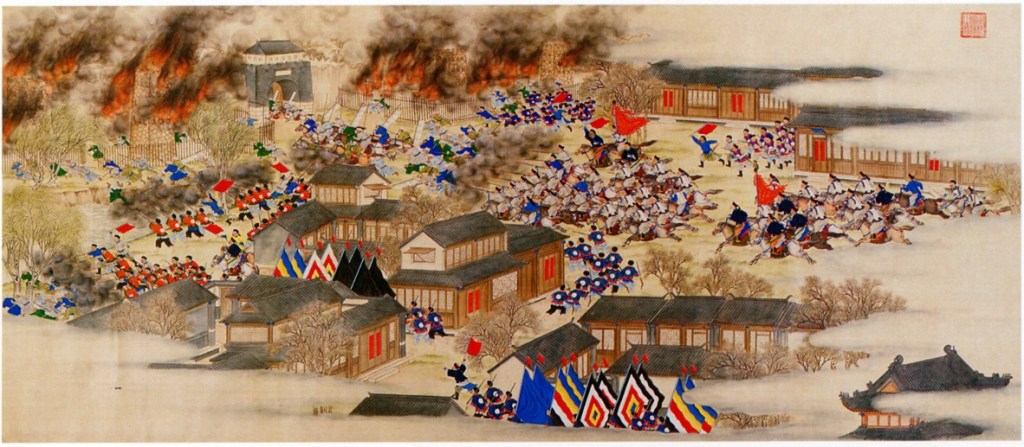
British diplomat Augustus Raymond Margary, on a fact-finding expedition to open up trade routes through western China from British-controlled Burma, visited Dali two years later in December, 1874. Christian missionaries since the massacre had been turned away. Distracting him with a waterfowl hunt on Lake Er several kilometers away, the Qing authorities tried to dissuade Margary from entering the city due to the “turbulence” of the “unruly and pugnacious” surviving ethnic Hui, Han, and Bai residents. Reluctantly they gave him access. Proclamations were sounded within the city warning people to keep their place as Margary’s procession entered the yamen for a meeting with the Qing general in charge, the prefect, and the magistrate. He was then allowed to explore a few streets, where friendly crowds ogled the cigar-smoking foreigner in his sedan chair (Alcock). Only months later, upon returning to Yunnan Province from Burma, Margary and his party were surprised and murdered under obscure circumstances (see Leffman for fresh research into the Margary Affair).
Three years later in October of 1877, British explorer Captain William Gill, following in Margary’s footsteps, was allowed unimpeded access to Dali. The city was still in a state of destruction:
We entered at the east gate, and the interior of the city presented a sadder scene of desolation than the country round. The streets were wide, but half in ruins, and bore the same aspect of poverty that, was everywhere apparent….[I]t rained incessantly night and day, and we scarcely left the house, except to pay the necessary official visits. We found that, notwithstanding the crowds brought into the city for the examinations, we excited but little curiosity, scarcely any one following us in the streets. These, though wide, are very miserable in appearance, and the shops wretched; but the city is very interesting, for people of every type are seen, and the women certainly are better looking than the generality of Chinese and aboriginal women. Some of those walking about in the mud…were quite fair, a great contrast to the very dark mountaineers amongst whom we had been travelling.
Scottish diplomat Sir Reginald Johnston, on a visit to Dali in 1906, noted the city’s continued state of disrepair, while the dominant crop being harvested in the surrounding farmland by male and female Bai locals (Dali’s indigenous ethnic group) was opium. English journalist Edwin Dingle, who traveled through Dali in 1910, observed that most Bai females did not bind their feet, allowing them to work in the fields, though the misogynistic Han practice was growing. He also noted the many abandoned temples and other “lamentable signs of gradual ruin and decay” lingering from the previous century’s rebellion. Dingle was a bit more impressed, as were all post-rebellion travelers, with the bustling activity of the city of Xiaguan at the southern end of Lake Er sixteen kilometers to the south. A third of the way down the road toward Xiaguan was a Temple of Guanyin, the Goddess of Mercy. This temple, boasted locals to Dingle, was the most popular Guanyin temple in all of China; the goddess was reputed to protect Dali from rebellion. According to Dingle, the coins tossed at the effigy by the numerous women who prayed there for the birth of a son were filched by the head priest for his own use. (We’ll return to this spot below, as it’s close to where I’m currently living.) Dingle seems not to have been impressed enough with Dali itself to bother mentioning it.
North of Dali, today a two-hour drive by car, is Lijiang, home to the Naxi people. Their distinct writing system caught the interest of Austrian-American botanist and explorer Joseph Rock, who set up shop in Lijiang from 1922 until forced to leave China upon the communist takeover in 1949. A man of immense curiosity and intellect, funding his projects by sending plant specimens to National Geographic, the Smithsonian Institution, and other organizations, Rock learned the Naxi language and produced the first Naxi-English dictionary. A large corpus of Naxi texts survives due to his safeguarding; many more were destroyed in the Cultural Revolution.
On his way to Lijiang, Rock passed through Dali in April 1922. At the time, the city was controlled by bandits, and opium cultivation and possession were severely punished. These measures did not spring out of any moralistic concerns about drug use but only to enable the military to monopolize the business. Rock was not impressed by the city. It “had a gloomy atmosphere of death about it, and he found the Bai…to be rather stingy and calculating compared to his Naxi and Tibetan acquaintances in Lijiang” (Woodhead). In 1925, a magnitude 7.0 earthquake devastated Dali, killing over 5,000 and destroying 76,000 houses; what remained standing was finished off by fire. The city had not even begun to recover when in 1941 a Russian, Peter Goullart, passed through on his way also to take up residence in Lijiang. Dali “had an air of desolation and death about it,” as he wrote in his lively memoir of Lijiang, Forgotten Kingdom.
LIJIANG AND CHIANG MAI: DALI’S COMPETITORS
Let’s linger in Lijiang for a few moments. While Dali was in a perpetual shambles from 1873 until its resurrection in the 1980–90s, Lijiang stood in as its prosperous sister (at least until 1949). It’s what Dali might have been had fate dealt it a better hand. The picturesque Old Town has much of the charm of Dali’s and is as popular a tourist destination, then and now, though in Rock’s and Goullart’s time the tourists were Tibetan traders bringing caravans of luxury goods from Bombay. Lijiang had a reputation as a staunchly independent, free-wheeling, freedom-loving city. The matriarchal Mosuo tribe would routinely appear in Lijiang from their fastness in the Lugu Lake area 220 kilometers further north, ostensibly to stock up on valuables. Parading along the streets in fancy attire and makeup, buying men drinks in streetside bars, the sexually aggressive Mosuo women snatched up local prey—and visited Goullart’s medical clinic, which he had set up with donated medicine from the Red Cross. He estimates that 90 percent of the Mosuo were afflicted with syphilis or gonorrhea. To be fair, so were the Tibetans. The first thing the communists did when they took over Lijiang in July 1949 was to ban alcohol and sex (Goullart).
STI arises not from a lack of morality but of sex education, and we shouldn’t be judgmental about the Mosuo’s fascinating sexual practices (discussed in my Insights into China, Part 8: An immersion in a museum). Denied their own independent status as a “minority nationality,” the Mosuo are officially lumped together with the Naxi, though they are quite distinct. Apparently, conferring recognition of a harmless matriarchal group is existentially threatening to Chinese patriarchy. A female artist friend, Loyi, introduced me to a woman living in a village outside Lijiang whom I’ll call Maomao. Maomao made her own absinthe, which I was eager to try as it would contain thujones, the mildly psychoactive compound that is banned in commercially produced absinthe in Europe. Maomao greeted us dressed in a blue Tibetan robe. When out of curiosity I inquired as to her ethnicity, she said she was Naxi, until it came out after a few shots of absinthe that she was actually Mosuo, and her ancestors’ hometown the Mosuo homeland of Yongning, near Lugu Lake. As a Mosuo, Maomao doesn’t believe in monogamy and is proudly independent. She has a daughter in high school in Kunming but has little contact with her daughter’s father, who in Mosuo fashion was not expected to be involved in raising the child.
A painter herself, Maomao very much lives the artistic life. In earlier years she opened a gallery in Shanghai. One exhibition which took place about a decade ago featured women painters she knew, including Loyi. As the subject was the female nude, she persuaded them to appear naked on opening day, without warning the hundreds in attendance. Though a one-off event, it garnered her not a little fame and notoriety. Back in Lijiang, Maomao cultivated cannabis and opium until the government started flying drones over people’s property to catch illicit gardening (thus her switch to wormwood for distilling absinthe, legal in China). Maomao used to entertain guests in overnight bashes lasting days at a time and cultivated Chinese and foreign boyfriends. She stopped the partying in recent years after government threats to bust large private gatherings, particularly in artist communities, made easier by the growing surveillance capabilities of the WeChat social media app used by every Chinese today, about which more below.
Following Chiang Mai in Thailand and Dali in the 1980s, Lijiang was later added to the “Banana Pancake Trail” (an extension of the “Hippie Trail” through Turkey, Iran, Afghanistan, India, and Nepal of the ’60s–’70s into Southeast Asia). Today Lijiang and Dali are equally thronged by millions of annual tourists, who formally had little interest in Yunnan Province until Western hippies started turning up in huge numbers in the ’90s and they wondered what all the fuss was about. Domestic tourism to Dali took off earlier than Lijiang for another bizarre reason, when in those same years the city created amusement-park simulacra of scenes from an enormously popular martial-arts novel set in a make-believe Dali in the Tang Dynasty, Jin Yong’s Demi-Gods and Semi-Devils (Tianlong Babu, orig. pub. 1963). Beth Notar’s Displacing Desire is a history of how these two trends merged to turn Dali into China’s utopian destination of the early 2000s.
The three cities make for an instructive comparison. Chiang Mai and Dali are both square walled cities of the same extent (1.5 kilometers along each side); both cities’ walls have disappeared but for a few preserved sections. Main roads run crosswise through the length of each city and between them can be found hidden restaurants and cafés in labyrinthine lanes. The environs around Chiang Mai’s Old City boasts the sacred Doi Suthep Mountain, Hmong hill tribes, and lovely riverside restaurants along the flood-prone Ping River. Outside the center it’s more urban and grimy, but the city holds a mystique for its many Buddhist temples and golden pagodas, laid-back atmosphere, infinite massage offerings, and (since 2022) legal weed. Its vibrant international restaurant and bar scene has been in place for decades and caters to global travelers and Western retirees. Thailand far surpasses any Chinese hotspots in this regard and has been a model for Vietnam, fast catching up as a haven for digital nomads; neither China nor Vietnam has a visa program for retirees but the latter is more astute in the Western amenities business.
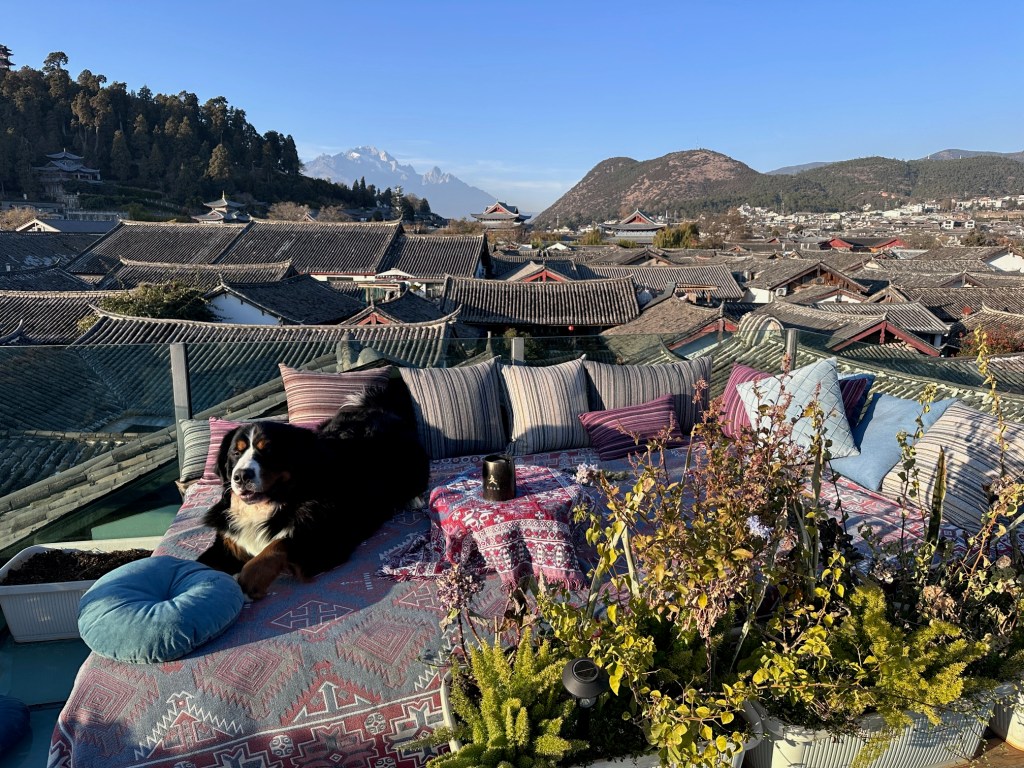
China has innumerable well-preserved antique cities and towns; more are being discovered (or reconstructed) all the time as the government throws huge resources into the post-Covid tourism industry. Some “ancient” towns are even built wholly from scratch (Hansor). (That’s the positive spin; the present regime’s underhanded totalitarian motive is to discourage domestics from traveling abroad.) Dali and Lijiang top the list and are representative. Lijiang was never walled but has the compact feel of a walled city. The repeated tiled rooftops of its two-story dwellings, rebuilt after a devastating 1996 earthquake and again after a 2013 fire in the Old Town, make for a stunningly scenic vista, with the majestic 5,596-meter (18,360-ft) Jade Dragon Snow Mountain as a backdrop. Today souvenir shops seem to outnumber all other shops, but many culinary treasures are to be found amidst the city’s incomparably picturesque lanes and canals. Like Chiang Mai’s, Lijiang’s Old Town is nested within a larger modern city of more limited interest.
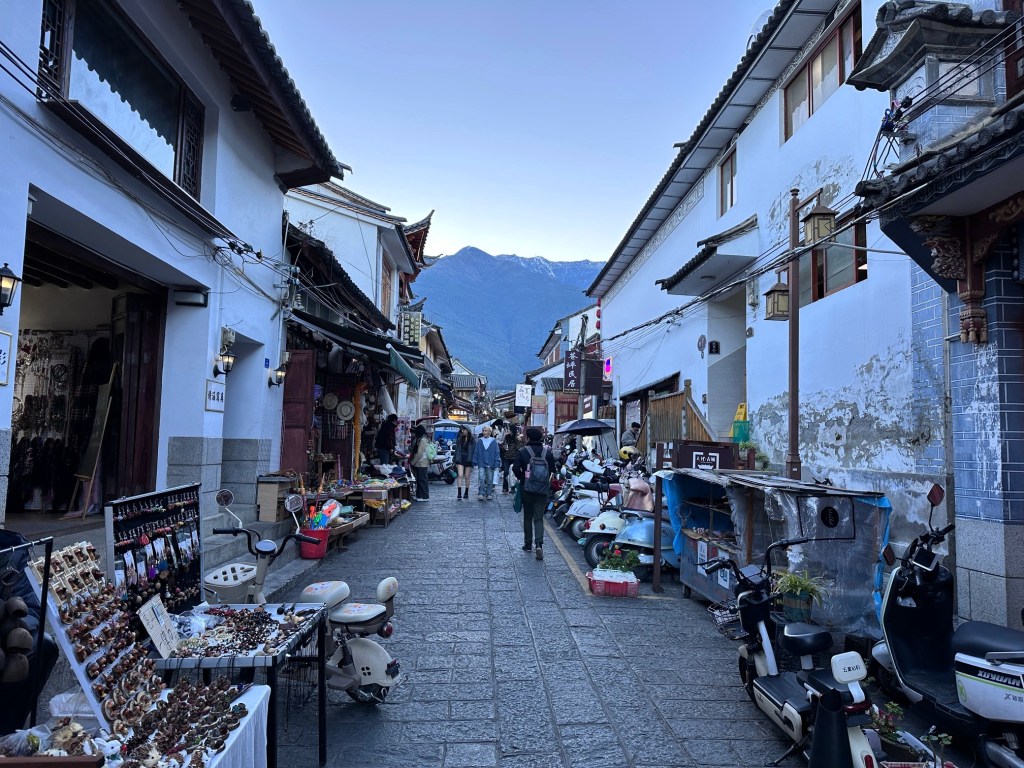
Dali’s natural environs are even more impressive than Lijiang’s. “Dali” is a confusing term. The Dali Bai Autonomous Prefecture is a large region with a population of 3.5 million. It doesn’t feel that populated, as its urban pockets, spaced between extensive villages and farmland, are spread out around Lake Er’s 40-kilometer extent and beyond. Xiaguan, mentioned above, is the administrative center, with several hundred thousand (population data are unclear after the city was reclassified as a subdistrict in 2019). Xiaguan is also known as Dali New Town to distinguish it from Dali Old Town (officially “Dali Ancient City”). The population of the Old Town swells from 50,000 to 200,000 in peak season. The tourists congregate not only in the Old Town but in the many lovely villages around it and on stretches along the lake, such as Xizhou and Shuanglang on the lake’s northwest and northeast shores. They are also discovering Xiaguan, an attractive city in its own right ensconced on mountain foothills facing Lake Er. When people refer to Dali, they may either mean the Old Town or the entire population in the valley, and both are correct.
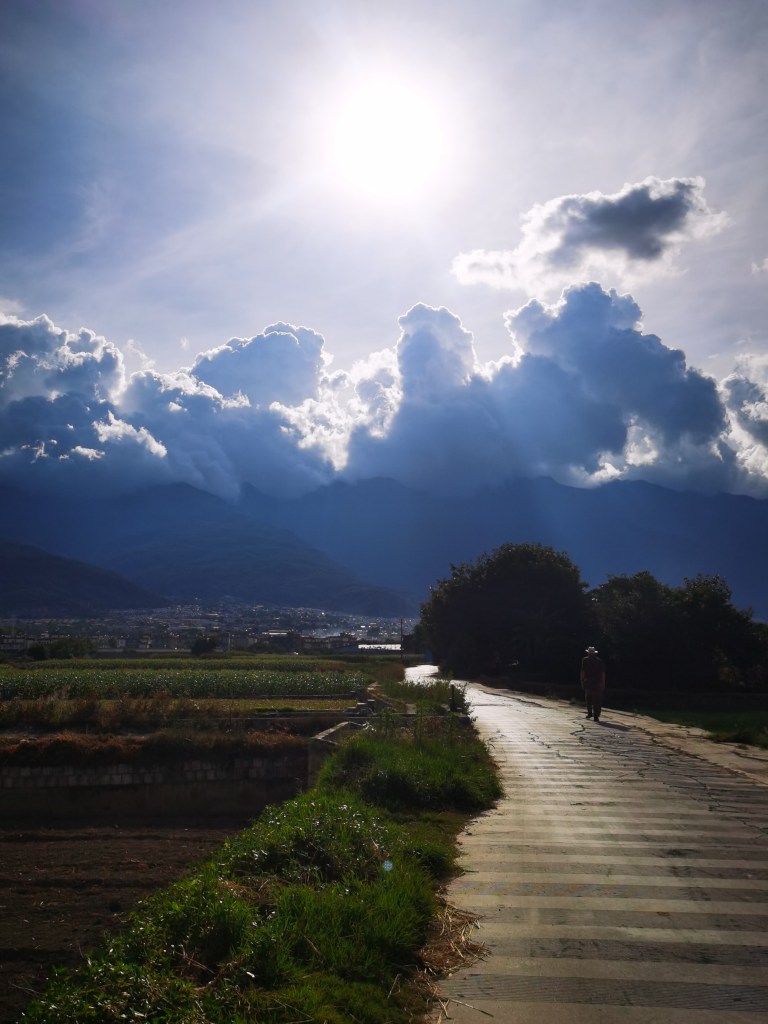
From Cai Village on Lake Er to the Old Town’s east gate is a level, three-kilometer stretch of farmland, which begins to rise just as one reaches the Old Town. The Old Town is built on a slope where the foothills of the Cang mountain range begin and rises more steeply as one emerges out the west gate. A short hike later and one is at the upper reaches of the foothills, too steep for habitation. Dali is already at an elevation of 2,000 meters; the mountains rise another 2,000 meters, looming up from the city like a massive wall. Snow-capped in winter, they have been pristinely reforested—after a crazed deforestation campaign during the Great Leap Forward that had utterly denuded them. Dali had the highest starvation rate among Yunnan prefectures in the 1960–61 famine, as farmers were forced to hand over their entire harvests to the state (Notar, Displacing).
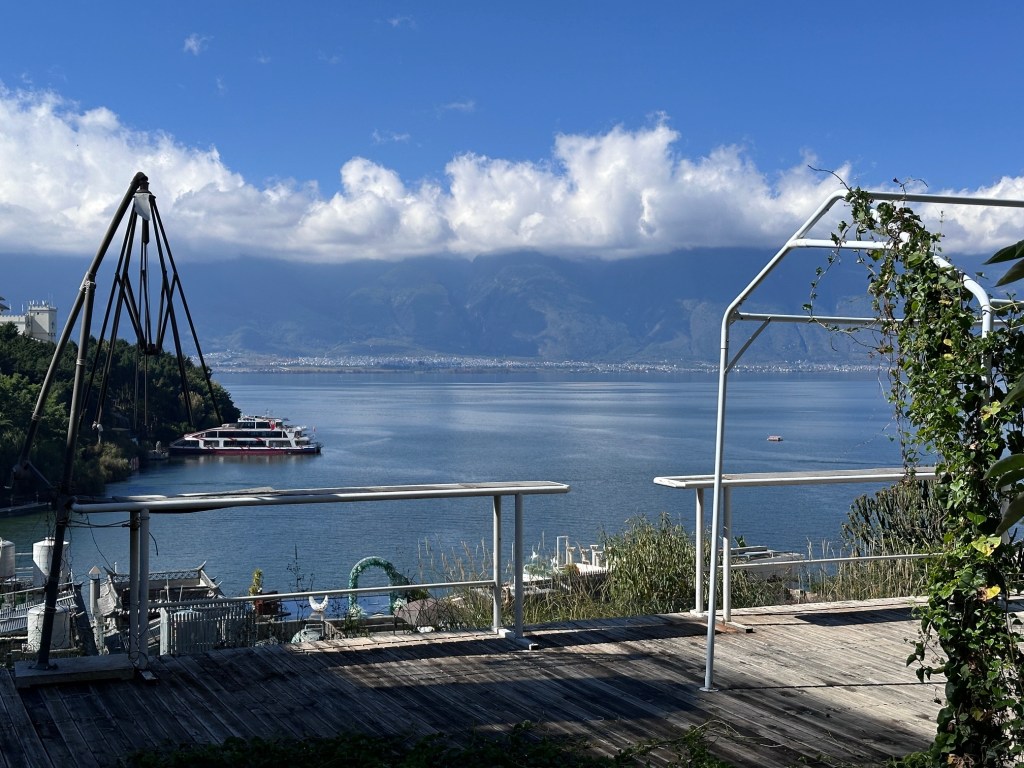
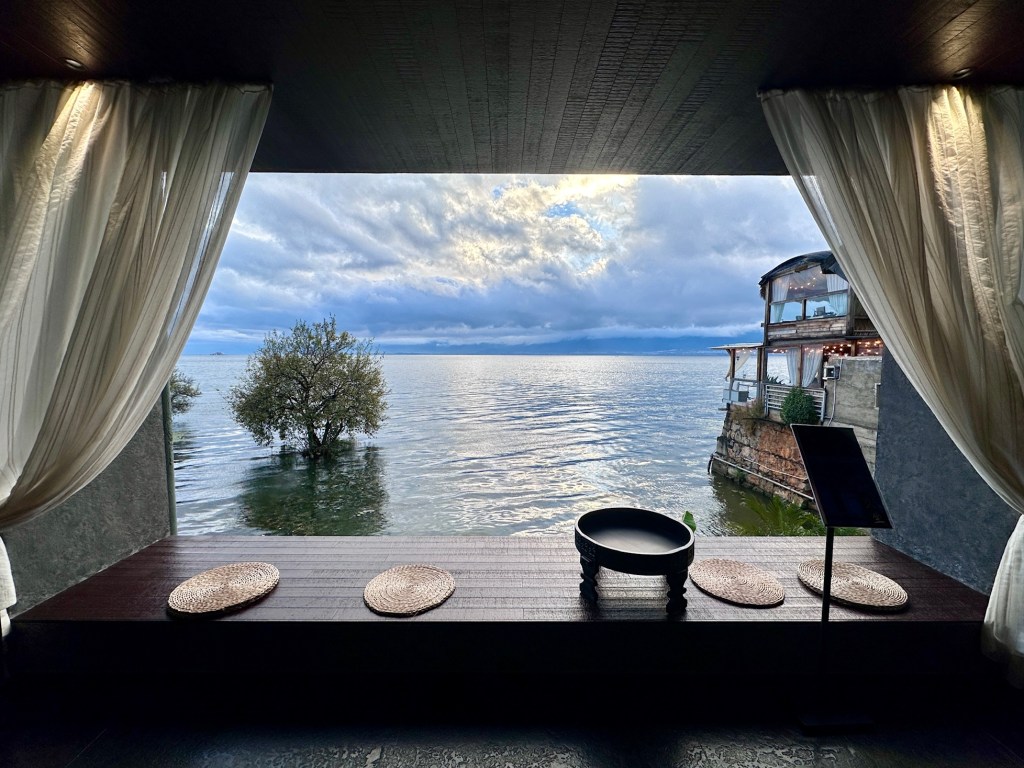
The clouds are often so close they nestle in the town. From any point in the vicinity, it is as if one is a spectator in a grand theater gazing on the drama of Lake Er, or Erhai (lit. “Er Sea”), as the sky changes the lake’s cobalt blue to a silver sheen and it shapeshifts from a lake to a broad river depending on the angle of view. Neither a sea-like expanse like the Great Lakes in the U.S., nor the tiny jewel of a Lake Louise in the Canadian Rockies or Lugu Lake on the Yunnan-Sichuan border, Erhai is an ideal midpoint between small and large, lending it a grandeur both spacious and intimate.
FENGYANGYI VILLAGE: THE ANCIENT TEA HORSE ROAD
Newly developed housing has been creeping up the foothills north and south of the Old Town. Seven kilometers south of the Old Town is the aforementioned Temple of Guanyin, and a twenty-minute walk west of the temple along a winding road leads to one such community in Taihe Village. This village, where I now live, lies over the buried ruins of Taihe City, formerly the capital of the Nanzhao Kingdom that controlled Dali between 738–902 CE. There is nothing about the community that suggests its history; the sprawling Hilton Dali Resort & Spa is a few minutes away on foot. But another ten-minute downhill walk from the Hilton brings you to a gravel road branching off to the south, which soon turns into a cobblestone road. This takes you through Fengyangyi Village, before the road exits onto the modern highway two kilometers away that links Dali Old Town to Xiaguan. Horses can be rented for a brief guided jog through the latter half of the village, crammed with cafés and shops selling crafts made by local Bai women. This path is a surviving section of the Ancient Tea Horse Road, also known as the Southern Silk Road, that brought goods to and from Tibet and India going back over a thousand years.
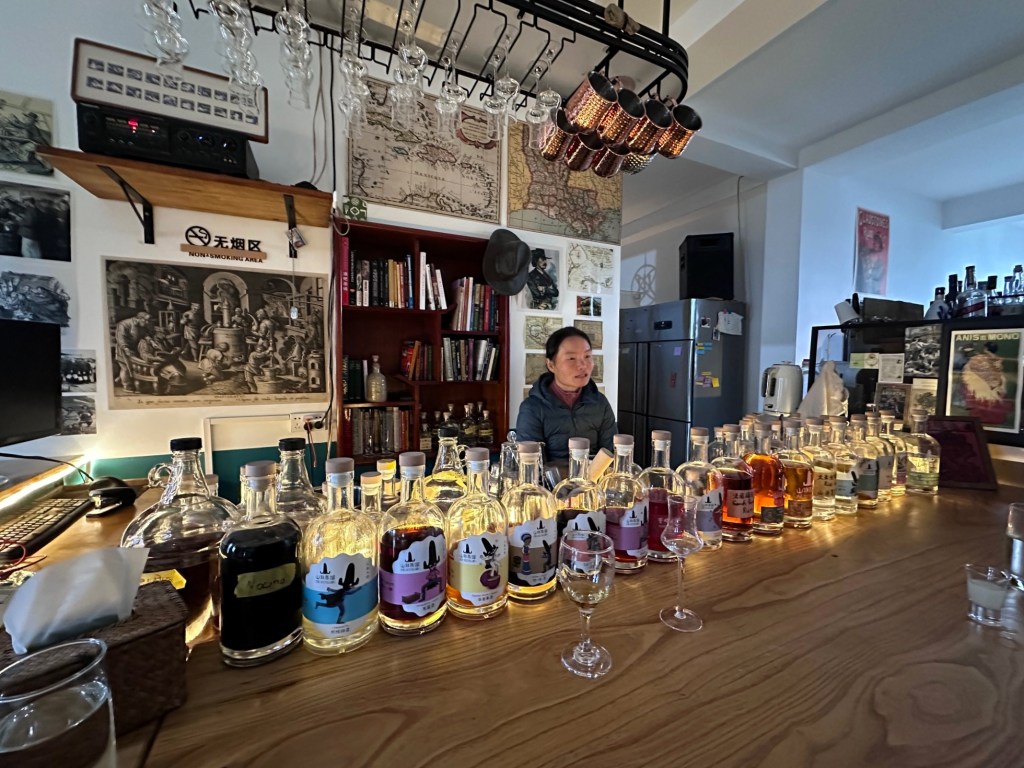
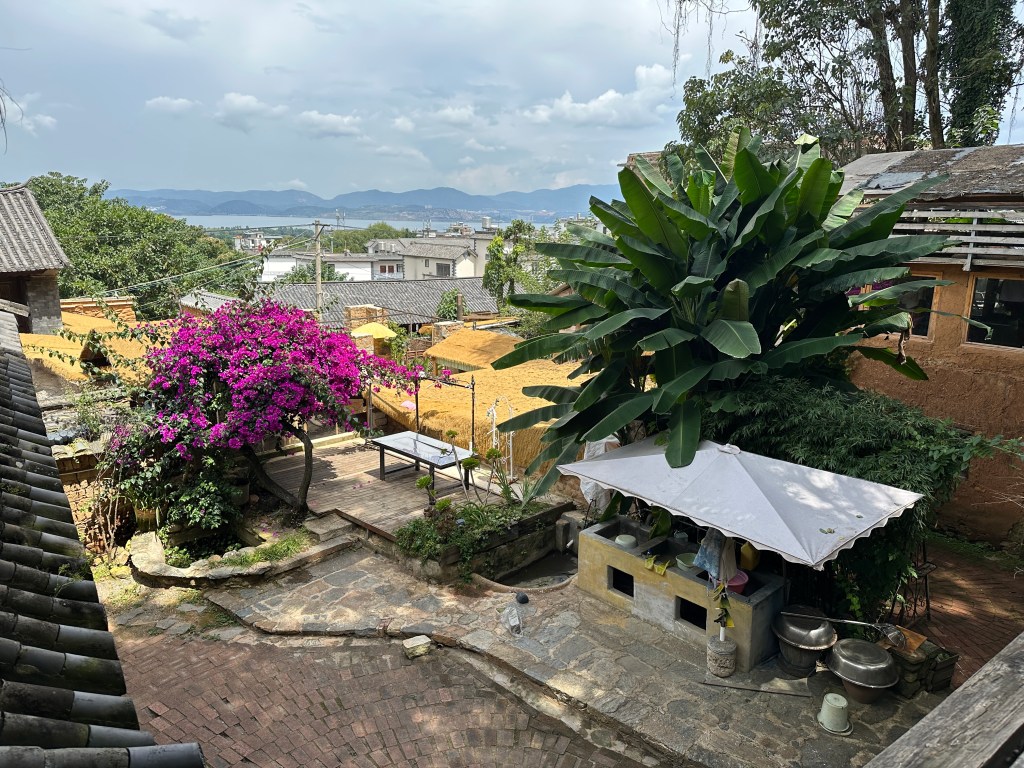
My favorite place on this cobblestone stretch is the Yimuchuan Garden Café (乙木川庭院咖啡集), opened by a Han woman from Hunan named Weiqun. As with many neighboring cafés and restaurants and in the Old Town, it’s a traditional courtyard dwelling. From its open window, the interior looks out on the courtyard and the crowds passing along the ancient path through the café entrance. On the property are two upper levels of receding buildings pushing up against the mountain woods, which Weiqun hasn’t renovated but could be turned into a resort with a nice view of the lake. A friendly woman, she invited us to her home in a courtyard dwelling a few steps down the road. Besides coffee, tea, and free snacks—the local specialty known as xianhuabing, handmade flower cakes of honey-sweetened rose petals in a croissant-like crust—the café sells liquor from a distillery specializing in absinthe, rum, and a variety of gins, run by another Hunanese woman and her American husband on the other side of the highway closer to the lake, the Shanfei Distillery (山非蒸馏).
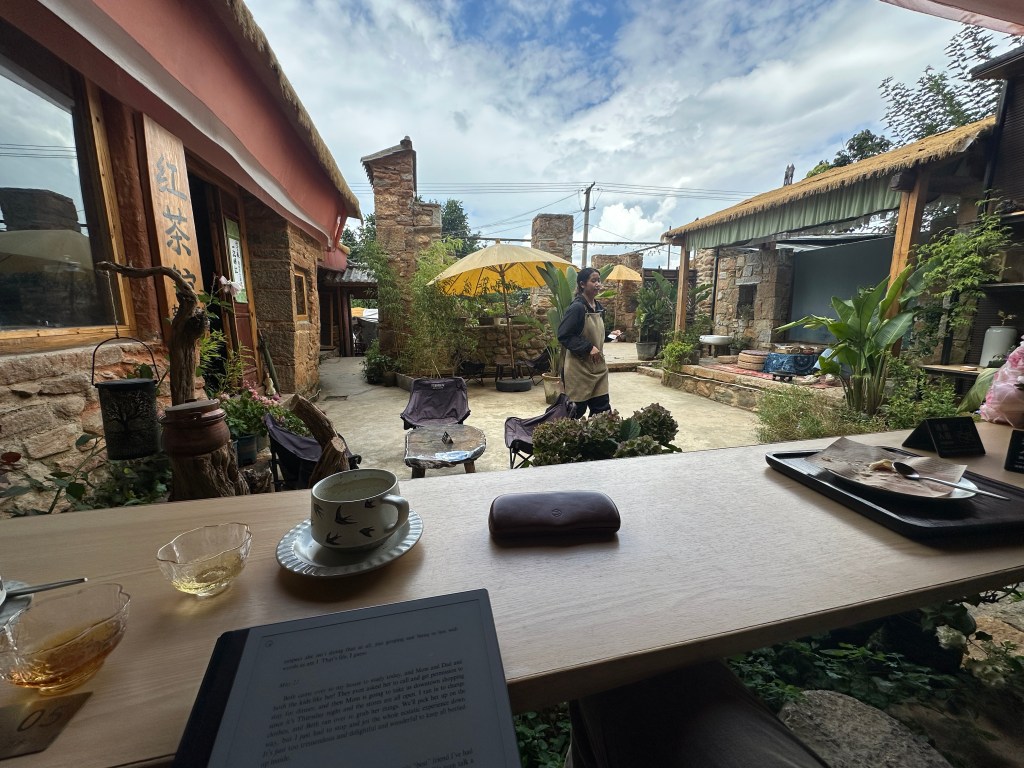
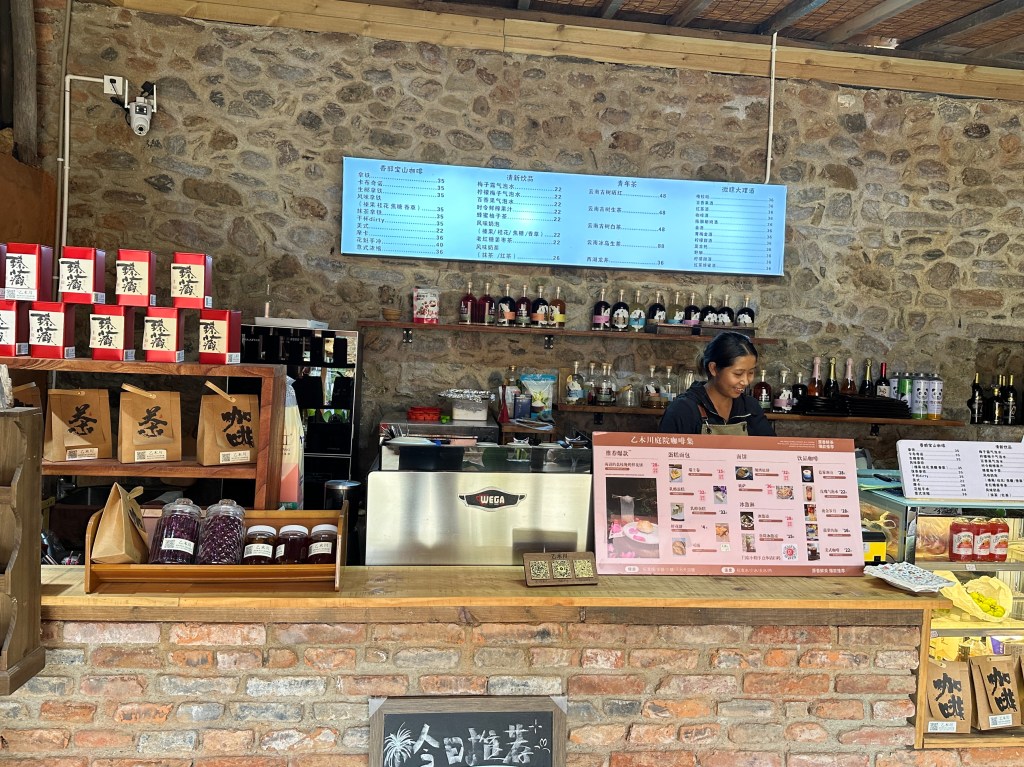
Weiqun hired a local Yi girl as a barista and server. Yunnan has a large population of ethnic Yi, who live mainly in the north of the province—the Lugu Lake area and across the border in Sichuan, as well as the Lijiang and Dali regions. Traditionally they have not had a good relationship with the Mosuo, who regard the Yi as uncultured and primitive. There may historically have been some truth to this but today it’s indefensible. The Yi had long been divided into the Black and White Yi, the Blacks self-styled aristocrats who kept the Whites as slaves. A tall, elegant female Yi friend of mine involved in the arts in Beijing and Guangzhou, who fits the stereotype mentioned by Goullart of the Yi’s round eyes and aquiline noses, told me it’s bad form to ask a Yi person whether they’re of White or Black stock lest they admit their ancestors enslaved or were enslaved, but intermarriage has largely erased these caste differences. However, the Yi still avoid intermarriage with the Han. After the Yi server quit when she met a boyfriend (of uncertain ethnicity), Weiqun hired an equally pretty Bai girl a village family introduced her to.
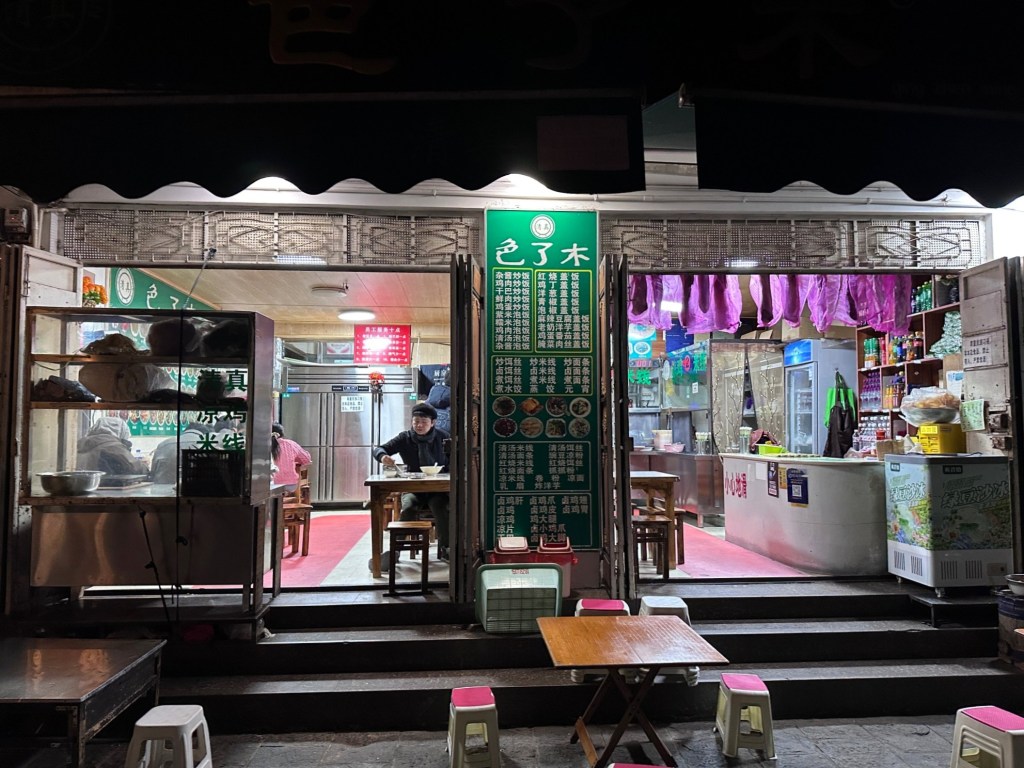
Very elderly Bai women can be seen in Dali wearing their traditional blue dress and turbans and carrying big loads of refuse for recycling, still going strong with all their daily exercise. In the past, the women did most of the manual work, while their men lolled around smoking opium. Today younger Bai dress in casual wear and there’s nothing about their features, bearing or character that distinguishes them from the Han. But class differences persist. The Bai work in the service industry and apart from small family businesses, the moneyed Han are their bosses. I’m a frequent patron of massage shops in Dali and most masseuses are Bai. I’ve also had Dai, Yi, and Sichuanese Han masseuses—Yunnan has 25 out of China’s 55 ethnic minorities or “minority nationalities.” I have yet to encounter a Hui masseuse. The Hui weren’t all wiped out in the Panthay Rebellion. Halal restaurants are plentiful in the city, typically at the lower price end and are generally delicious. Needless to say, the variety of Dali’s restaurants, adding the large Bai menu to the mix, is endless, as in any Chinese city.
THE NEW MIGRANTS
In both Lijiang and Dali are to be found high-end teas and coffee beans (Yunnan grows both), artisanal liquors, metalwork jewelry, carved wooden kitchenware, pottery workshops, indigo tie-dyes featuring traditional and modern designs such as marijuana leaves, stylish handmade clothing of high-quality fabrics, you name it. Dali’s craft industry is more varied and of higher quality than Lijiang’s. There is an informal bohemian uniform worn by some Han women who migrate to Dali to assert an artistic sensibility or air of sophistication: vaguely Taoist robes, tunics, and pants in earthy monochrome hues. Dali has been a magnet for Chinese disaffected by the monotony and oppression of urban work culture. They are not all “lying flat” (tangping)—rejecting the “996” rat race by giving up and doing nothing—but more often going with the Taoist flow, finding their true vocation and even thriving.
One Beijing couple we met who moved to Dali a few years back exemplify this trend. They took out a 20-year lease on a traditional Bai courtyard home in a quiet village close to the lake, with its regulation white exteriors trimmed with painted filigree under the eaves, and fixed it up. The standard deal is they won’t be reimbursed for the outlay when they leave but the rent is cheap. They have a word-of-mouth therapeutic business in TCM detox fasting. Ziya has a large collection of New Age energy crystals prominently displayed on a living room shelf. Her husband, Hongxing, built a tea-ceremony hut in their courtyard, outfitted with framed calligraphy paintings and shelves of expensive rocks and Buddha figurines also displayed with museum meticulousness. Though I can’t speak for their private life, this proud couple appear to all but have the world to themselves, moving in and out of society with Taoist dexterity and grace.
This can be a double-edged sword. The solution to the alienation of modern life is not to be found isolation but in community, yet many of those migrating to Dali just want to get away from people. In his memoir of Dali during Covid, The Mountains Are High, Alec Ash pointed out this paradox. In a Siddhartha-like pursuit to find himself, he ticked all the boxes—visiting local Taoists and eccentrics, scaling Mt Cang, biking the 130 kilometers around Lake Er, joining local festivals, staying in monasteries and hippie communes, and doing psychedelic drugs (the title is a pun on “high”). None of it really provided any satisfying answers:
After six months here, I had met many city transplants on the same quest, but I was yet to form any meaningful relationships. I had preferred to keep myself at a distance, to nurse my hurt in silence. All of my hikes, and this bike ride, were done alone. Nobody in my village, or among my new friends in the valley, knew exactly why I was here. There was an undercurrent to the counterculture of Dali, whether in the parties or the drugs, the lucid dreamers or the livestreamers, that could take you away from reality, not connect you to it. Maybe that was what we sought.
The answer seems to have been there all along when he eventually finds a girlfriend.
What I have noticed after living and traveling in the big cities for decades is an unfortunate cultural characteristic of many Chinese, their timeworn and notorious reluctance to engage strangers (see my The many faces of Chinese “face”). My wife (who is Chinese) and I regularly visit cafés and craft-beer bars. We start with the owners and servers. In big cities, conversation is polite but rarely sticks, though friendlier staff will recognize us on repeated visits. In Dali, people are decidedly more relaxed and easier to talk to. Or more exactly, there may be a budding, embryonically rebellious movement throughout the country of people weening themselves off cellphone addiction and actively socializing. China’s southwest and “Dalifornia” in particular signifies this trend. Rebellious because the government would prefer that people stay in their nuclear-family bubbles and keep self-monitoring each other through mutual online surveillance. Community socializing is dangerously close to community organizing.
Most of our friends in Dali now are café owners. Of course, congeniality is good for business, but their hospitality is not just for the sake of business. We invite each over for dinner. The fact that we prefer to accumulate friends in cafés or bars rather than online provides for a highly revealing insight about the current state of the country, which I will return to below. Let’s first delve into Dali’s café culture in more detail.
CAFÉ CULTURE
Novelist Chris Taylor spent years in Dali and Yunnan in the 1990s–2000s. His novel Harvest Season, vaguely set in Dali and nearby Shaxi, conveys the wistful atmosphere of an exotic environment that for foreigners was at once relaxing and alienating (“Interview”). Beth Notar also writes intriguingly about the era from the perspective of the restaurateurs catering to foreigners, how they learned Western menus and in turn became globalized without ever leaving Dali or China (“Producing”; see Connolly for photos of Dali circa 1995). Those recalling the era bemoan its present commercialization. But I would add that this nostalgia often misses the point about Chinese cities’ constant state of change, where when one thing gets pulled down two more things of interest pop up in turn.
The shops for Western backpackers, bearing their Lonely Planet China (the bible of budget-traveler guides), who were the only foreign visitors in the ’90s, were confined to several blocks along Huguo Road, dubbed Foreigner Street (yangrenjie). The street still has a handful of Western restaurants (Kaiyi’s Kitchen, Stella’s Pizzeria), though not much in the way of cafés. The reason for this is that café culture in Dali, and the country as a whole, has been utterly transformed in the decades since. It is no longer for foreigners. There are countless cafés evenly spread throughout Dali Old Town today, though typically on the quieter, less merchandise-saturated streets, and in every town and village in the environs wherever Chinese tourists go. The international fare has migrated over to Guangwu Road, except for Japanese and Korean and more recently Thai and Vietnamese fare, Asian flavors closer to the Chinese palate. The bar scene is now on Renmin Road, featuring live guitarists singing Chinese folk or pop for domestic tourists.
The café storm started gathering before Covid and is showing no signs of letting up. The establishments can be magnificent and stunning. Bijing Café (彼境咖啡) occupies an old two-story house and large courtyard. Somewhat startlingly, customers are engaged in lively conversation rather than glued to their cellphones. Servers come up to chat and hand out free xianhuabing. The coffee comes from the Baoshan region 200 kilometers to the west and is superb; one server told us they go there to study coffee harvesting and roasting. The courtyard is always crowded, even when the temperature drops to the 50s F (southern Chinese are impervious to cold and seldom heat their establishments in the winter). Xindi Coffee (心邸咖啡), one of hundreds of cafés along the Lake Er shore, this one directly east of where we live, is an example of the recent trend of fashionably dressed young women “punching in” to spend hours photographing each other in smart coffeehouses (see my Insights into China, Part 6: An afternoon in a café). Along the shore several kilometers north of the Old Town is another, Yasheng Coffee Space (牙生咖啡空间), repurposed from a three-story Bai house with added scenic decks into a kind of theatrical space inviting customers to snap away amidst its intentional mix of American Pueblo and indigenous southwest Chinese decor.
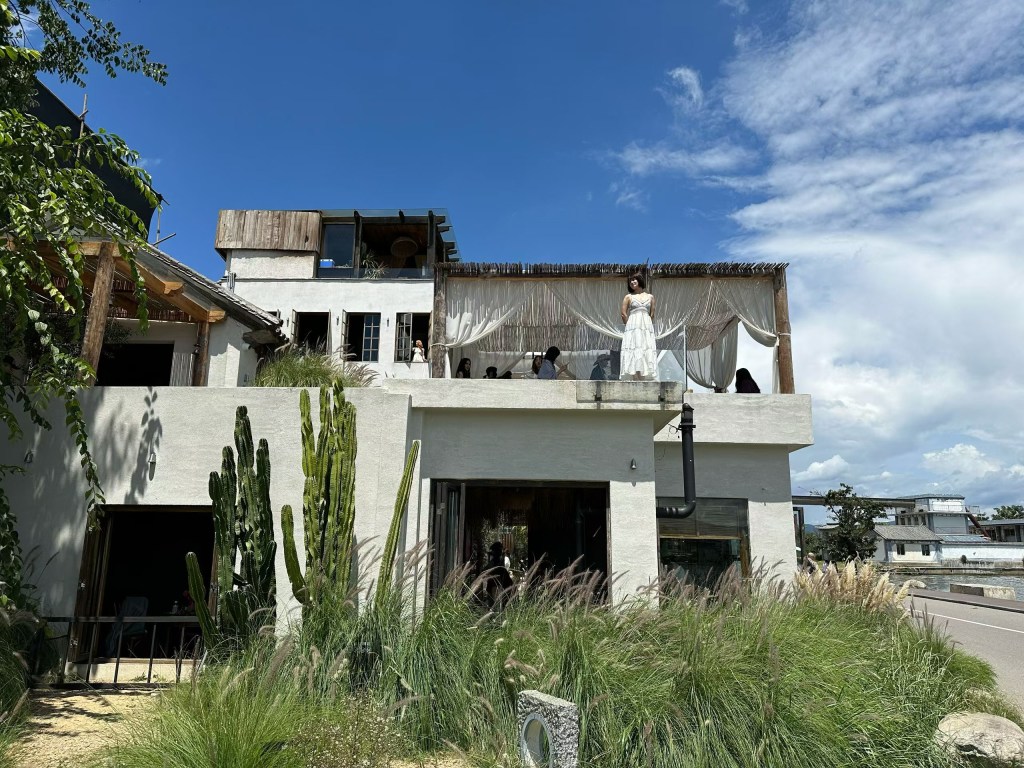
This café renaissance is occurring throughout the country but is especially exciting in Dali, where owners, servers, and customers appear just a bit more eager to interact and create a sense of community. More and more Chinese are inevitably pushing back against the collective pressure to submit to the electronic surveillance regime, even if they feel they have to come to Dali to do it. At the same time, contemporary China’s social predicaments are more complex than they’re made out to be in the Western, especially U.S. mass media. On balance, the Chinese are getting along fine, but the younger generation has its work cut out for it if they want to create a freer society in the future. In what follows, I’m going to zoom out from Dali to give a broader snapshot of the weird and fraught state of the country in the digital age and hint at what the future holds.
Where the journey from Kunming to Dali used to take twelve hours along dangerous hairpin turns, it’s now two hours on the fast train; China’s high-speed rail network covers 48,000 kilometers (30,000 miles) and counting. Multiple local transportation options are standard everywhere, including Dali, where one can easily get around by regular and electric share bikes and Didi taxis (China’s Uber). The variety of hotels and guesthouses is practically limitless, at all price ranges. Breathtaking natural scenery and historical sites are plentiful and more are being spruced up all the time. Cashless pay apps are used for pretty much everything (foreigners can sign up with a credit card). Delivery of food and other goods by app is fast and cheap.
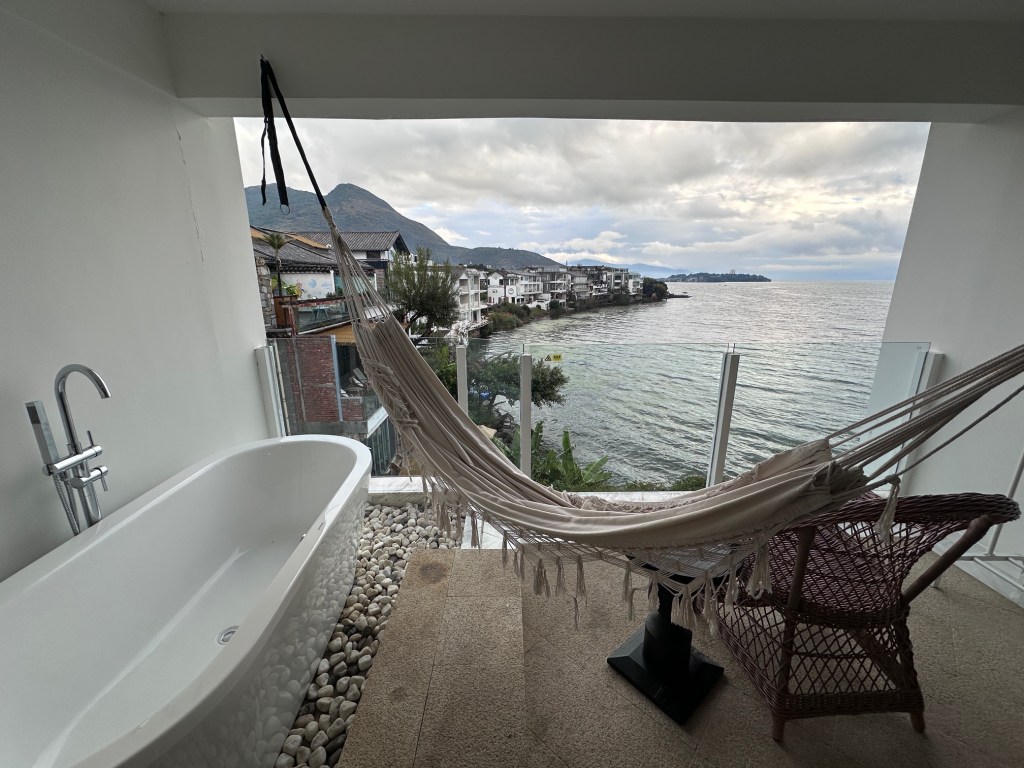
These modern conveniences apply to every corner of the country (see my Insights into China, Part 9: A journey to the hinterland). You don’t know Chinese food until you encounter all the extraordinary delicacies the people really eat. Besides the cornucopia of restaurants, cafés, and teahouses, nightlife is increasingly vibrant. Craft beer pubs have sprouted up in every city; Beijing leads the way with nonpareil ales and IPAs while Shanghai has worldclass wine bars. The country boasts a vast spa industry, employing TCM modalities for every need (moxibustion, cupping, scraping, acupuncture), though massage venues are priced higher than Thailand’s and may seem less numerous due to the lack of English signage and advertising (instant translation apps are making communication easier). Meanwhile, topnotch museums, concert halls, libraries, and bookstores are sprouting up everywhere, part of a cultural explosion over the past decade that I’ve explored in other posts in this series.
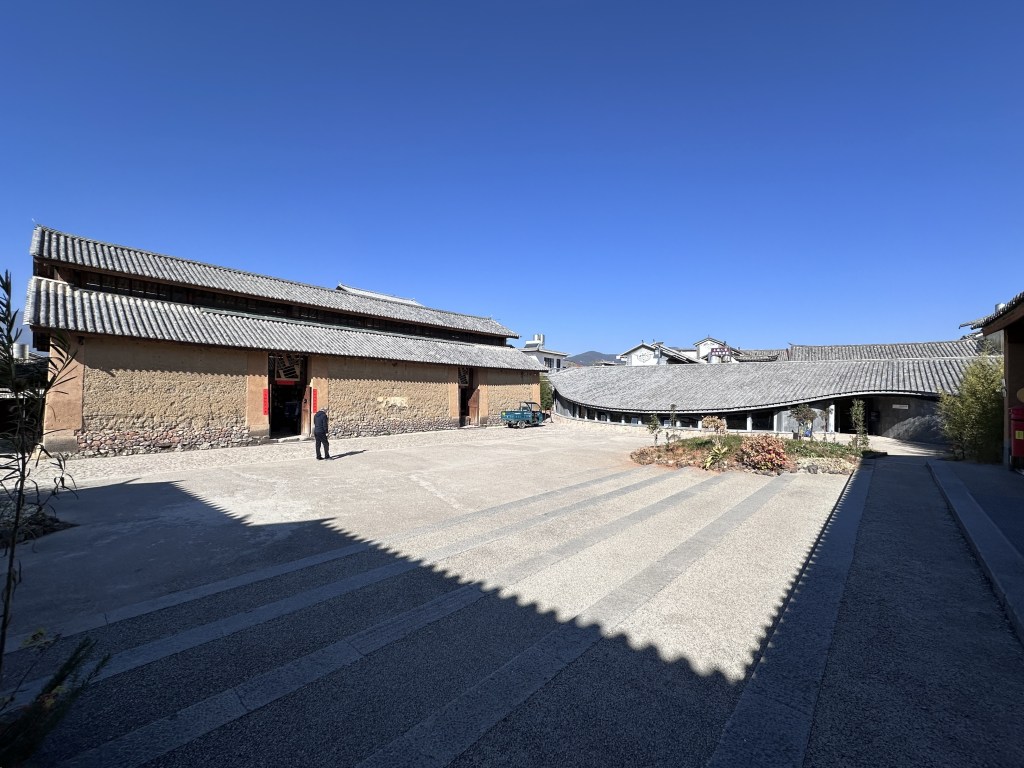
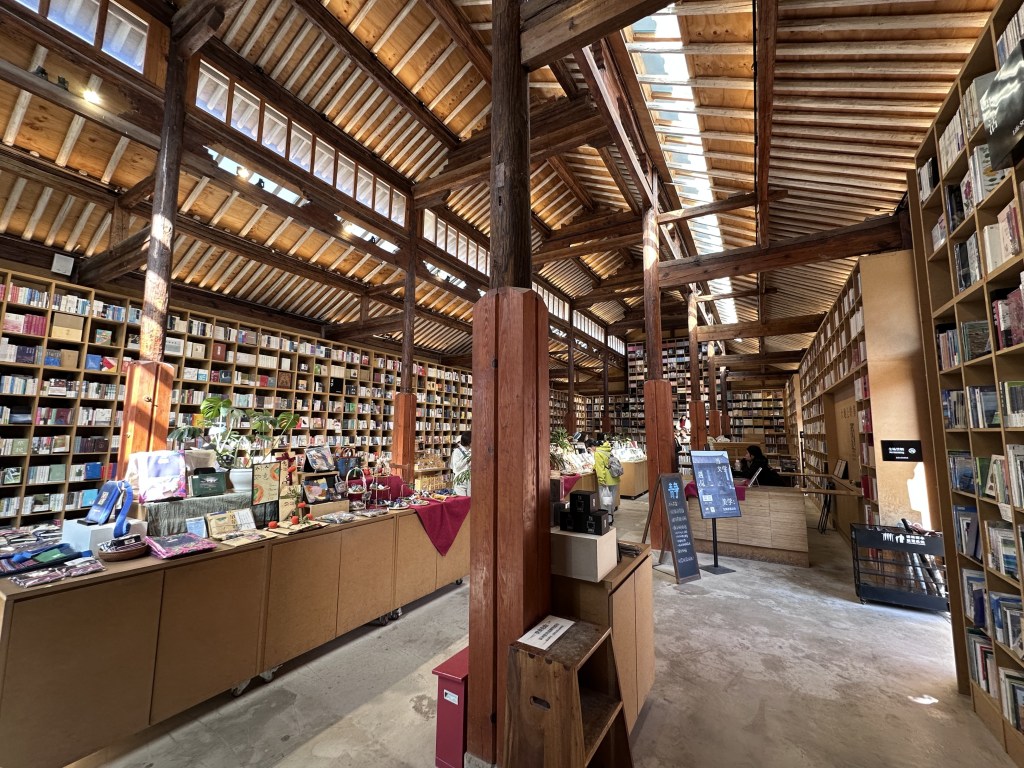
I could go on about life in contemporary China, which is magnitudes better than it has been in its entire history, the present economic doldrums aside. The point I’d like to stress here is that the constant diatribes by China bashers and sinophobes ring hollow when we realize that for the vast majority of Chinese, it is enough. They have everything they need and more, as their country continues to develop and prosper. For most people anywhere, in any country, it would be enough. Indeed, it is more than enough, considering people everywhere tend not to make use of all the resources available to them. They live in survival mode as if still in the past, when providing for the family was enough.
On the other hand, for a minority of us with more esoteric tastes, needs, and conceptions of freedom, you are better off in Thailand, or even Vietnam.
DIGITAL DYSTOPIA
In the last year of Covid, the government tested the limits of public tolerance by incrementally constricting freedom of movement. The cellphone was a uniquely powerful tool in enforcing this experiment. Everyone was required to get mouth swabs for the virus every 24, 48, or 72 hours (it kept changing) to keep their green-code status, displayed on their phones. Lapsing (a gray code) locked you out of stores and restaurants, public transportation, parks, and all public venues and services. In virus hotspots people were confined to their apartment complex or even prevented from leaving their apartment. Many lost their jobs due to these restrictions if work couldn’t be carried out online. Untold numbers may have suffered severe, if not fatal, starvation during the Great Shanghai Lockdown in spring of 2022 when food delivery was curtailed. A yellow code (in a virus hotspot) or a red code (a positive test) saw people being forcibly removed from their homes and shipped to quarantine centers or hospitals, their pets left to perish. The experiment was stopped when the virus finally broke through, everyone caught it, and Covid was over. People have moved on as if the whole thing was a bad dream, the sooner forgotten the better. But these restrictions could easily return in the event of another epidemic; they could also be enforced during a political uprising.
On top of government surveillance through cellphone access codes, facial-recognition video surveillance is on every street, which can triangulate with GPS and cellphone transactions to track people in real time. Omnipresent video surveillance does have limits. It does not reach into the privacy of people’s homes like the mounted telescreens in every residence in Orwell’s 1984, though there have been tentative moves in this direction and I’m sure it’s a fantasy among some apparatchiks. During Covid, the police in one city installed video cameras in the homes of workers for quarantine purposes who were returning from lockdowns in their hometowns. This was found to be unbearable and the police backtracked after negative publicity (Gan).
The police are not actively observing every citizen. They neither remotely have the manpower to do so nor need to. It’s enough for central databases to employ algorithms to flag patterns of behavior, such as groups of people organizing events for unclear or suspicious purposes, aided by their unwitting or careless communications on WeChat, the unencrypted social media app used by all Chinese. No one knows how closely the government scrutinizes conversations on WeChat. Politically sensitive texting will be on the radar if you share to multiple people or groups. If this is causing people to self-censor by being careful about what they say online, that’s exactly what the system seeks to achieve. As long as they stay out of trouble, the Chinese can go about their lives without government interference.
The Chinese can travel freely throughout the country and abroad, with a major exception that applies to a significance portion of the population. The passports of public employees in government offices, banks, hospitals, and schools are held throughout their employment and are only returned several years after retiring. They must apply to travel abroad and can be refused on the flimsiest, most arbitrary grounds. A friend of mine who teaches at a public university had planned to go to Thailand for her summer vacation this year but was refused, merely because another teacher had gotten into unspecified trouble while on a trip abroad and everyone in her department was punished for it. Though this would be considered an outrageous violation of one’s rights in most other countries, it doesn’t affect enough Chinese to cause pushback. Moreover, people who enter the civil service sector know they are sacrificing certain freedoms for greater career stability. And they may in addition be just the type who aren’t that much interested in traveling abroad anyway.
The Chinese take for granted that every person must present their national ID in all hotels, hostels, or airbnbs. Each person traveling together must register at reception with a camera device that confirms their identity by matching their face to their ID. (Chinese travelers are often startled to discover that only one person in their group need register at hotels in many foreign countries.) The same strict requirements apply to foreign travelers and residents in China. From the government’s standpoint, it is intolerable for any foreigner’s overnight whereabouts to be unknown, and the passport of each traveler must be duly registered and copied at every accommodation. They have it even stricter than the Chinese: foreigners staying in a friend’s home (whether the friend is foreign or Chinese) are also required to register, in this case with the local police. I’m sure many get away with secretly staying with friends, but it’s against the law.
Another major issue of contention, at least outside the country, is the Great Firewall, which blocks most international websites. For foreign travelers and residents in China, this can be circumvented with a good VPN (officially illegal but seldom enforced). Quite a few Chinese find their way over the firewall with underground VPNs if they can’t sign up for an international one (not easy to do as the VPN sites are all blocked). For the vast majority, however, they don’t need the outside web. The Chinese web is vast and meets all their needs. Not to mention few have the language skills to find the international web of much use anyway.
China does stand apart in this regard. Thailand and Vietnam have some of the same restrictions on travelers as China; in both countries, foreigners must all register at hotel reception with their passport, and one wouldn’t want to engage in naughty activities like political organizing or insulting the government. But crucially, the international web is not blocked. This means that Thailand and Vietnam both enjoy massive tourism among younger internationals who stay for longer periods because they can work online while traveling. China’s tourism industry is growing in crippled fashion. Not being able to get online without a VPN and other privacy safeguards is an automatic dealbreaker for many foreigners who might otherwise like to check out the country.
Another possible deal breaker is that there isn’t much of a rave scene in China. The government is suspicious of people having a good time not on its terms. To say that drug laws are strict is an understatement. The government’s fanatical intolerance for recreational drug use isn’t due so much to historical hangups over the Opium War as it is to the technology of control that enables it. Random drug-testing for cannabis can occur at ports of entry, and even prior use of cannabis detected through DNA hair samples (sensitive up to three months) gets one turned away at the border or arrested and deported if already in the country. Again, that’s not even for possession but for having consumed cannabis before arriving in China. The rationale is that you have recently engaged in a criminal activity and are therefore unwanted. Bars popular with foreigners and local artist communities are often spot-checked with urine or DNA tests. Loud partiers in someone’s home, beware. Neighbors with nothing better to do will call the police at the slightest annoyance and the cops will bring their drug-testing kits. You may be better off staying in Thailand or another country where cannabis is legal.
Don’t expect any sympathy from your Chinese friends or students when they find out you’ve been busted and deported. Drugs are entirely alien to them and they don’t use them. Lifelong indoctrination and a semantic trick leave the Chinese convinced that drug abuse is entirely a foreign problem. The word for drugs, dupin, literally means “poisonous substances.” The fact that annually some 2.7 million Chinese die of tobacco-related and 380,000 of alcohol-related illness is not a matter of drug abuse, to them, because alcohol and cigarettes are legal, and “drugs” are by definition illegal. Tobacco and alcohol also happen to serve important male-bonding rituals in China, who die at far greater rates than females from addiction to these two drugs.
Marijuana, incidentally, was easily acquired in earlier decades—Dali was famous for it—because the authorities weren’t savvy to its psychoactive effects. I used to buy Xinjiang-grown hashish from the waitresses in Uyghur restaurants in Beijing in the ’90s. That changed around the turn of the century after likely bogus rumors that the Uyghurs were trying to drug Han customers by putting it in their restaurant food. I ate at Uyghur restaurants for years without any issues. Thousands of Uyghurs were kicked out of Beijing and other cities and sent back to Xinjiang and the restaurants razed.
The current situation of sexual freedom is more complex. Interference in people’s sexual lives has diminished over the decades but potentially could return as a consequence of the demographic crisis and falling birth rate. The government has been launching various campaigns to encourage romance, marriage, and the production of babies. LGBT culture is legal but not officially sanctioned or celebrated. Pride parades are out. Domestic gays learn to act discreet, but there is no need to hide one’s sexual identity (unless things take a turn for the worse), a great improvement over decades back when homosexuality was classified as a disease. Sex work is illegal though quietly available in certain hotels and KTV clubs. Private sexting is illegal but nothing will happen unless the recipient formally complains.
But there is scant space for other forms of bodily and sexual freedom (naturism, social nudity, polyamory, swinging). Nudity is equated with sex. It’s a crime for a mixed-sex group of three or more to be in a state of undress together regardless of what they are doing. In other words, threesomes are illegal. This means you are taking a risk checking into a hotel room with two other people and one of you is not of the same sex, if the hotel even allows it. I suspect they won’t. I haven’t tried. The fact that all three of you must register together and your information is entered into a database means the police have immediate access to the knowledge that you are likely not rooming together for the purpose of playing chess. You can easily get around this, of course, by paying twice the fee and booking two adjacent rooms, one for the girls and one for the boys. You can then do whatever you want once you’re up in your rooms.
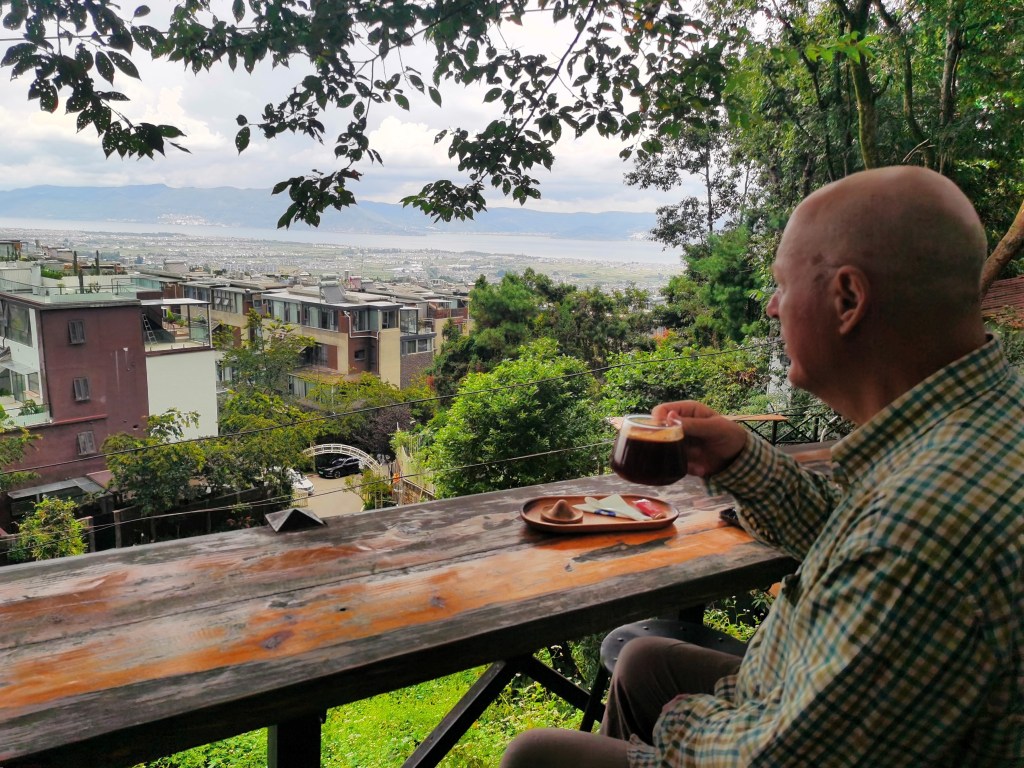
Again, let’s maintain perspective. These more specialized personal and social freedoms regarding sexuality and recreational drug use, which may be taken for granted in certain developed countries, are not tolerated in many others, not only China. One can always go to the Netherlands, Spain, Canada, Brazil, or Thailand. Your average Western traveler doesn’t need them and would never notice their absence in China. For the internet, get a VPN. Don’t worry about the Chinese government possibly having access to some of your cellphone’s data; they’re not going to do anything to you. Enjoy your trip.
Works cited:
Alcock, Rutherford. The Journey of Augustus Raymond Margary, from Shanghae to Bhamo, and Back to Manwyne (London: Macmillan & Co., 1876).
Ash, Alec. The Mountains Are High: A Year of Escape and Discovery in Rural China (London: Scribe UK, 2024).
Connolly, Bruce. “Dali in 1995: A personal ‘Heaven on Earth,’” China Daily (12 Oct. 2018). [https://www.chinadaily.com.cn/a/201810/12/WS5bc0387aa310eff3032820b5_1.html]
Dingle, Edwin John. Across China on Foot: Life in the Interior and the Reform Movement (New York: Henry Holt & Co., 1911).
Gan, Nectar. “China is installing surveillance cameras outside people’s front doors and sometimes inside their homes,” CNN, 28 Apr. 2020.
Gill, William. The River of Golden Sand: Being the Narrative of a Journey through China and Eastern Tibet to Burmah (London: John Murray, 1883).
Goullart, Peter. Forgotten Kingdom: Nine Years in Yunnan, 1939-48 (London: John Murray, 1957).
Hansor, Robert. “Is Beijing’s Gubei Shuizhen authentic? A designed delight that works.” Substack, 5 May 2025. [https://robhansor.substack.com/p/beijings-gubei-shuizhen]
“Interview: Chris Taylor, author of Harvest Season,” Wild China (23 Feb. 2011). [https://wildchina.com/2011/02/chris-taylor-author-harvest-season]
Johnston, Reginald Fleming. From Peking to Mandalay: A Journey from North China to Burma through Tibetan Ssuch’uan and Yunnan (London: John Murray, 1908).
Leffman, David. A Murder in Yunnan: The Unsolved Killing of a British Diplomat on China’s Southwestern Frontier (Hong Kong: Blacksmith, 2026).
Notar, Beth E. Displacing Desire: Travel and Popular Culture in China (Honolulu: U Hawai’i Press, 2006).
Notar, Beth E. “Producing cosmopolitanism at the borderlands: Lonely Planeteers and ‘local’ cosmopolitans in Southwest China.” Anthropological Quarterly, 81(3): 615-650. [https://www.jstor.org/stable/25488227]
Woodhead, Michael. In the Footsteps of Joseph Rock: Travels in Southwest China, 1990 to 2012 (no. pub., 2024).
* * *
Other posts in this series:
Insights into China, Part 1: A walk down the street
Insights into China, Part 2: A meal in a restaurant
Insights into China, Part 3: A stay in a hotel
Insights into China, Part 4: A visit to the library
Insights into China, Part 5: An invitation to a party
Insights into China, Part 6: An afternoon in a café
Insights into China, Part 7: A glimpse inside a school
Insights into China, Part 8: An immersion in a museum
Insights into China, Part 9: A journey to the hinterland
Insights into China, Part 10: A vision in a concert hall
Insights into China, Part 11: A time slip to the glorious Qing
Also by Isham Cook:
THE TAO OF POISON
“The bold characters, kinetic plot, and rich sense of atmosphere make this epic tale a studied contemplation of how beauty can usher in tragedy and sorrow.” — BookLife Reviews by Publishers Weekly

 ISHAM COOK CHINA
Leave a comment