As I wrote in a previous essay, Music and totalitarianism, rock music has an unenviable history in China. Western popular music was banned for almost four decades after 1949, and today rock and pop music both domestic and international continue to be strictly controlled in terms of what lyrics bands are permitted to sing and publish and who can perform where. Not only is the overtly political forbidden, but anything evocative of youth discontent—rock music’s raison d’être—is risky, particularly if it references youth as a whole rather than the individual, that is, anything suggesting the younger generation has been let down by the Party. As a result, Chinese rock-music lyrics tend to be as benign, and banal, as those of Chinese pop music. Rock acts from abroad are only invited to perform after strict vetting. Those who violate Chinese Government injunctions with their support for Tibetan independence or other taboo flashpoints (Björk in 2008, Oasis in 2009, Elton John in 2012, among others) earn bans or make things difficult for subsequent invitees. As for Chinese pop music, it’s a challenge to sort out the wheat from the chaff—the few singer-songwriters of genuine individuality and talent, not to mention daring, amidst the unending blight of assembly-line pop clones.
While it can certainly be said that the progress and contradictions in Chinese society’s grudging acceptance of rock and pop music, in the decades since these musical genres have been allowed, serve as a barometer of the country’s emergence into a more mature cultural relationship to the world, it is in fact the Western classical music scene that is more revealing of the country’s transformations.
What could classical music possibly inform us? Rock music produces strong, spontaneous reactions from audiences—and in inflammatory cases, from the Chinese Government itself. Classical music seems to elicit only polite applause behind its staid scrim of genteel respectability. It is also scandal-proof against political provocation (well, not completely, as we shall see). Contrary to this stereotyped view, however, Chinese audience reactions to classical music are in fact highly telling, in subtle and not-so-subtle, indeed bewildering ways. Also important for understanding classical music’s place in Chinese society are the sheer quantity and quality of purpose-built concert halls, the huge administrative apparatus bringing music to these venues, and professional training opportunities for gifted musicians. All paint a lively, burgeoning picture of classical music in China.
My own angle on this topic derives from over thirty years of attending concerts in the country. I divide this span of time into three periods, roughly corresponding to the leadership eras of Jiang Zemin (1993–2003), Hu Jintao (2003–13), and Xi Jinping (2013–present).
PERIOD 1 (1990-99): INCOMPREHENSION
In the 1990s, people lived in cramped apartments with fluorescent-tube lighting and bare concrete flooring in mud-gray walk-up tenements. Restaurants resembled apartments and were indistinguishable from one another. Apart from five-star hotel lobbies open only to their foreign guests (and prostitutes with connections), teahouses and coffeehouses didn’t start cropping up until later in the decade. The few bars were either pseudo-ritzy karaoke brothels for businessmen or informal brothel “cafés.” Young couples had sex in park bushes at night as other options for privacy were usually lacking. Most people could not afford a computer. They communicated with pagers, which were called beepers. Bicycles still dominated the streets, but people could get a driver’s license under-the-table with no need for a driving test, and buy joint-venture manufactured cars. Foreigner sightings were rare. Corruption was rampant.
It was also in this decade that old concert halls were being renovated and a few new ones constructed. In 1995 I attended my first classical concert in the country, at the 1,713-seat Century Theatre (built in 1990) in Beijing’s Chaoyang District, where the international business scene was then budding. Across the concert hall on Liangmaqiao Road was a row of makeshift restaurant shacks where one could eat before the concert. There were few places to hang out after the concert, though the nearby Kempinski Hotel had recently opened the Paulaner Brewery, Beijing’s first German-style, genuine craft-beer restaurant.
On the program was Gustav Mahler’s epic Second Symphony, performed by the China National Symphony Orchestra under the baton of American Gilbert Kaplan. At the time, I had never heard of Kaplan. Later I saw some less-than-flattering news articles about him. A wealthy businessman with no professional classical training, he possessed a fervent, obsessive passion for this particular work (he owned the autograph manuscript of the score) and conducted it exclusively and relentlessly, eventually notching up over 100 live performances and two recordings with the London Symphony Orchestra and the Vienna Philharmonic. The view among classical critics was that he had financially inveigled his way into the privilege of conducting major orchestras and conducted stiffly. Indeed, the idea that a conductor could conduct only a single work by a single composer throughout his entire career was extremely weird. It’s insulting to classical music, which is breathtaking in its variety. Mahler’s Second is a great symphony but so are other symphonies by Mahler, not to mention innumerable symphonies by other composers.
At the time, anyway, it was nice to see a live performance of the work, with its massive chorus and earth-shaking brass, in culture-starved Beijing, though it was hard to gauge how the audience took in the piece. Few had likely heard a recording of it or even knew who Mahler was. It was fairly well attended but the front rows were empty. They were customarily reserved for company work units as gifts to hand out to their employees, again with little likelihood anyone involved had the slightest notion of what sort of event it was and thus saw no reason to attend.
After all, the country still had little acquaintance with classical music. In city parks in those years, loudspeakers blasted out Richard Clayderman’s easy-listening piano arpeggios, his saccharine versions of Schubert and Chopin. People told me they thought Clayderman was Western classical music.
At the concert’s end, the audience clapped politely but listlessly before immediately dispersing. Meaningful clapping wasn’t a concept, to say nothing of the standing ovation or encore. Many of those attending were old enough to have gone through the Cultural Revolution, when all of Western music was banned and only eight Chinese “model operas” allowed and played over and over in factory workplaces (private radios weren’t permitted). Western classical music has a long history in China, going back to Jesuit priest Matteo Ricci’s gift of a clavichord to the Wanli Emperor in 1601, but had been systematically wiped out in modern times for a whole generation of Chinese. Here is not the space to go over this history, which has been eloquently covered in Sheila Melvin and Jindong Cai’s Rhapsody in Red: How Western Classical Music Became Chinese (Algora, 2004).
Yet the tide was starting to turn and interest was mounting. One shop I recall in Beijing selling music CDs and cassettes had a respectable beginners’ selection of classical music. An image is frozen in my mind of an attractive young female who was pouring over some cassettes by J. S. Bach behind the glass cases in which shops at the time displayed their goods.
You may have heard of the documentary From Mao to Mozart, about violinist Isaac Stern’s 1979 visit to Beijing’s Central Conservatory of Music and the Shanghai Conservatory of Music soon after the country’s opening up under Deng Xiaoping, which won the Academy Award for Best Documentary Feature in 1981 (available on YouTube). In the follow-up documentary, From Mao to Mozart—Isaac Stern Returns to China, 20 Years Later (2000), Stern gives masterclasses to three string quartets, a piano trio, and an orchestra at the Central Conservatory of Music during preparations for the Second Beijing Music Festival in 1999. The musicians are not named (except for several soloists who appeared in both documentaries), other than being “students from the Central Conservatory.” In fact, the quartet Stern is seen coaching at the start of the film is the Tangula Quartet from the Shanghai Conservatory, two males and two females, all nineteen years old. I know this because I saw them perform at the festival at the Jinfan Concert Hall. This was my first chamber music concert by a Chinese ensemble, and I was a bit worried about their capabilities. On the program were quartets by Haydn, Brahms, and Ravel—serious stuff.
One reason the concert has stuck in my memory is that the two females, second violinist Hou Ye and cellist Jin Jie, were ravishing in their body-hugging black qipaos. All four seemed more relaxed than they had appeared in the documentary, with the camera and Isaac Stern, friendly though he was, no longer hovering over them. The other reason is that they sailed through the three works with expertise and elan. I was blown away. They also didn’t seem in the least perturbed that the audience, acting as if they were there by mistake, hesitantly at first then inexorably emptied the hall in the midst of the performance. Now I was appalled. Just a few people held out till the end, feeling sorry for the quartet perhaps, and even they only pretended to clap, their limp hands making no sound, before they filed out. If the musicians weren’t perturbed, it was because they knew China wasn’t quite ready for chamber music. Why go see a couple of string players when you could see a whole orchestra?
Melvin and Cai relate a similar reception in Guangzhou, also that year:
Because the concert was given by the renowned Julliard String Quartet, it drew a large crowd, most of whom had evidently never before attended a chamber concert and many of whom clearly did not often attend classical concerts of any sort. It got off to a bad start when late-arriving audience members forced their way into the concert hall after the performance had started and then climbed over seats to get to the best ones. The situation quickly went downhill when “the entire audience dispersed after the first work, interpreting the brief break as an intermission.” The Julliard musicians were so upset by the audience’s departure that “they argued among themselves as to whether the concert should go on.” They decided to continue, but “during the second half of the program, Smetana’s From My Life quartet, the performance was halted by a beeper in the audience. The musicians were willing to finish only after order was restored.”
Another chamber performance I attended in those years by members of the Central Conservatory was confronted with similar audience incomprehension. They had prepared for a stolid audience reception, or at least they thought so, giving little lectures about each piece—several Mozart piano trios—before performing them. Nevertheless, at the end of the evening, when the audience was invited to air their impressions, two women stood up, one after the other, and angrily expressed their disappointment that the musicians hadn’t played music they were already familiar with. What Mozart music were they familiar with, I wondered, Eine Kleine Nachtmusik? Or was it Richard Clayderman they were referring to?
PERIOD 2 (2000-9): ENTHUSIASM
At the turn of the century, residential housing and restaurants discovered decor, though garish, faux-rococo and mass-produced, devoid of character. Teahouses and bars open 24/7 had private rooms where couples could have discreet sex, though from 2003 hotels began allowing unmarried couples to room together for the first time. Coffeehouses were sprouting up like mushrooms (including both real and fake Starbucks), with the country’s newfound interest in coffee. Everyone now had a personal computer and a Nokia or a hinged Samsung cellphone. Massive traffic jams occurred at intersections as drivers only reluctantly grasped that they could reach their destination faster by obeying traffic lights. Car exhaust and factory production caused serious air pollution. In 2007, to send a message, the government executed the director of the State Food and Drug Administration for corruption involving adulterated food products. This was followed by the 2008 melamine scandal, a fake protein substitute in baby formula that sent 54,000 infants to the hospital. The 2008 Beijing Olympics was brought off to acclaim. The foreigner populations exploded in Beijing, Shanghai, Guangzhou, and Shenzhen, both tourists and those on legit or shady business or working visas.
Recalling its glory days in the International Settlement and French Concession in the 1920s–30s, classical music was gathering force in Shanghai, with the 1998 opening of the 1,631-seat Shanghai Grand Theatre. While Beijing was razing whole neighborhoods of hutong lanes to make way for high-rise developments and imposing office buildings, three new concert halls popped up that changed the equation for the city’s classical music scene. The Beijing Concert Hall, formerly the Central Cinema built in 1927, opened for classical music in 1986, but it was not until its 2004 renovation that this 1,024-seat gem of a hall started attracting audiences with its discerning programming. A twenty-minute walk away via Tiananmen Square was the 1,419-seat Forbidden City Concert Hall, originally built by the Japanese in 1942 but renovated not until 1999. There in 2001 I saw Tang Muhai conduct a concert version of Pietro Mascagni’s opera Cavalleria Rusticana with the China Symphony Orchestra to stunning, roaring applause. Overnight, it seemed, the Chinese had learned how to applaud not only properly but passionately.
The Forbidden City Concert Hall also boasted superb acoustics. Wherever you sat, you could pick out the individual instruments with intimate clarity, as if poised in different positions in space just in front of you. The only other concert hall where I recall such remarkable sonic imaging was the 3,800-seat Louis Sullivan Auditorium in Chicago, built in 1886. The modern science of acoustics is now employed wherever new concert halls are built. Fine acoustics couldn’t come soon enough. Peking Opera, which I also frequently attended, was still using Soviet-era entertainment technology. Whatever the venue, screechy loudspeakers amplified the singers so painfully that I had to stuff balls of tissue in my ears, if I didn’t walk out first.
It was a curious incident at a performance I attended in 2004 at the 1,428-seat Poly Theatre (built in 1991 and renovated in 2001) which suggested that audience appreciation was improving by leaps and bounds. The concert hall, which doubled as an opera house, was the new home of the annual Beijing Music Festival. Back in 1999, I had met a Chinese woman in the personals section of an English-language magazine (when we still used magazines to meet people), who was seeking an Italian man interested in classical music. As an American, I only fit half the bill, but she agreed to meet and we soon became friends. Li Ming happened to be a key liaison person for the Beijing Music Festival. Her job was to escort bigwig musicians flown in to perform at the festival and dole out free tickets to friends and contacts (you can see her in the From Mao to Mozart…20 Years Later documentary, opening the door for Mr. Stern in his chauffeured car at the Conservatory of Music). I thus became a regular attendee.
The ad for one upcoming concert, entitled “L’Orfeo” with no other information, caught my attention. They still needed to work on nailing down the identity of composers, so paramount in Western classical music. In Chinese classical music, long passed down orally, composers were anonymous and forgotten; only the names of works survived. This belittlement of the artist was inherited by Western classical fans in China as well, with a key difference. A select group of the most famous composers were deemed worthy of an identity. They hovered in timeless space like gods, bereft of historical context, such as the defining musical periods (Baroque, Classical, Romantic, etc.). Apart from the late-Baroque composers Bach, Handel, and Vivaldi, Early Music (the Medieval, Renaissance, and Baroque eras) was beyond the pale. I couldn’t believe they were performing Claudio Monteverdi’s opera, composed in 1607, the first opera and a milestone in the history of Western music. It wasn’t until I received the program notes at the concert that I learned who the musicians were: the renowned New London Consort under Philip Pickett. Sadly years later, in 2015, Pickett was convicted of rape and sentenced to eleven years in prison, but at the time he was going strong.
Outside the hall after the performance, which as expected was outstanding, an excited man came running up to my Chinese female companion, chosen at random, telling her, “Miss, do you have any idea how extraordinary this concert was? You will probably never see a performance of this caliber in China again!” Whether he knew anything about Monteverdi, the force and quality of the music clearly hit him like a bombshell.
In other Beijing Music Festival highlights, the world premiere of contemporary American composer Philip Glass’s Cello Concerto was held in October of 2001, with cellist Julian Lloyd Webber; Glass himself decided not to attend over fears of flying in the wake of the 9/11 terror attacks. The year 2005 saw the first complete cycle in China of Richard Wagner’s four-opera Ring cycle, conducted by Philippe Auguin with the Nuremberg Philharmonic Orchestra. In another first, in 2007 German conductor Klaus Weise delivered a concert version of Wagner’s Tristan und Isolde with the China Philharmonic Orchestra. In 2008, the Poly Theatre staged Wagner’s Tannhäuser under Peter Schneider and the Orchestra of the Deutsche Oper Berlin. The foreign female dancers in the bacchanalian Venusberg scene were, appropriately, topless. While nude dancers in opera are not uncommon in Europe and North America, this was probably the first and only occasion in China where bare breasts were allowed in an artistic performance. It’s unclear whether this had been cleared with the authorities or was sprung on them. No one in the audience, including myself, seemed to mind.
Before we jump into Period 3, one more anecdote, illustrating the continuous honing of domestic musicians’ talents. In 2005 I attended a master class at Beijing’s Central Conservatory by the Croatian pianist Ivo Pogorelić, a favorite pianist of mine whose albums I had collected for years. A graduate student pianist, Gong Jing, was chosen to perform Beethoven’s “Appassionata” Sonata, an unimaginative if understandable choice for someone wishing to display his prowess. Tall, devilishly handsome Pogorelić strolled in. Now 47, the wild mane of hair of his youth was gone and he wore an embroidered kufi over a crew cut. He moved with a deliberate grace, announcing in his deep resonant voice that fresh air was needed in the stuffy room as he proceeded to open the window. He sat with us in the audience during the student’s rather mechanical but proficient-enough performance, marking up his copy of the score at various points. At the end, he made one select point for everyone’s benefit but made it thoroughly. He stood behind the pianist and with his hands on his shoulders, showed him how to sit with a posture that channeled natural strength through the body and arms rather than attacking the keyboard solely with the hands. Pogorelić sat down at the piano and a sonorous chord materialized at his slightest touch. Then it was time for a more detailed critique in private. He wore a kindly expression as he unhurriedly followed the nervous pianist into another room.
Pogorelić performed a few days later at the Eighth Beijing Music Festival. The key work on the program was Robert Schumann’s dense, knotty Fantasie in C. His torso writhed and crawled over the piano like a strange animal, occasionally looking up into the distance with his dreamy eyes. It was a powerful display.
PERIOD 3 (2010-present): SOPHISTICATION
The Chinese are dressing better, with more style and taste, bringing out their individuality. Less exclusively obsessed with money due to rising living standards, they are becoming friendlier and more personable. Tea and coffeehouses are more elegant and comfortable. City metro and high-speed railway systems are rapidly expanding. Just about everyone has an iPhone, but Huawei will soon be a major competitor. Air pollution is hitting crisis levels, and the government is finally acknowledging the problem and cleaning up the tourist cities, at least. The Chinese are traveling abroad in record numbers and bringing back luxury goods—and new ways of thinking. Beijing’s brewpubs and the classier pizza joints, many run by foreigners, are as good as anywhere abroad. Video surveillance cameras eerily proliferate in every street and public building, but it’s accompanied by a noticeable drop in crime. Even backwater cities are getting into the act with beautification campaigns. It’s quite stunning how they have been morphing from bleak concrete jungles into positively attractive urban spaces. I am writing this in the present tense because although these developments began a decade and a half ago, they are still going on.
China is already a contender for world-class concert and opera halls. Ground was broken in 2001 for the mammoth National Centre of the Performing Arts (NCPA) in Beijing (1,859-seat concert hall, 1,035-seat opera house, and 556-seat theater), designed by French architect Paul Andreu, which opened in 2007. Ground was broken in 2005 for the magnificent 1,804-seat Guangzhou Opera House, designed by perhaps the most famous architect in the world at the time, Zaha Hadid, and opened in 2010. With the country’s penchant for grandiose vanity projects, great displays of form without content, I was concerned the spectacular NCPA was just for show and no one would be bothered to manage the place and set up a stable repertoire of programs and concerts.
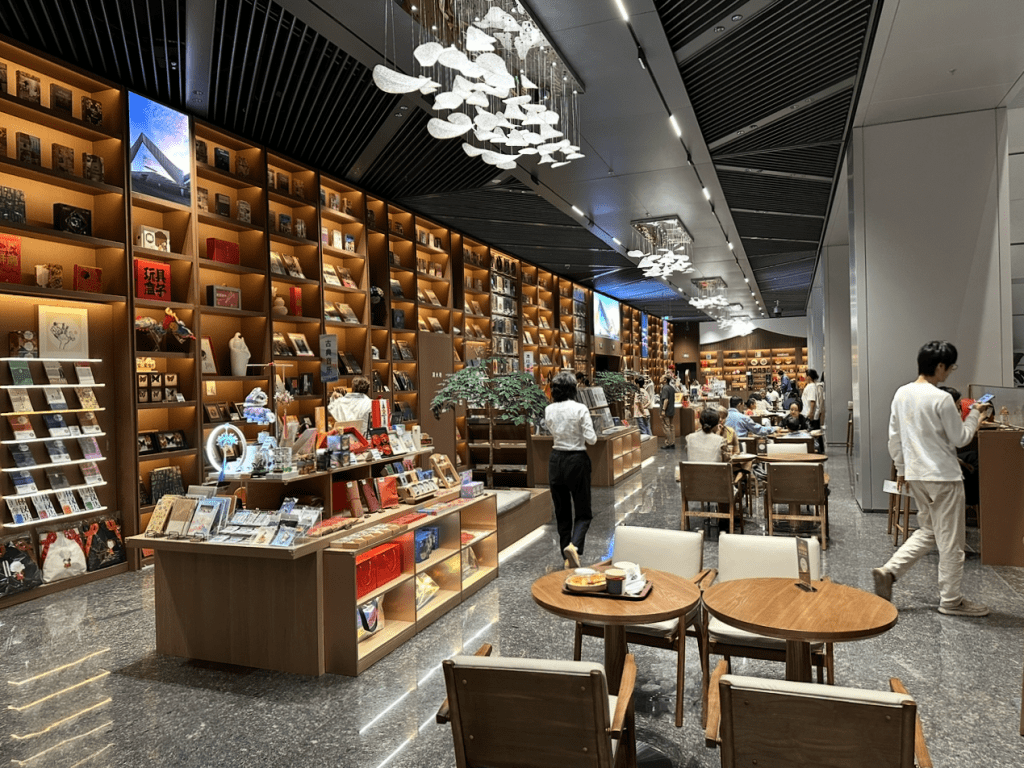
I’m proven wrong. A gleaming titanium bubble sitting on an artificial pond, the “egg” is entered through an underground tunnel beneath the water and opens into a vast wood-paneled atrium enclosing the concert hall, opera house, and theater in a single glance. A well-stocked shop sells books, CDs, and classical-themed gifts, and cafés at opposite ends of the enormous lobby serve sandwiches, acceptable coffee, and wine (a strict policy forbids smuggling in one’s own food). The performances are numerous and first class. To list just a few among the many I attended: Bernard Haitink conducting the Haydn 101st, Bruckner Seventh, and Mahler Sixth with the Chicago Symphony Orchestra in 2009; the Old Vic Theatre from the UK staging Shakespeare’s Richard III in 2011; and the NCPA’s own production of Wagner’s Flying Dutchman, directed by Giancarlo Del Monaco with the NCPA Orchestra in 2012 and 13. Russian conductor Valery Gergiev and Polish composer Krzysztof Penderecki were frequent guests, the latter conducting his own and other works.
Still more adventurous offerings were taking place over at the Forbidden City Concert Hall, which had been cooperating with various embassies to bring in exotic troupes to educate the Chinese public on Early Music. I attended, among other concerts, the French ensemble Le Poème Harmonique in 2009 and the Canadian ensemble Les Voix Humaines in 2015, both performing music of the French Early Baroque. At the latter concert, the bass viola da gamba player had left her instrument on the stage during intermission. A couple classical-music students came up to examine the unusual instrument, somewhat resembling a cello but with a fretted fingerboard and five rather than four strings—a cross between a cello and a guitar. The viola da gamba and the guitar have a common ancestor in the fifteenth-century vihuela, and the viol family predominated in the Renaissance and Baroque until superseded by the violin family in the Classical era.
Today many troupes in the West specialize in Early Music, and countless high-quality recordings are available that unveil the beauty of original instruments; the curious may refer to my John Dowland and the lost English Consort School of chamber music. Incidentally, the Chinese manufacture viols and other ancient Western instruments to the highest standards and at lower prices than in Europe. Markku Luolajan-Mikkola of the Germany-based viol consort Phantasm plays a Chinese-made bass viola da gamba, for example (personal communication with the group’s founder Laurence Dreyfus).
It all came crashing down in January 2020 when Covid-19 hit. Public performances throughout the country were halted for the first year or two, before provincial governments cautiously allowed them back once the virus was thought to be under control. But everyone at classical concerts was required to wear a face mask, and I had no desire to sit through several hours of music with the hot encumbrance on my face. I had also moved to Ningbo for employment, a large city on China’s east coast but a classical-music backwater. I couldn’t attend a proper performance again until 2025, Tristan und Isolde at the Shanghai Grand Theatre, a co-production of the Shanghai Opera House Symphony Orchestra, the Orchestre de Paris, and the Gewandhausorchester Leipzig. I was pleased to note that the seats remained filled for the entire five-hour performance. Audience attrition in Wagner operas can be a problem even in the West.
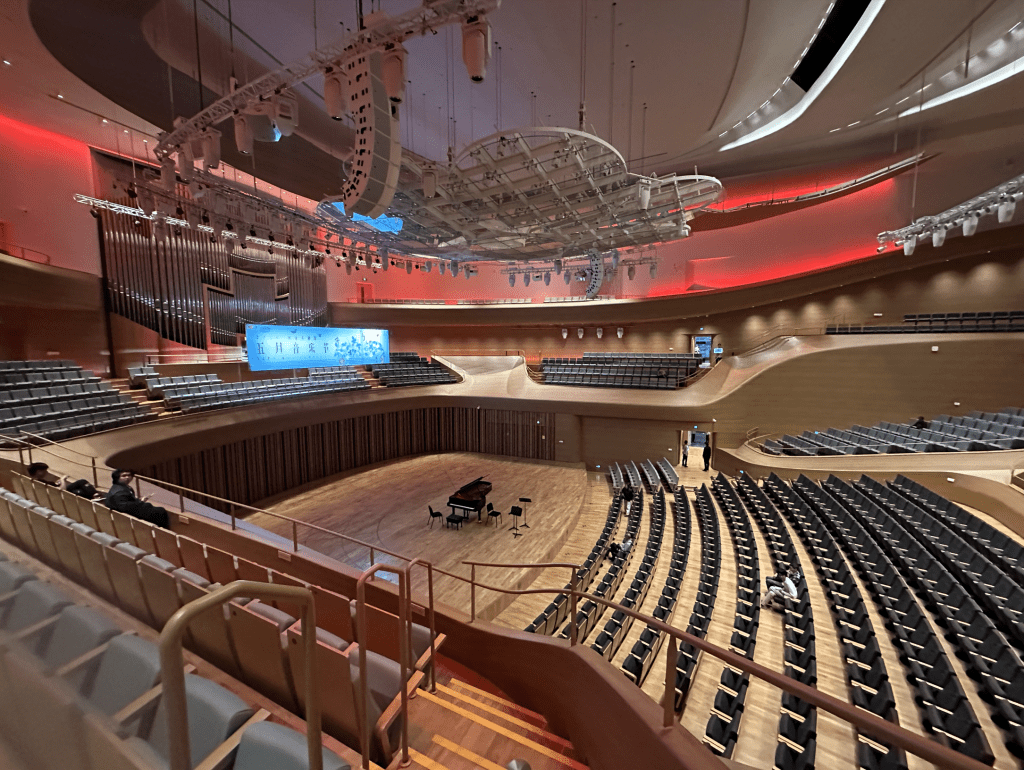
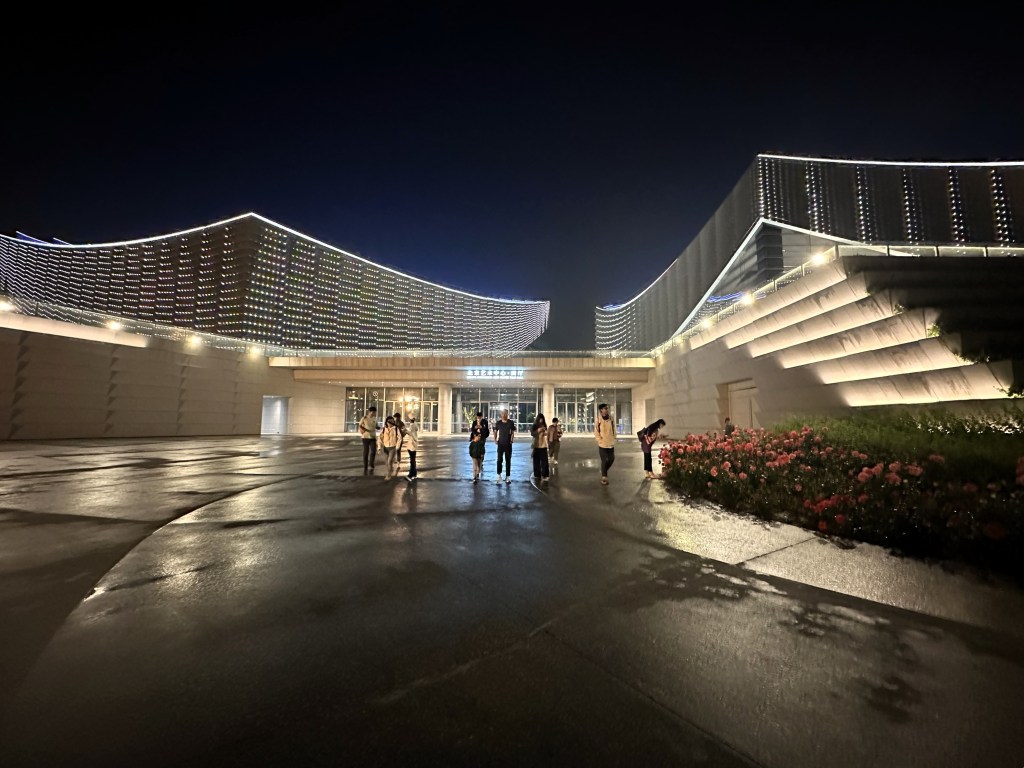
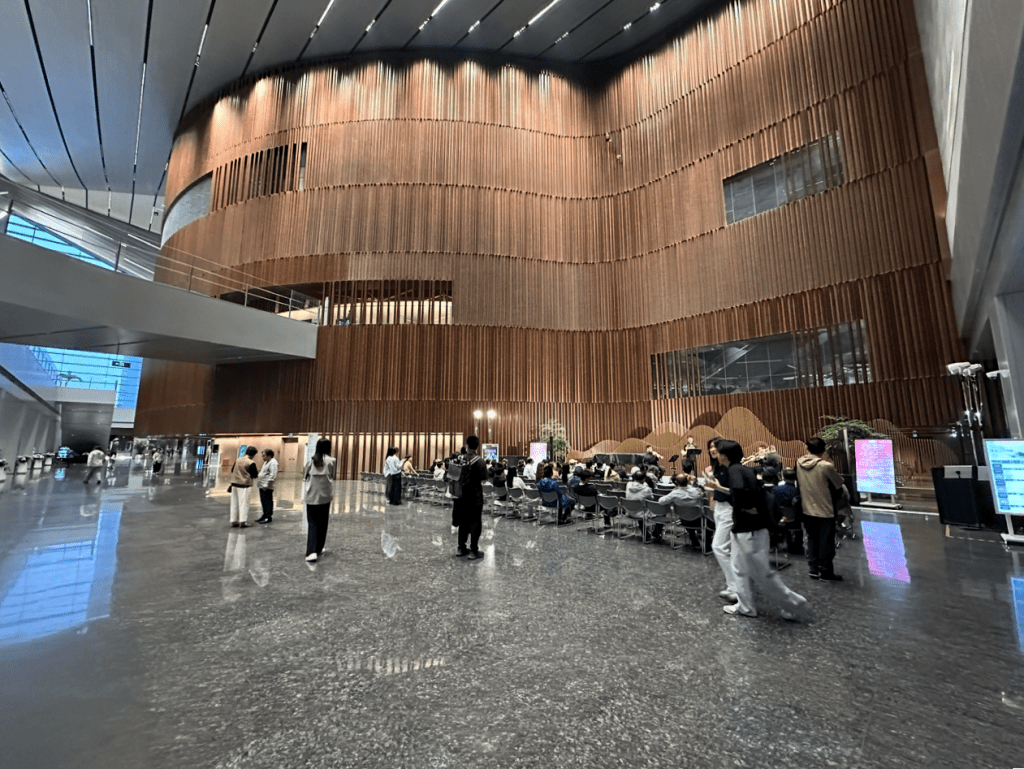
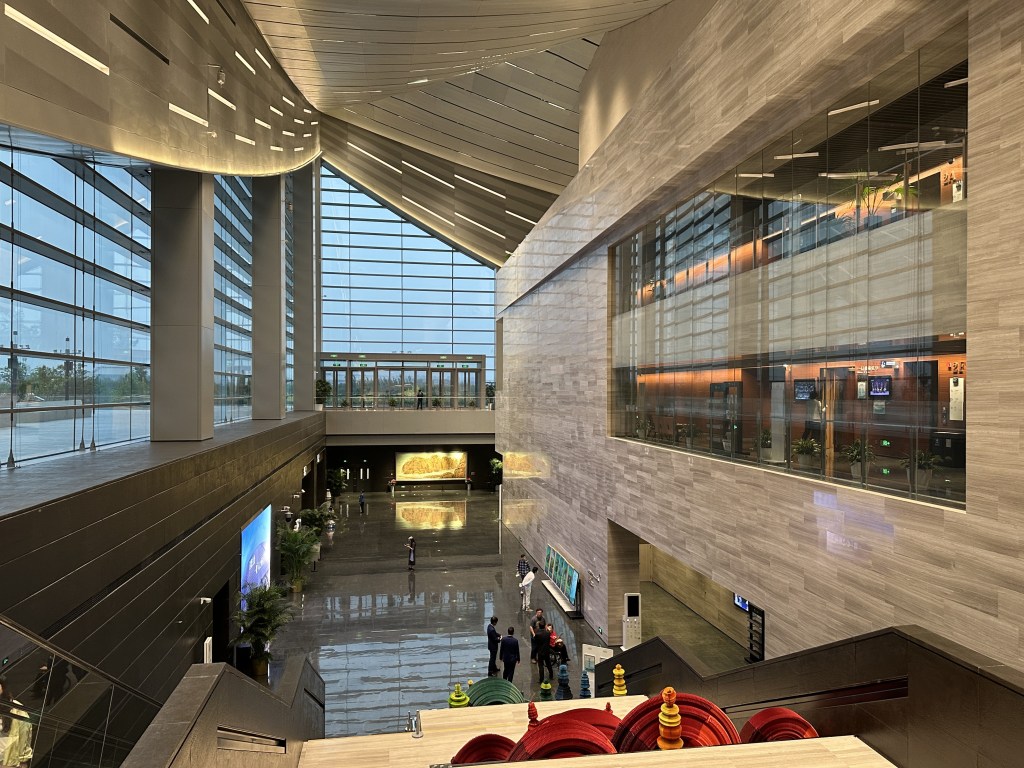
Back in Beijing for a visit in mid-2026, my excitement returns at the prospect of a concert at the spanking new Beijing Performing Arts Centre, unveiled in 2023 in the suburb of Tongzhou thirty kilometers to the east, a “small” city in its own right (pop. 1,850,000), where the municipal government is in the process of moving most of its operations to reduce congestion in Beijing. To persuade people to move there, the government spruced up the Grand Canal scenic area, built a museum devoted to the historic canal, and nearby, the stunning new Beijing City Library. The Performing Arts Centre is a huge continuous structure devised by a team of foreign and Chinese architects, housing a 1,600-seat concert hall, a 1,000-seat opera house, and a 500-seat theater—in scale only slightly smaller than the NCPA in the Capital.
On the program is a marathon Brahms concert of all three of his piano quartets by the Berlin Philharmonic Piano Quartet. The three quartets are substantial works and seldom executed in one sitting; it’s the equivalent of an orchestra doing three Brahms symphonies in the same evening. The audience is as quiet as in a library, with nary a cough, and they give the musicians a standing ovation at the end. The cellist thanks the audience for their patience over the “long evening.” For an encore, they recount how an admiring Brahms visited Schumann as a young man to learn his compositional secrets, before playing a movement from a Schumann piano quartet. The acoustics in the concert hall are excellent, though as I am up front in the eighth row, the instruments are merely loud and clear; I would need to sit farther back to ascertain the quality of the house’s sonic imaging.
CONCLUSION: A VISION OF THE FUTURE
John Adams, whom I regard as the preeminent contemporary American composer after Philip Glass, turned President Nixon’s ground-breaking 1972 visit to China into an opera, Nixon in China, composed in 1984. It’s an odd subject for an opera, but he succeeded and the work is performed around the world in the more adventurous opera houses. Unanimously considered to be a great opera, it may never be performed in the People’s Republic, at least in the near future, not due to anything objectionable in the opera’s content—it paints largely sympathetic and humane portraits of both Nixon and Mao—but the subject matter is too recent in Chinese history to allow anyone to comment on the Mao era outside the official narrative. It doesn’t matter how pro-Chinese or pro-Mao the opera is; the very attempt to provide another perspective on this history is in the Chinese Government’s perspective taboo.
The government is certainly aware of the work. A China Daily article back in 2011 (since deleted or suppressed) raised the possibility of getting it performed in China. An American blogger gathered everything she could on the controversy and cites a Chinese commenter familiar with the opera, “My god, this period of history. Old U.S. knows it more deeply than we do.” Another China Daily article (now on ChinaCulture.org) that came out the same year (and may have replaced the earlier article), in classic Chinese news-media fashion, reviewed the premiere performance of Adams’ “masterpiece” at the Metropolitan Opera in New York without once making the obvious connection to the possibility of a performance in China. The mere appearance of this article, though, was a tacit acknowledgment that it’s on some government back burner, if a distant one.
Western classical music in China has come a long way since the Cultural Revolution, when Mao’s wife, Jiang Qing, caused an enormous headache for conductor Eugene Ormandy and the Philadelphia Orchestra upon arriving in Beijing for their momentous 1973 concert at the Great Hall of the People, following upon Nixon’s visit. She didn’t want Beethoven’s Fifth Symphony to be on the program, already scheduled and rehearsed, since it was about “fatalism.” She proposed instead the Sixth Symphony on the grounds it was about nature and the countryside, though her lackeys protested it was really about rural folk’s bondage to landlords and the feudal class and was thus as unacceptable as the Fifth. More problematically, the orchestra lacked the scores for the Sixth, which had to be dredged up from conservatory storage somewhere. In the end a compromise was reached and both symphonies were performed.
I mention the Nixon in China conundrum because it’s a synecdoche for the entire repertoire of Western classical music permitted in China today. While countless works have been aired in the media and performed on the nation’s stages, it’s unknown how many more have not been allowed for one inscrutable reason or another.
In such an atmosphere, it’s understandable why China’s greatest living composer, Tan Dun, emigrated to the U.S. in 1986, where he has flourished (Philip Glass and Tan Dun). He has returned to his homeland on plenty of occasions to perform his works. It is interesting, however, that his opera, The First Emperor, which received its world premiere at New York’s Metropolitan Opera in 2006, has not yet been performed in China (though a symphonic version was given in Xi’an in 2023). Qin Shi Huang (259–210 BCE), China’s first emperor, is remembered fondly for unifying the country but is also infamous for burying 460 scholars alive for possessing banned books. I can’t help but sense that this historical association over two millennia ago is behind the refusal to stage this opera today. Let’s hope I’m proven wrong.
* * *
Other posts in this series:
Insights into China, Part 1: A walk down the street
Insights into China, Part 2: A meal in a restaurant
Insights into China, Part 3: An invitation to a party
Insights into China, Part 4: A stay in a hotel
Insights into China, Part 5: A glimpse inside a school
Insights into China, Part 4: A visit to the library
Insights into China, Part 7: An immersion in a museum
Insights into China, Part 8: An afternoon in a café
Insights into China, Part 9: A journey to the hinterland
Insights into China, Part 11: A timeslip to the glorious Qing
Insights into China, Part 12: An idyll in paradise
BUY THE BOOK. FORTHCOMING THIS FALL:
At the Police Café: China in Twelve Scenes


Leave a Reply