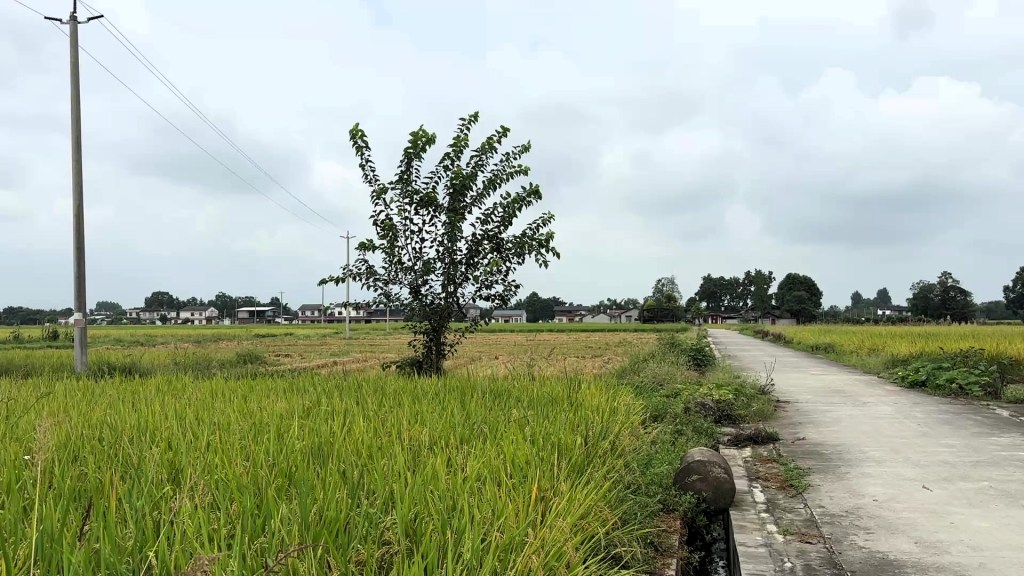
THE COUNTRYSIDE IS EVERYWHERE
Consider a few statistics. China’s urban population today dominates its rural population by two to one, 944 million to 465 million (2025 figures). The urban total of 944 million includes a so-called “floating population” of 376 million migrant workers from rural areas, who are officially counted as urban as long as they reside at least six months of the year in a city. This represents a dramatic change and reversal from three decades ago, when in 1995 the urban population was 30% and the rural population 70%. The migrant floating population was significantly less then but still substantial, estimated to have been between 53.5 to 80 million, up from 40 million in 1985 (the estimates for 1995 are vague because census takers lacked adequate survey tools at a time when economic reforms caused the migrant population to surge).
In large cities today, the floating population can approach 40%, a rough national average. In Shanghai they’re counted as 40% of the city’s official population of 25 million, in Beijing 37.5% of its 23 million. It also varies from region to region. Chongqing’s city population is 18.53 million and its municipal (metropolitan) population 32.8 million. It’s unclear how many of its estimated 8.4 million migrants are living in the city proper or within the municipality outside the city. Similarly, the Pearl River Delta megalopolis has an estimated 86 million, and its four largest cities, Foshan, Guangzhou, Dongguan, and Shenzhen, which form an adjacent arc, 9.5, 15.1, 7.9, and 13.77 million respectively. The whole megalopolis is largely urban and people can commute from home to work almost wherever they live. There are no exact figures on the number of migrants, but their combined population in this four-city axis, not counted in their official city populations, is estimated to be as high as 40 to 50 million. That would mostly make up the difference for the whole Pearl River Delta (population data from DeepSeek and Wikipedia).
Data collection on the migrant population coming and going in the Pearl Delta region, and to and from other regions in the country, is well-nigh impossible. Even when migrants stay put in rural areas, they are officially counted as urban if they live in a town. Due to a quirk of conflicting definitions, a village becomes a town for administrative purposes when the population reaches 20,000, but for statistical classification purposes, it is counted as urban with only 3,000. In reality, many towns deep in the countryside are far larger—up to 200,000, when a town is considered a city (though the state can classify a town with a much smaller population as a city for legal or other reasons). Thus the countryside is a patchwork of urban and rural. And urban pockets within the countryside also experience daily migratory labor to and from surrounding villages and townships.
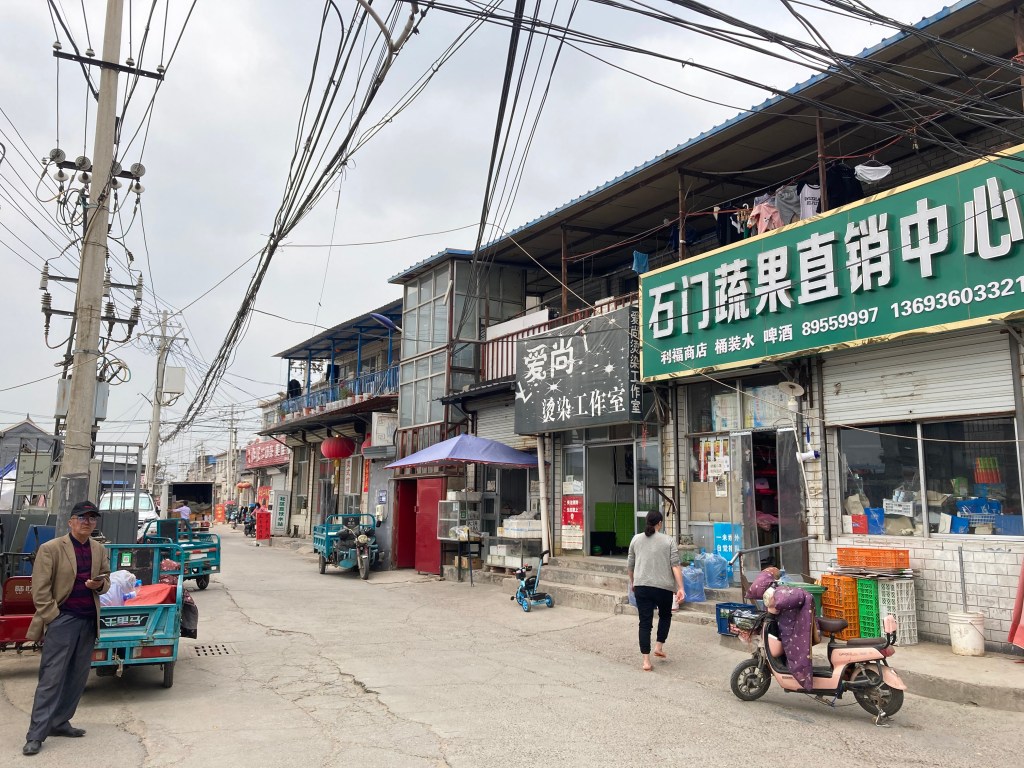
Cities too are a patchwork of urban and rural communities. Migrants reside in cheaper neighborhoods within the city limits or around the outskirts, often in makeshift prefabricated housing that is easily demolished when city authorities want them out. In the 1990s, for example, migrants poured into Beijing’s Daxing District—500,000 of them at its peak—and were evicted in turn in various anti-crime clean-up campaigns before the huge area was bulldozed in 2018 to make way for the Daxing Airport (Jane Hayward, “Building city walls: Reordering the population through Beijing’s upside-down villages,” Modern China 48(5), 2022). The migrants quietly return and flow into new neighborhoods like water. These “urban villages” can physically resemble rural villages to such an extent that migrants effectively set up the countryside in the city. Those who aren’t hidden away in factories, construction sites or transportation vehicles live and work in these migrant zones, serving their community, or make daily commutes to their city jobs in the service industry. They tend to have few educational credentials, if any. Some manage to pull themselves up by the bootstraps and get (relatively) wealthy—enough to buy a car and an apartment in the city.
Virtually every urban shop assistant, restaurant worker, hairdresser, and car mechanic you encounter, to mention just a few service jobs, hails from the countryside. The one-hundred to two-hundred thousand deliverymen on electric bikes in any first-tier city are from the countryside. Many office workers hail from the countryside: real estate agents and insurance salesmen at the lower end, accountants and bankers at the upper end. White-collar workers with high-paying jobs may come from the countryside if they bubbled up through a good university.
You can assume that most of the people you meet in Beijing, Shanghai, or any other major city are not locals. You can get a sense of just how many when the big cities empty out during the Chinese New Year and they all go back to their hometowns to join their families for a week or two. Some among this massive Spring Festival migration come from smaller cities and are urban by birth, others from the countryside. It’s hard to say which unless you ask them. Even that can be a tricky question, since many Chinese identify their adopted city as their “hometown” and may be reluctant to admit they’re actually of rural origin. And they can state with some justification that they are from their adopted city if they’ve been living there for decades. The countryside is an increasingly lonely place, its villages populated by grandparents and the grandchildren they bring up in their parents’ absence, and a dwindling number of farmers off in the fields.
Let’s have a quick tour of one migrant community in Beijing. From Henan Province, Yanyan was a massage worker in her thirties whom I met in a massage shop in my neighborhood near the Central Business District, eight years ago. The massage business tends to have a high staff-turnover rate, and shops themselves often close abruptly, typically due to rent increases. When her shop closed, she decided to work directly out of her apartment where she lived with her boyfriend, in the Shimen East Road neighborhood off the Sihui expressway interchange, also close to the CBD.
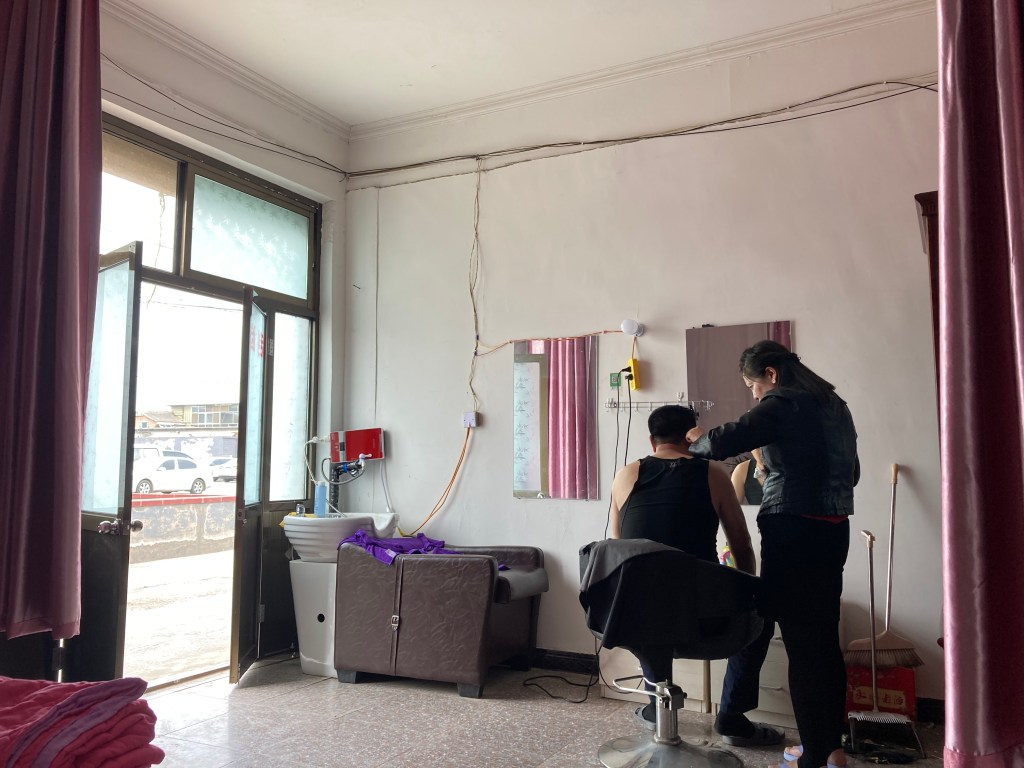
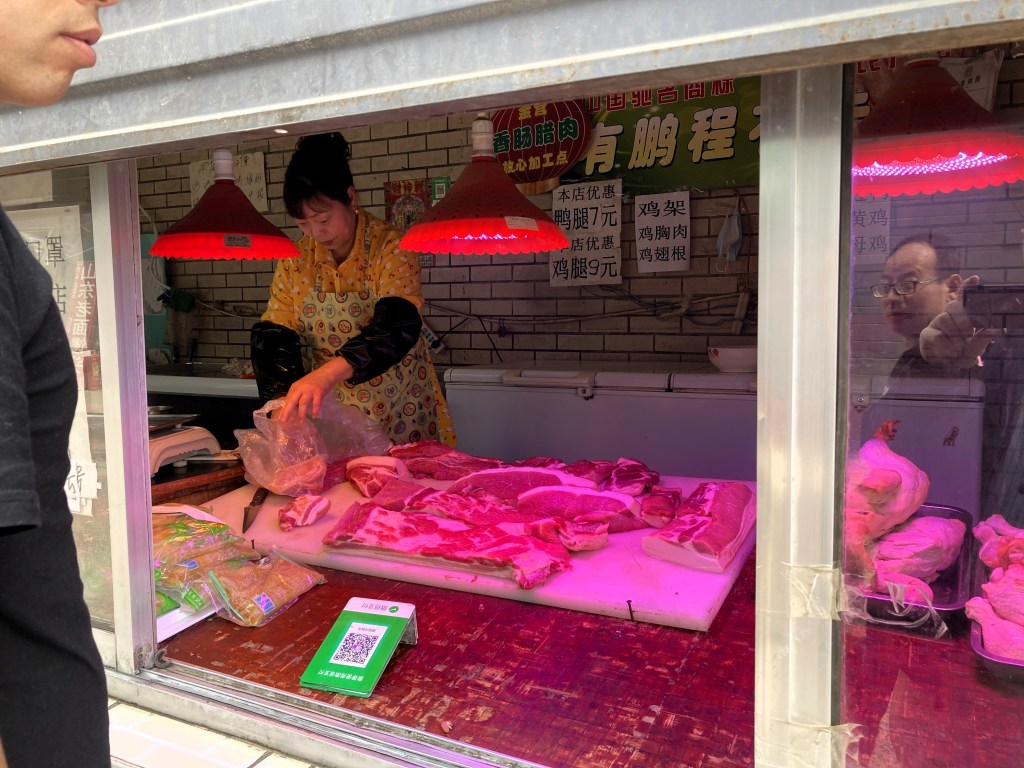
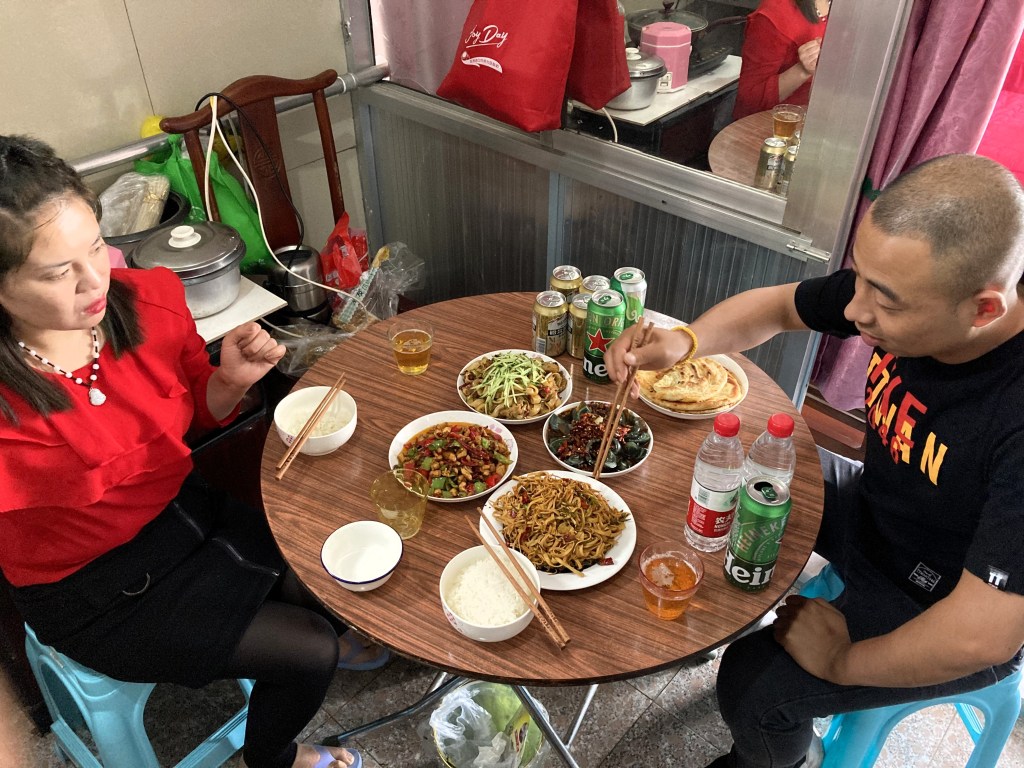
Yanyan invited me to visit her hair salon. She had neither shop sign nor registered address and drew customers by word of mouth. I used WeChat’s mutual location-finder to find her. She was cutting someone’s hair through the open doorway and led me inside. At one end of the bare salon was her customer, at the other a massage table and pull curtain. In back was a bedroom and a small dining space and kitchen cubicle. Her boyfriend, a truck driver, took me to the butcher’s nearby to buy some chicken; no need to kill and skin a chicken but I suspect he knew how to do that. While he prepared our lunch, she gave me a chaste rubdown behind the curtain, once her customer had left. He served us diced chicken with green peppers and chili, tofu skins with chili, “cold skin” noodles with cucumber and chili, preserved duck eggs, pancake-like shaobing buns, and beer. The meal was ordinary but cooked fresh, as is usually the case. Only harried urbanites resort to fast food or instant noodles.
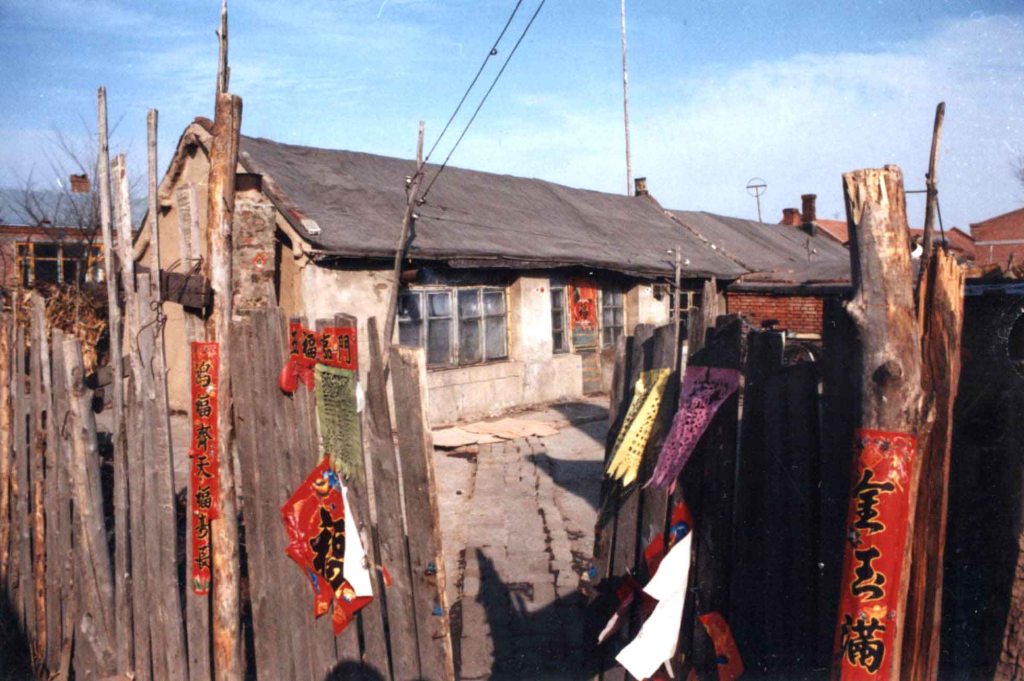
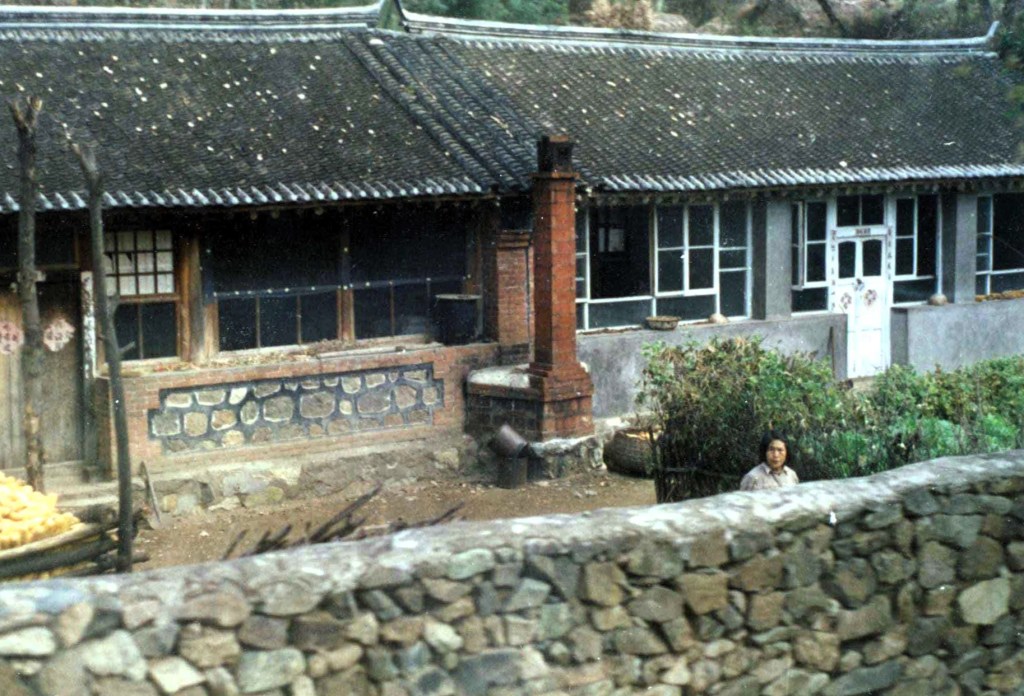
My first visit to a home in the Chinese countryside was back in 1999. Lixin, a librarian at the university in Beijing where I was teaching, was involved in the city’s migrant community, organizing and educating migrant women on their rights through community theater. Many had children attending underground schools, since as unregistered families they weren’t allowed to attend regular schools. Although Lixin, who had served in the PLA in her teens during the Cultural Revolution, was a Beijing native, she was staunchly egalitarian toward people of whatever background. One woman she got to know invited her to her hometown in Fengyang County in northern Anhui Province. Deng Xiaoping had singled out Anhui as one of the more impoverished provinces in need of development. Lixin took me and a female student along, and we arrived at the village by a minibus after an overnight train to Bengbu. Our hosts’ recently built two-story brick house stood out among the old stone huts surrounding a field with a few unfettered oxen. It was spacious enough to accommodate Lixin and the student in one guestroom and myself in another. In traditional rural homes in China, as the world over, animals are kept in the main ground-floor room and mingle with the family; the upper floor is for sleeping. The only thing distinguishing this house’s ground-floor room from the timeless past was a concrete rather than dirt floor; it resembled a garage more than a house. They kept the large doorway open and chickens and their chicks scurried about inside.
(In Chinese cities as well in the 1990s, most people’s apartments still had concrete floors. I once asked a professor friend why he didn’t cover his floor with a nice rug. He said dealing with a rug was so much trouble when it was easier to dump water on the floor and wipe it up with a mop. It wasn’t until the turn of the century that apartments discovered decor, and shiny white floor tiling and ceiling lighting more elaborate than bare fluorescent tubes became the norm.)
They placed a couple tables together to make a bigger table for dinner. I don’t remember the dishes except the food was surprisingly fresh and delicious, in contrast to many “home-style cooking” (jiachangcai) restaurants in Beijing—the Chinese equivalent of the American greasy spoon—with their overuse of oil, salt, and sugar. I also have a distinct memory of this family’s habit of not washing cups and glasses, the rims of which were encrusted in grime.
Not all urbanites showed the same solidarity with their country brethren as Lixin. The word for a rural person, nongmin, can have the pejorative sense of “peasant” in the hands of snobbish city types. The label is applied not only to farmers but to anyone whose subtle or not so subtle signs seem to betray their class. This discrimination can be more extreme than anything in the U.S. or even the UK. The bus ride to the suburb of Mentougou, thirty kilometers west of central Beijing, passed through a corridor of factories and fields. The suburb used to be a major steelworks producer and is the very definition of urban working class and is thus not the countryside. Still, anyone not from there automatically considers anyone from Mentougou a peasant. My ex-wife was from Mentougou. Despite the fact she had a good university education and could speak standard Mandarin without a Beijing accent, she was very sensitive about her origins. To distance herself from the place, she was fond of pointing out all the women around her who were trying to pass yet, she claimed, were actually nongmin.
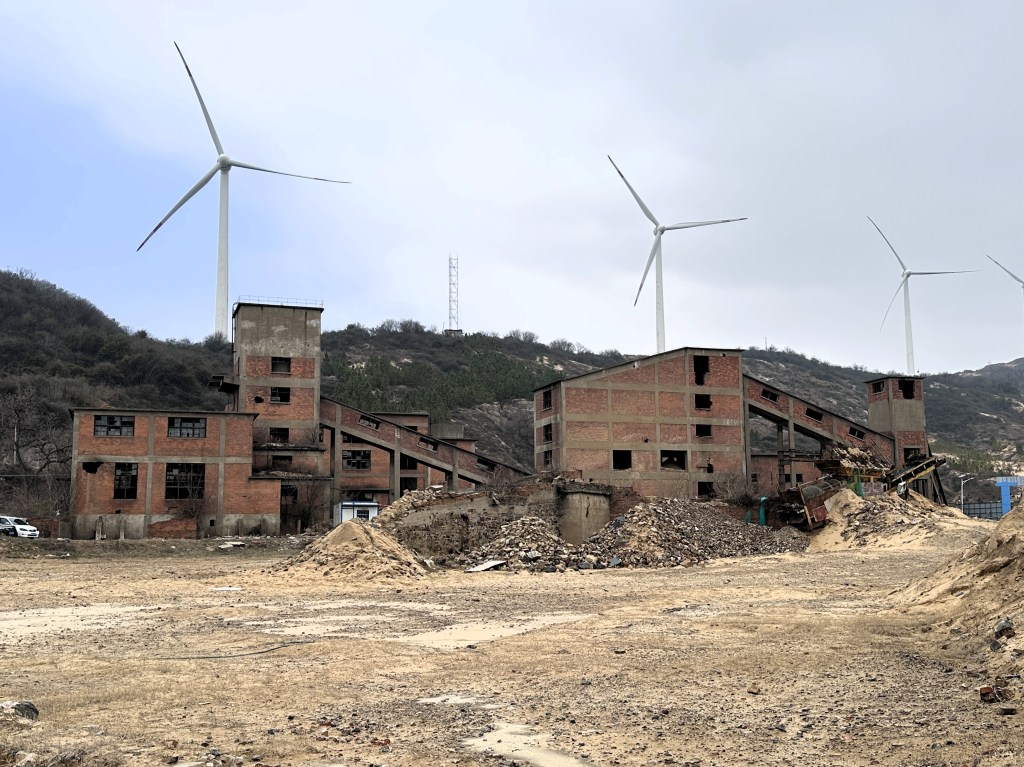
JIANGXI PROVINCE: WIND TURBINES TOWERING OVER ABANDONED FACTORIES
Qingqing is a massage worker I met in 2021, in the midst of Covid, while living in Ningbo, Zhejiang Province’s wealthy second city after Hangzhou. On my first visit to her shop, as I lay prone during a full body oil massage, I heard her roll a machine in and turn it on. She placed something over my butt which alternately pulled up and released each buttock with a powerful pressure. They were vacuum-operated suction cups. She moved the cups to my thighs and over my back in turn. The procedure was repeated on my front. When she was done, she showed me the results in a mirror. There were dark red circles all over my body. They were painless to the touch and would fade away after a few days. I had had this done before but not by a machine. It’s known as cupping (baguan). Normally, glass cups are briefly heated by a flame to create negative air pressure and placed over the flesh, pulling the internal organs upward toward the surface and literally sucking toxins out of the body, visible as black or brown deposits in the skin. Mechanical cupping does the same but has the advantage of continuous sucking action.
Another “technician” in Qingqing’s shop, as they liked to refer to themselves, specialized in scraping (guasha) and moxibustion (aijiu). With scraping, a dull copper blade is drawn across the flesh, opening the superficial capillaries to allow toxins to dredge and also forming painless bruises. It’s often combined with moxibustion. The infrared heat and radiation from burning moxa (mugwort) is better able to penetrate the flesh when opened up by scraping. There are a variety of ways to apply moxa smoke to the body. This shop used a “three-in-one” porcelain cup with a thin edge and smoking moxa which was slid firmly over the flesh, thereby combining moxibustion, scraping, and massage. Yet another shop technician had a machine that transmitted an electric current through a flat steel knob rubbed over the flesh with oil (or directly through her massaging hands). This is said to open up the “meridians” and “collaterals,” the branching system of energy channels interpenetrating the circulatory and nervous systems, through which qi flows through the body.
Traditional Chinese Medicine (TCM) holds that the body gradually loses heat over its lifetime, and poor health accelerates this. Whether combined with massage or separately, moxibustion, scraping, and cupping all work to stimulate blood circulation and heat and expel internal “wind,” “cold,” and “dampness,” thus slowing down the aging process. Most massage technicians in China have some formal training in TCM and certificates or diplomas of one sort or another; some are licensed acupuncturists. The bodywork side of TCM—as opposed to the medicinal side which tends to operate out of hospitals—is a huge, lucrative business these days and a step up in luxury from run-of-the-mill massage shops.
I was always experimenting with various treatments in various combinations to see what worked and was a frequent visitor to Qingqing’s shop. She also came over for house calls, sometimes with a coworker. They appreciated customers like me because they could experiment as well. And then she informed me she was working in a massage shop in Shanghai and wouldn’t be returning to Ningbo. A two-hour ride from Ningbo on the high-speed train, I was often in Shanghai and paid her a visit. This time she packed me in medicinal mud held in place with cellophane wrap, before scraping it off and concluding with a massage. Among the many massage workers I’ve gotten to know over the years, Qingqing was among the friendliest and most insistent in maintaining contact with me. She often invited me to visit her hometown and finally I was able to take up the offer during Spring Festival 2026.
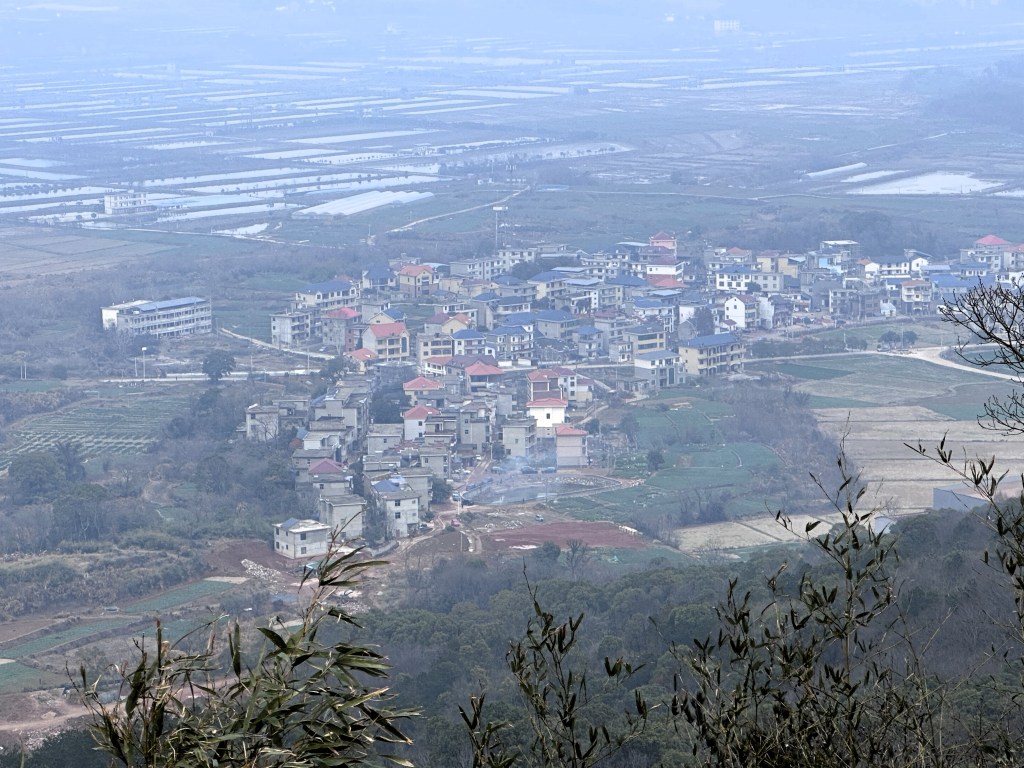
In contrast to cities where everyone, except for the gated communities of the wealthy, lives in old low-rise or new high-rise complexes, in the countryside they are proud of their spacious free-standing houses. Qingqing had shown me photos of her maternal family’s 400-sqm house (4,300 sqft) in the northern Jiangxi countryside on the sprawling Poyang Lake. I was curious to see it. Logistics prevented us from making it to her territory until Day One of the Spring Festival, one day too late, as she had spent Spring Festival eve at her parents’ house and was due the next day at her husband’s household in another part of Duchang County, where she told us to go instead. They were too busy to make the round trip to pick us up at the high-speed railway station an hour away, and we took a taxi. It was crowded at the station when we arrived—many others were also a day late in getting back home.
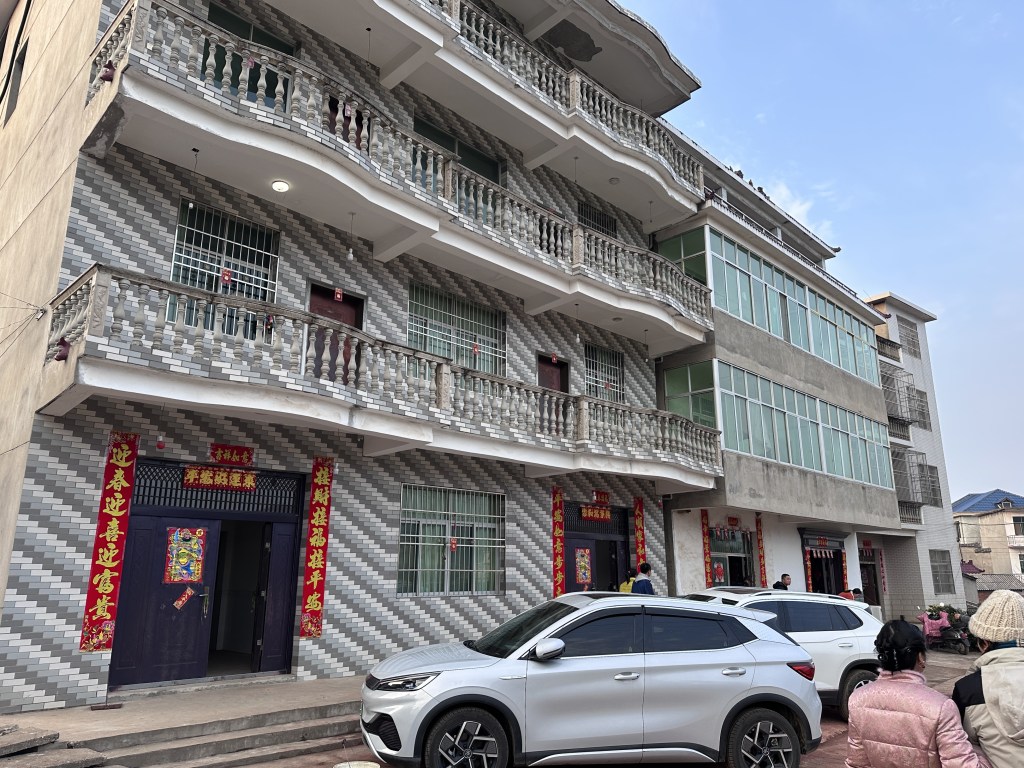
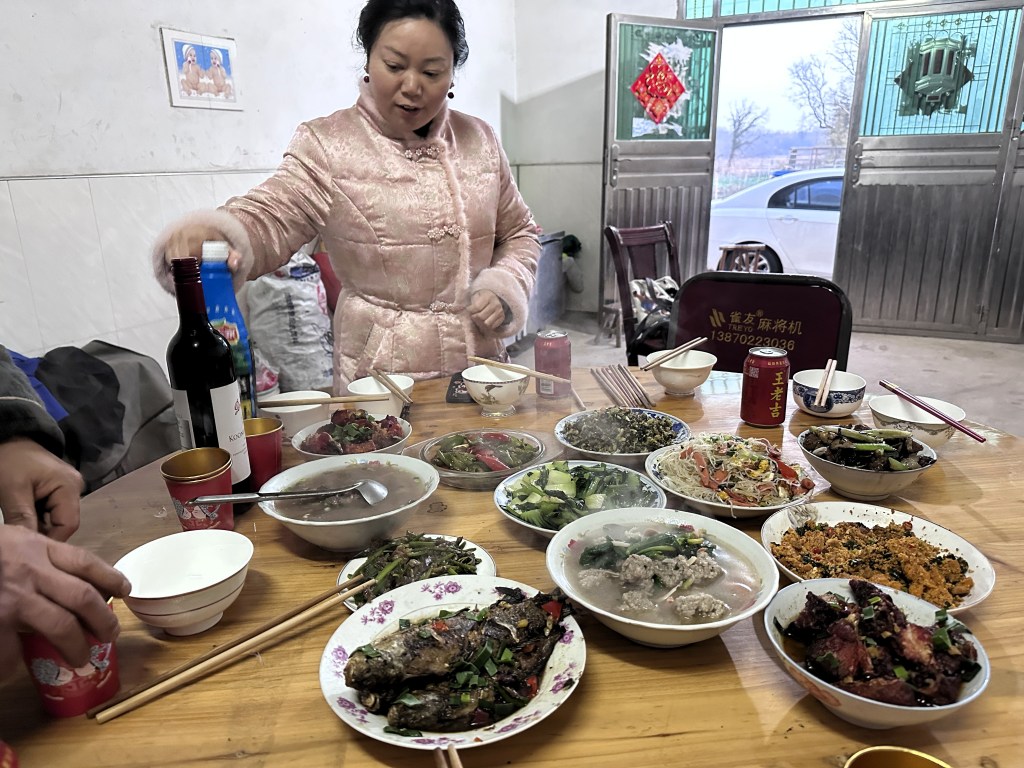
The taxi dropped us up a side road running along the edge of Jishan Village, with wheat and cabbage fields on one side and four-story residential buildings on the other. Qingqing emerged out of one entrance waving at us. We dropped our stuff in the garage-style main room with the usual concrete floor, round dining table, and a poster of Mao Zedong on the wall. The adjacent apartment in the same building housed a number of relatives, who began congregating outside, and it was impossible to keep everyone straight. A few males offered me cigarettes—a standard gesture; not being a smoker I politely refused. A toddler with “2026” shaved into his haircut got the leash of a woman’s poodle tangled around our legs as he chased it. Qingqing’s husband’s mother sat on the steps clipping the nails off chicken feet to prepare a dish; her apron showed an ad for some Christian organization. The husband, an electrician, was a handsome, take-charge guy and loaded us into his white Volkswagen SUV for a tour of a nearby mountaintop temple and surrounding wind turbines, which along with solar farms provided the area’s main sources of electricity, which he claimed was plentiful and cheap.
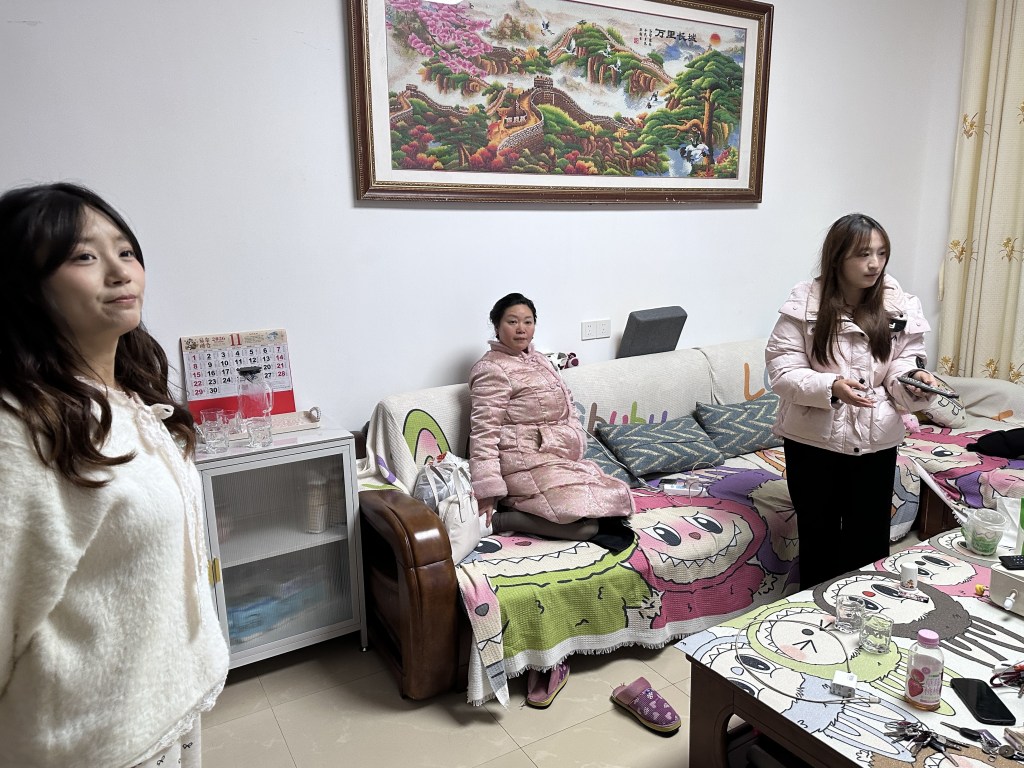
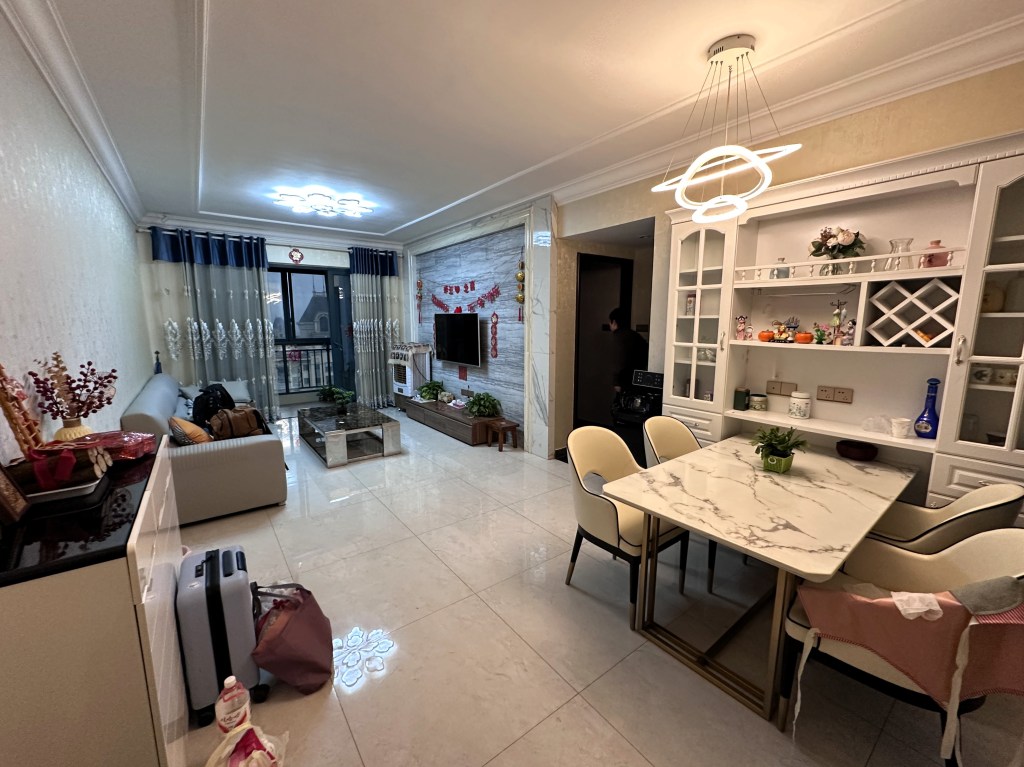
Though her husband’s house had lots of space, Qingqing decided we would be more comfortable in the apartment they owned in nearby Duchang Town, the county seat, where her two daughters and son lived. One daughter taught kindergarten, the other worked in a fried-chicken shop, and the son in a hairdresser. He agreed to vacate his bedroom for us and sleep back in the village for a night. The three-bedroom apartment was on the seventh floor of a walkup with no elevator but was clean and spacious. We spent the evening watching a domestic romantic movie on their wide-screen TV. It was mid-February and still chilly out (in the forties Fahrenheit) and uncomfortably cold inside. They had heating but didn’t use it. This is standard practice in China’s south; people feel it’s more economical and logical to wear winterwear inside and only resort to heating when absolutely necessary. Unless you’re brought up this way, it takes some getting used to. Psychologically, we were freezing and they weren’t even cold; it didn’t even occur to them to close the windows. When we finally went to bed, they had to scrounge around to find the remote to operate our bedroom’s wall-mounted air conditioner-heater combo.
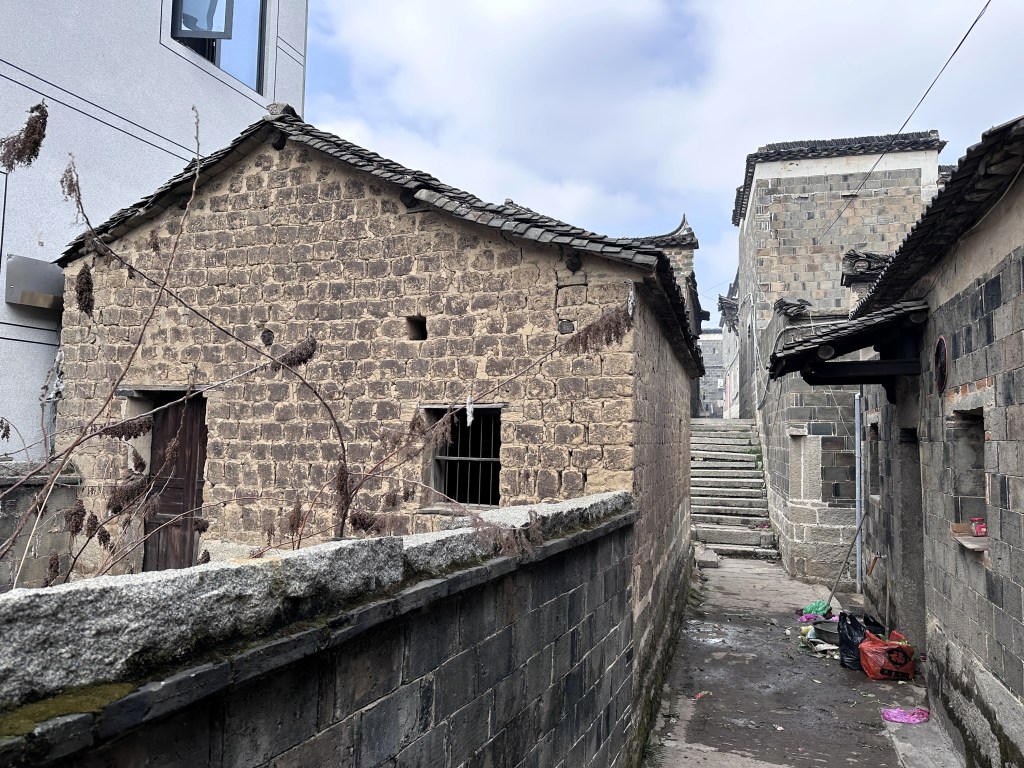
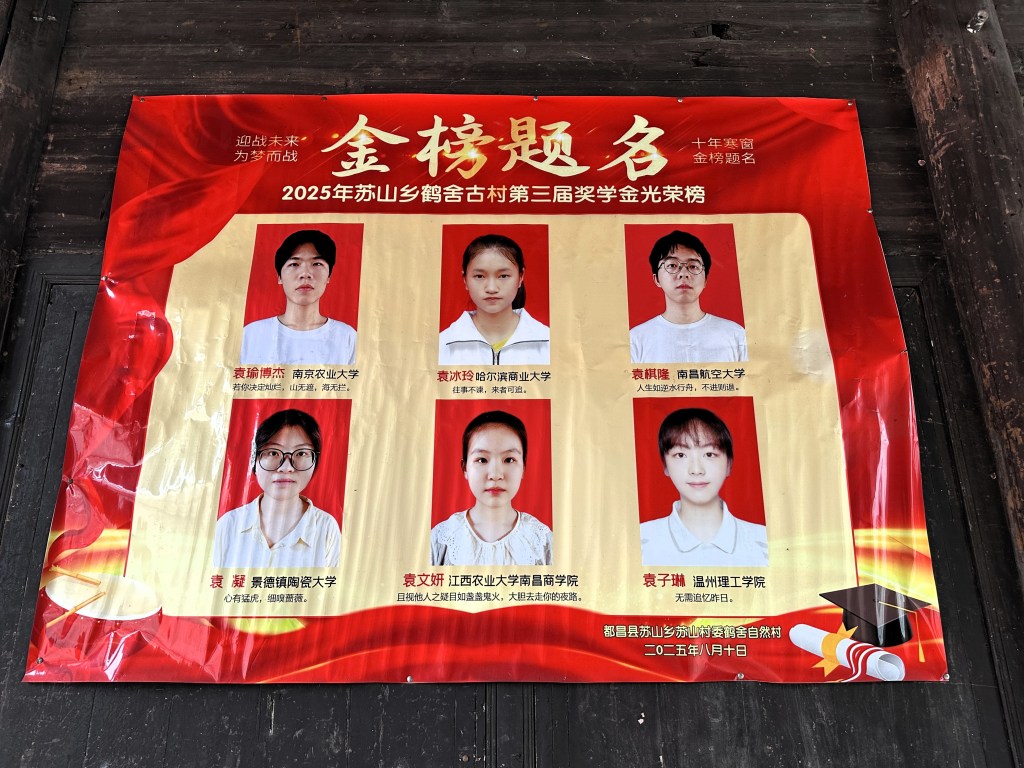
The next day, while the younger daughter was off serving fast food, the elder daughter drove us around in her white Geely sedan (Qingqing couldn’t drive) to see a lakeside temple fair and an old village in Sushan Township, where new residential homes were literally rising above abandoned homes. Heshe Village wasn’t completely razed; a large section was preserved without being renovated. The authorities seemed unsure what to do with it but clearly saw potential tourist value in the village, which they now designated “Heshe Old Village.” Tourists were indeed already in evidence wending their way among the labyrinthine lanes. It’s significant that this kind of foresight at this lowly regional level was operating at all.
Mother and daughter dropped us off at the high-speed rail station for an hour’s ride to the city of Jingdezhen, China’s famous porcelain mecca, where Qingqing owned another apartment and invited us to stay there, currently empty, after giving us her electronic door code. We were fortunate. Jingdezhen is swamped by Spring Festival tourists and hotel rates astronomically inflated when rooms can be found at all.
SICHUAN PROVINCE: EARTHQUAKE TERRITORY
Yeye is a massage worker I also met in Ningbo during Covid, who worked at a different venue from Qingqing’s. This shop occupied a large space on the third floor of an office building and specialized in moxibustion. You could smell the burning moxa wafting from its windows out on the street. It was a fancy place. The owner was a middle-aged Daoist woman who wore colorful garments and taught Daoist dancing, whose graceful twirling hand movements had an obvious relationship to Taijiquan. The large lobby was outfitted with classical hardwood furniture where she entertained friends and patrons. Regular oil massage and scraping were also on the menu but were expected to be finished off with a moxibustion session, which in this shop involved placing rows of rubber capsules filled with burning moxa over the naked body.
Yeye didn’t perform massage or moxibustion herself but was the owner’s friend and star hostess. From Sichuan, she was a pretty, stylishly dressed woman in her mid-thirties. A massage worker there confided to me that Yeye actually did massage certain clients—VIP businessmen who had donated large sums of money to the shop and thereby earned certain privileges. I often teased Yeye to give me a massage but she firmly denied she knew how and I never pressed it. She was often away for family matters back home in rural Sichuan. And then one day she informed me she was opening her own moxibustion shop and wasn’t returning to Ningbo (well, she did turn out to be adept at moxibustion). I had recently moved to Dali in Yunnan Province and wondered if I could visit her hometown. Not only was she amenable, she seemed flattered and happy at the prospect of showing me around.
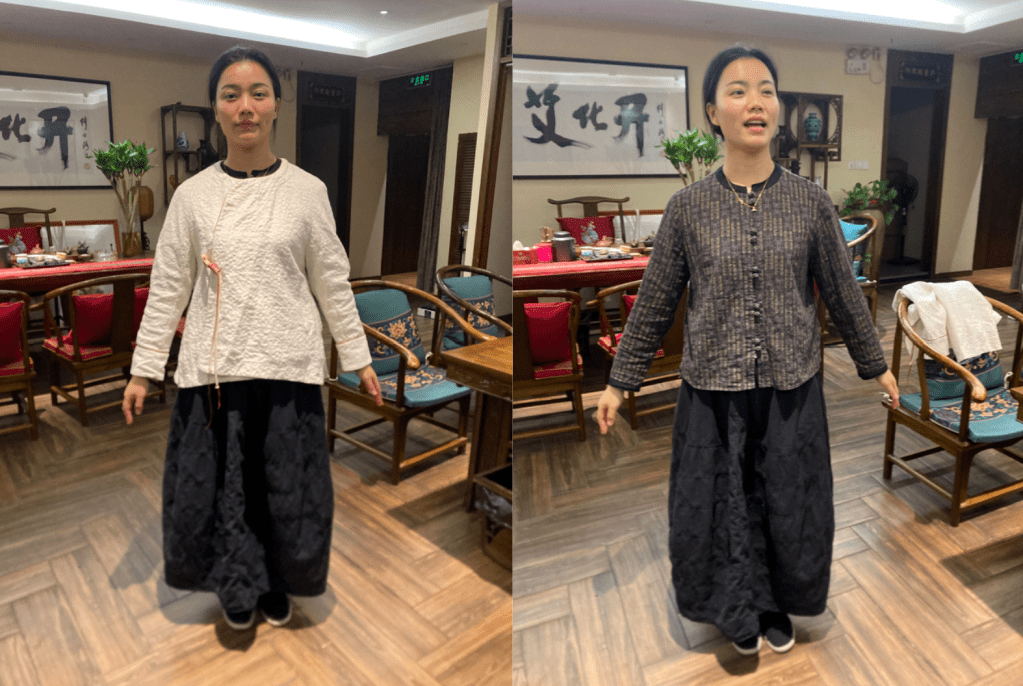
She lived with her husband and teenage daughter in a modern apartment complex in Deyang, an industrial satellite city an hour’s drive north of the megacity of Chengdu. She recommended a hotel, and the hotel was both affordable and luxurious (hosting guests overnight, even close friends, is not a Chinese tradition, exceptions such as Qingqing’s hospitality aside). Yeye dashed into the lobby to pick me up. We toured around the city in her husband’s black Cadillac SUV before heading over to her massage shop for dinner. The shop was on the second floor of a residential building overlooking a pedestrian street, with restaurant tables spilling out onto the street. Outside the shop was a veranda that wound around the building and provided enough space for the shop to set up dinner tables out in front. Yeye had helped me arrange transportation from Chengdu airport to Deyang, and it turned out that the boss of the company providing it was a friend and fellow local from Mianzhu, her hometown. He brought along several other male friends to dine with us, also from Mianzhu. Here we have another instance of the countryside in the city, where a network of rural friends and relatives help each other through connections to get an economic foothold in the city: like Yeye, they all now lived in Deyang.
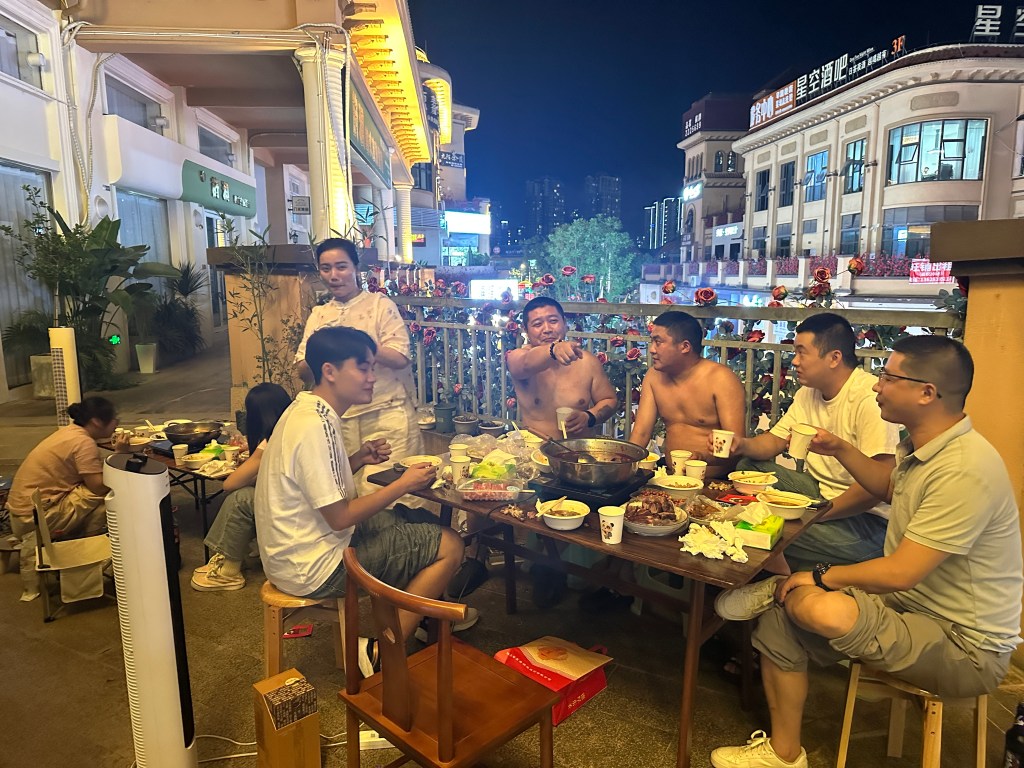
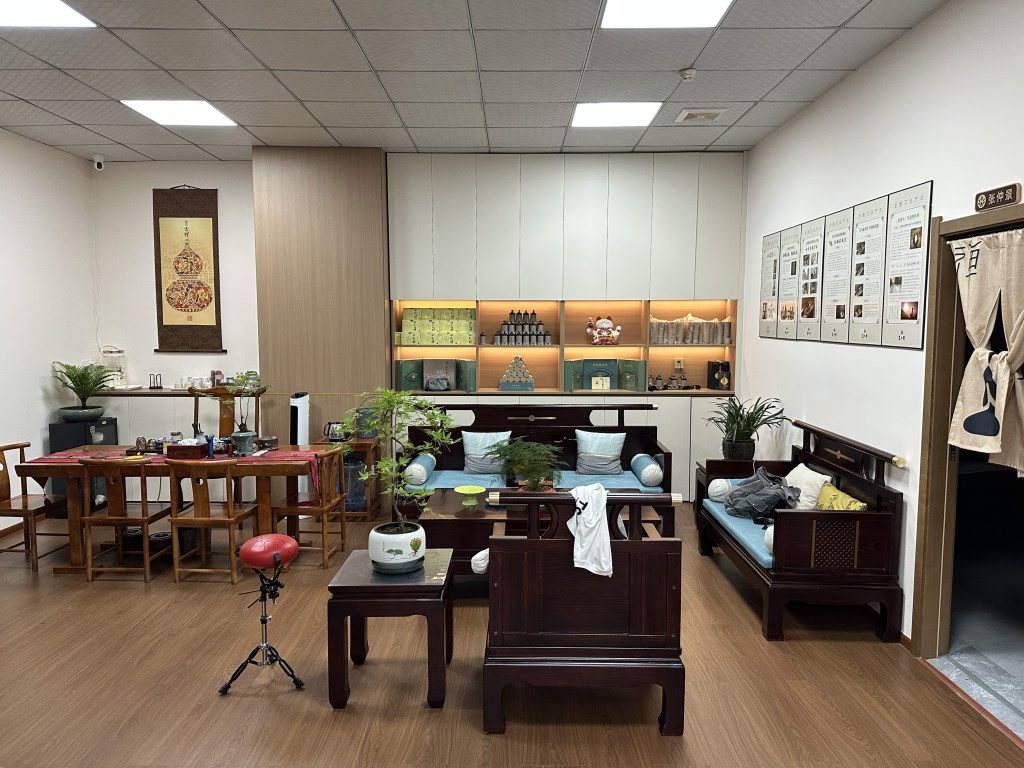
The dinner presented a curious montage of city and countryside. Yeye spoke clear Mandarin though with a strong local twang. She was wont to dress in silk blouses; her husband dressed casually but smartly. They outfitted their massage shop with an immaculate sense of taste. But the evening was imbued with rusticity. The male guests were seated at one table, the women at another. Several men were shirtless. Male toplessness, incidentally, is also common among urban working-class men. Personally, I’ve always found it offensive, not due to any prudishness but, on the contrary, the entrenched sexism that only allows men to go topless. The boys pulled out cigarettes and sorghum spirits for toasting. I did my best to contribute to the conversation but it was a struggle to understand their country drawl. The hotpot meal presented challenging ingredients for the uninitiated: on top of the usual beef, mutton, tofu, cabbage, and vegetables, there was pig brain, pig aorta, tripe, chicken gizzards, and duck feet, all scalded in the pot’s chili oil and dipped again in bowls of sesame oil and raw minced garlic. The Sichuanese unite in ecstasy around hotpot. It turns them into rustics: the simplicity of the dish bespeaks a time when every part of the animal was cherished as food. So beloved is this primal dish that it would be unthinkable, an insult, not to serve it whenever guests are involved, no less foreign guests. They cannot understand how we don’t automatically take to the sensuous succulence of chewing organ meat and nibbling fowl cartilage.
I was careful not to spoil decorum by asking Yeye for a massage, but she pushed me into the shop anyway for a gratis session by a novice masseuse she had just hired, to give her some practice.
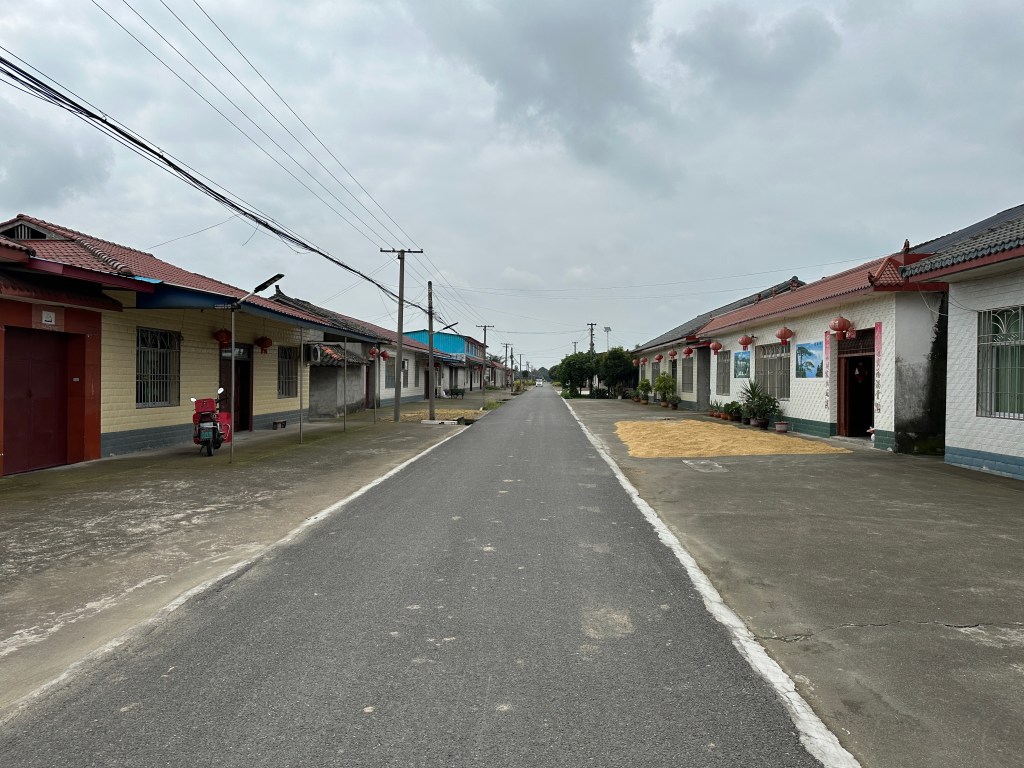
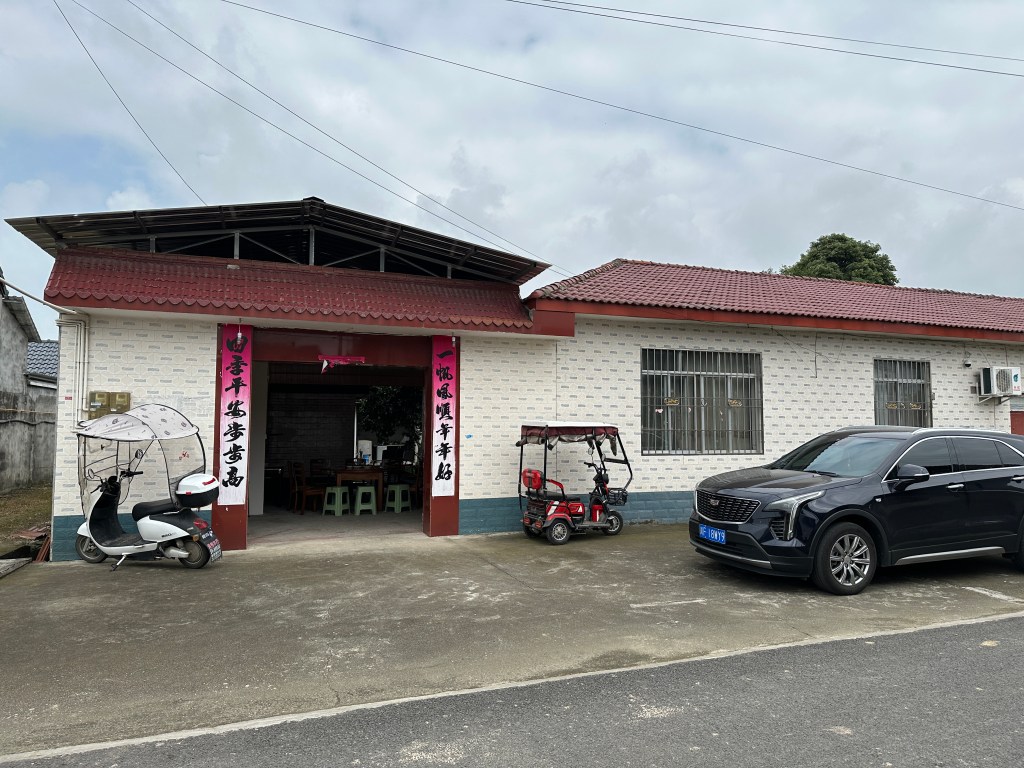
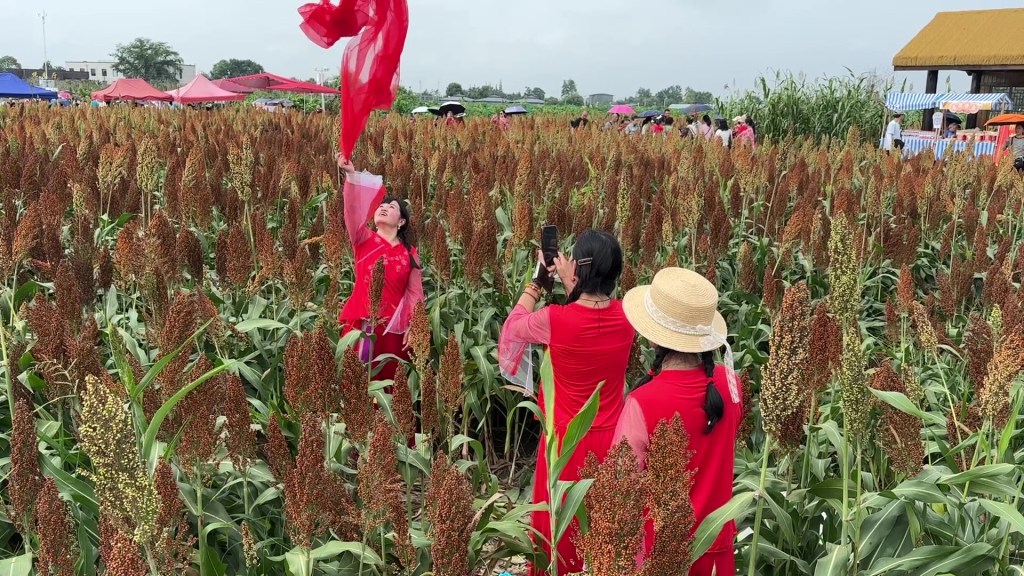
They picked me up in the morning for the half-hour drive north to Mianzhu. Although a substantial city in its own right (pop. 440,000), Mianzhu administers a rural area and is surrounded by farmland. We were headed to a most unusual festival that happened to be going on at the moment, sponsored by what Yeye’s husband claimed was Sichuan’s superior baijiu brand, Dongsheng (东圣), distilled from sorghum. Soon the country road was backed up by traffic trying to find parking. The hundreds wending their way along the road turned into thousands as we reached the fields, red with ripening sorghum. People were spread out in all directions along the paths between the fields and amidst the sorghum stalks, the women dressed in red and photographing themselves. Of course, Zhang Yimou’s film Red Sorghum (1988) starring a sultry Gong Li tumbling with her drunken lover in a sorghum field came to mind. Most outdoor festivals take place on temple grounds during the Spring Festival, heralding the spring. This was a real fertility festival celebrating the fall harvest of a plant employed for alcohol. No drunkenness was in evidence (there might have been later in the day), but the collective enthusiasm and energy was startling, beyond anything I had ever seen in your usual temple festivals, which tended to be unvarying year after year wherever the location. Much bacchanalian potential here.
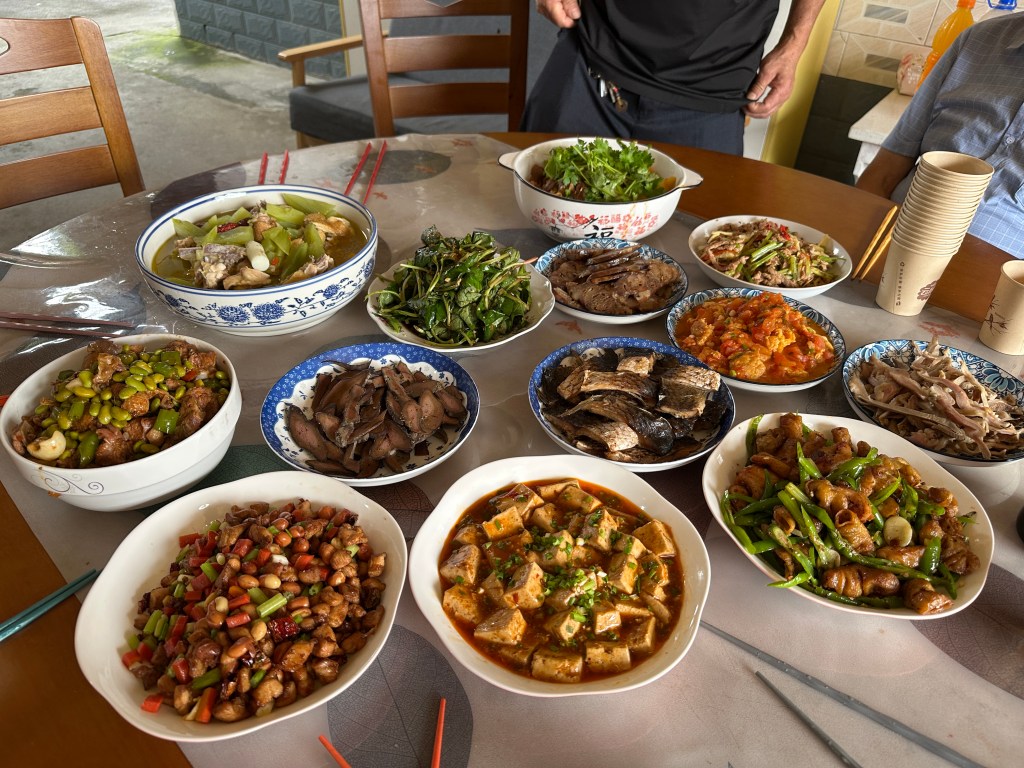
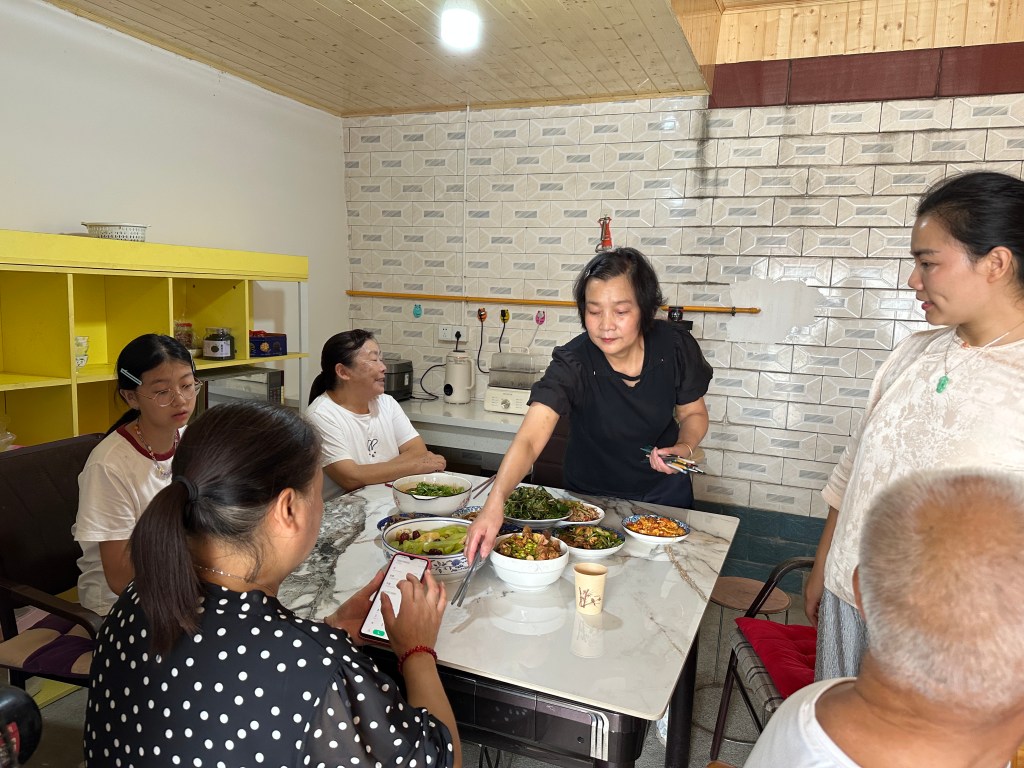
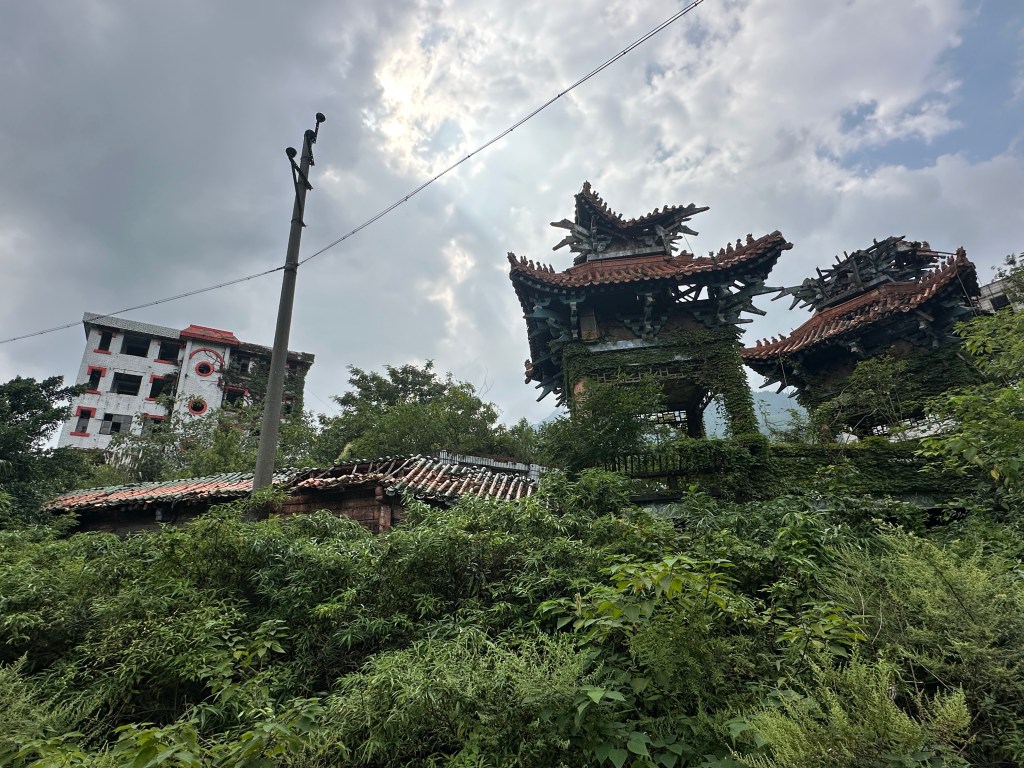
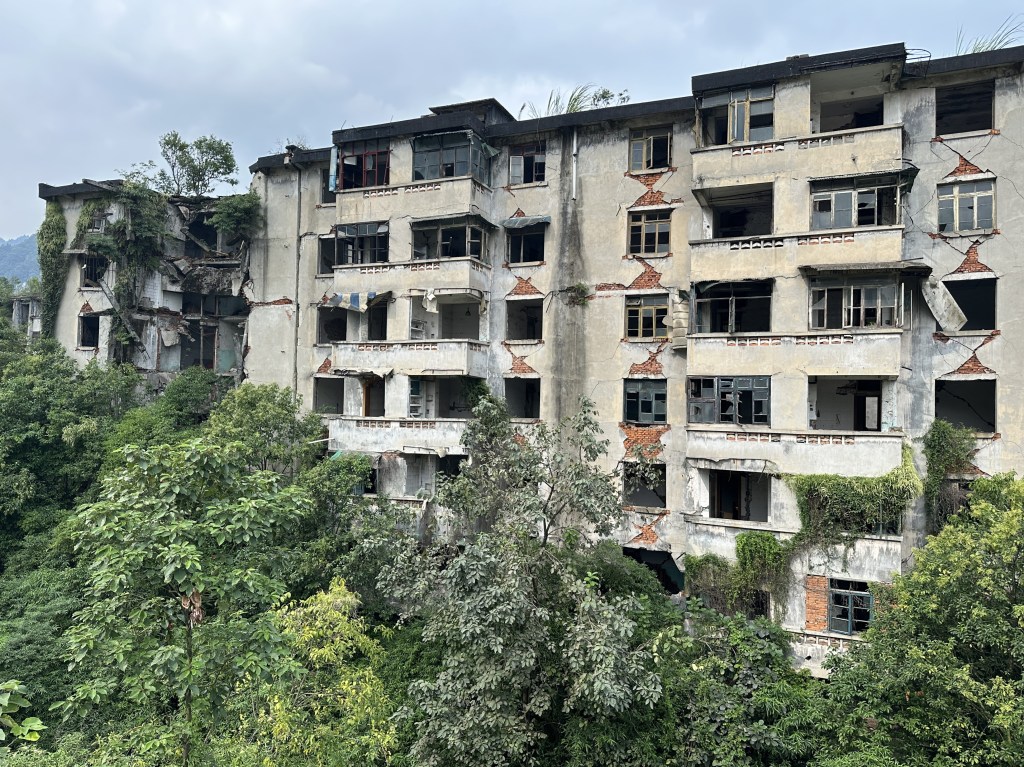
Back on the road, in the foothills of the Jiuding Mountain range another twenty kilometers north of Mianzhu, we reached Hanwang, a town so devasted in the 2008 Sichuan Earthquake that it has been preserved as an earthquake relic zone and left as is. Over 11,000 died, 37,000 were injured, and 133,800 houses collapsed in the Mianzhu City area, mostly in Hanwang, which lay close to the fault line. Another 17,000 died in Deyang (total casualties for the earthquake are 87,587 dead, 374,643 injured and 18,392 missing). Yeye’s parents lived in a rural community on the outskirts of Mianzhu. Luckily the earthquake had occurred in the afternoon when they were outside, for their entire street was leveled (Yeye was in school in Ningbo at the time, where her family has long had connections). It was there that we headed next for a late lunch.
The village was completely rebuilt. Yeye gave me a tour of the surrounding rice paddies and the family house. Their courtyard, built around the original house, held a pomelo tree and a mandarin orange tree. The original kitchen, the only surviving room, was left empty; they had built a whole new kitchen. A chicken coop was in a back shed. We had stopped at a supermarket along the way where I picked up a bottle of wine; Yeye recommended a brand of milk for her parents as well. As expected, they turned the meal into an occasion, and a host of friends and relatives piled into the main room. I noticed that someone else had brought the same brand of milk for the hosts. Apart from Yeye’s mother who unmistakably resembled her, again I could hardly keep anyone straight. I was placed at the big round table for the men. The women set up a separate table for themselves. Three girls were affixed to their cellphones in the TV room and later joined the women’s table. I’ve always found this separation of the sexes odd and disconcerting but declined of course to register any signs of protest, as they clearly felt it to be an obligatory sign of honor and hospitality. (On the other hand, Qingqing was adamant that her family in the Jiangxi countryside didn’t practice it.) The food was as delicious as it was dazzling.
On the way back to Deyang, knowing I needed my afternoon coffee, we stopped off at a Luckin Coffee shop (the domestic competitor of Starbucks) in the Mianzhu downtown. Yeye ordered a latte for herself.
CONTRADICTIONS OF THE COUNTRYSIDE
My Beijing friend Lixin, the librarian with whom I traveled to the Anhui countryside back in 1999, once related a trip she took in those years to the countryside in Ningxia Hui Autonomous Region in north-central China. She said the rural folk she met there were so poor that some worked the fields naked: they couldn’t afford clothes. Going on three decades later, in 2024, I traveled around central China to do research for a book. This involved staying in a number of backwater cities not known even for Chinese, let alone foreign tourism—Dazhou in east Sichuan, Ankang in south Shaanxi, Shiyan, Xiangyang, Jingmen, Yichang, and Enshi in west Hubei. Every one of these utterly ordinary cities was clean and orderly, with excellent restaurants, craft-beer bars, and quality coffeehouses that rendered the inevitable Starbucks most of them boasted redundant. The trip also took us via bus through the remote countryside—Xuanen, Luyuanping—in southwest Hubei. I tried to find evidence of poverty in the villages we passed through and only saw well-stocked stores and busy family restaurants open to the street.
To be sure, depressed pockets in the countryside are certainly to be found. But these pockets are shrinking. To anyone who’s been paying attention, China has come a long way in eliminating poverty. This is an indisputable fact plainly evident to anyone willing to visit the country and witness it with their own eyes. And no, I am not in the paid employment of Chinese state propaganda.
It could reasonably be pointed out that my native exemplars of countryside life are an exceptional group, the well-to-do of rural origin but no longer exclusively rural, with their cars and apartments, and certainly not representative of the majority. But who wants to be exclusively “rural” anymore? They had made it, achieved a secure foothold in the big city. The fact that I met them in the city already means I have, in a sense, self-selected them. However, I would ask why the indigent majority—and it is by no means clear that the indigent are a majority—must be taken as representative, when the trend is clearly moving towards general wealth and abundance, slowly but surely, if too slowly to be noticed by the rest of the world.
There is no need to go into an orientalist analysis of the Western imaginary (I refer to Edward Said’s famous 1979 study Orientalism), whereby the West cannot apprehend the East in any objective sense because it only sees in the distorting mirror the negative fantasy of what it fears in order to reassure itself of its own superiority. It’s enough to say that the U.S. media, in particular, with its relentless negativity about China, needs to see the country as a seething cauldron of oppression, a giant concentration camp frozen in the 1980s, a dispossessed mass of grasping humanity, whose only route to freedom is through the jungles of the Colombian-Panamanian Darién Gap. The millions of rural Chinese who are building wealth in the cities are, correspondingly, invisible. Unless you care to look.
* * *
Other posts in this series:
Insights into China, Part 1: A walk down the street
Insights into China, Part 2: A meal in a restaurant
Insights into China, Part 3: A stay in a hotel
Insights into China, Part 4: A visit to the library
Insights into China, Part 5: An invitation to a party
Insights into China, Part 6: An afternoon in a café
Insights into China, Part 7: A glimpse inside a school
Insights into China, Part 8: An immersion in a museum
Also by Isham Cook:
THE TAO OF POISON
“The bold characters, kinetic plot, and rich sense of atmosphere make this epic tale a studied contemplation of how beauty can usher in tragedy and sorrow.” — BookLife Reviews by Publishers Weekly


 ISHAM COOK CHINA
Leave a reply to John Luke Stables Cancel reply